Community | FOTMATION - 1-3-4-3 DIAMOND SHAPE MIDFIELD

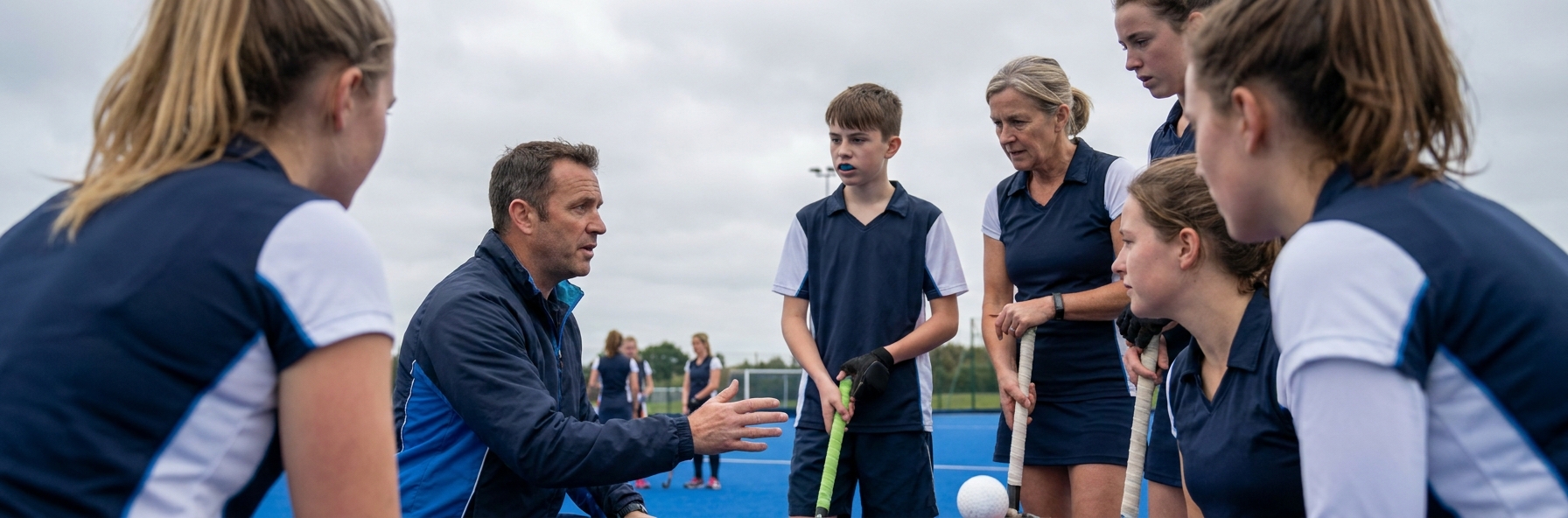
England Hockey's "25 in 2025" initiative has been touring the country, bringing two-hour on-pitch workshops to 25 locations. The focus: practical practice ideas that coaches can take straight back to their clubs. Here's a summary of the key concepts being shared.

The Philosophy

The workshops are designed for everyone involved in delivering hockey, from experienced coaches to volunteers just starting out. The emphasis is on fun, engaging sessions that keep players coming back - because player retention depends on the quality of the experience we create.

Each workshop covers arrival activities, carrying and passing progressions, and game-based learning. Participants leave with a bank of ideas they can implement immediately.

Arrival Activities That Work

The first few minutes of any session set the tone. Arrival activities should be:

Self-managing: Players can start without detailed instruction. This lets the coach focus on organisation while early arrivals get active.

Engaging: Not just standing in lines. Movement, decision-making, maybe a competitive element.

Scalable: Works with 2 players or 20. As more arrive, they join seamlessly.

Examples include: grid-based possession games where players can join any team, skill stations with clear visual instructions, and small-sided games that expand as numbers grow.

Carrying and Moving with Purpose

A significant portion of the workshops focuses on ball carrying. The key insight: carrying isn't just about technique, it's about purpose. Why are you carrying? Where are you taking the ball? What's your next action?

Practices progress from technique-focused (head up, ball position, change of pace) to decision-focused (when to carry vs pass, reading space, timing runs with teammates).

The workshops emphasise "game-realistic" carrying - not just running through cones, but carrying with pressure, carrying to eliminate, carrying to create passing angles.

Passing as Communication

The workshops reframe passing as communication between players. A good pass says "here's where I want you to receive." A great pass also says "here's what I want you to do next."

Practices focus on:

  • Weight of pass - firm enough to arrive quickly, soft enough to control
  • Timing - not too early (intercepted), not too late (receiver can't use it)
  • Receiver's next action - passing to the correct foot/side for what follows

Games-Based Learning

Perhaps the biggest takeaway from the workshops is the shift toward games-based learning. Instead of isolated drills, players learn through modified games that naturally develop the required skills.

The coach's role becomes designing games that create the learning outcomes, then facilitating rather than instructing. Questions replace commands: "What did you notice there?" "Why did that work?" "What could you try differently?"

This approach develops players who can problem-solve, adapt, and transfer learning to match situations.

Making Sessions Engaging

The workshops share specific techniques for keeping energy high:

Quick transitions: Minimise time between activities. Have the next game ready before the current one finishes.

Appropriate challenge: Too easy is boring, too hard is frustrating. Find the "just right" level for your group.

Variety within structure: Keep the same game framework but change small elements - scoring methods, playing areas, team compositions.

Player voice: Give players choices. "Do you want to play again or try something new?" This builds ownership.

Video Support

All workshop practices are available on YouTube, allowing coaches to revisit and refine after attending. This resource bank is growing as the roadshow continues.

Who Should Attend?

The workshops are pitched at all levels. Experienced coaches report learning new ideas and getting reinforcement of good practice. New coaches gain confidence and practical tools. The shared experience of learning together builds community within the sport.

If a workshop is coming to your area, it's worth attending. The time investment is small; the return in practical ideas is significant.

Key Coaching Points

  • Arrival activities set the tone - make them engaging
  • Carrying with purpose, not just technique
  • Passing is communication between players
  • Games-based learning develops problem-solvers
  • Keep sessions varied and appropriately challenging

Drills to Build Your Practice Bank

VIEW ALL WARM-UP DRILLS

JOIN SPORTPLAN FOR FREE

  • search our library of 1000+ hockey drills
  • create your own professional coaching plans
  • or access our tried and tested plans
Muddasir Abbas Coach, Australia

DESCRIPTION

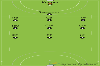
The 1-3-4-3 formation with a diamond-shaped midfield is a popular setup in field hockey, providing a strong balance between defense and attack. Here's a breakdown of each position: 1 - Goalkeeper: - Positioned in front of the goal to prevent the opposition from scoring. - Primary responsibilities include saving shots on goal, directing defenders, and distributing the ball to teammates. 3 x Defenders: - Positioned in front of the goalkeeper to protect the defensive zone and help fullback in double defence and transfer the ball position (Sweeper - Very important position) - Responsibilities include intercepting passes, tackling opposing players, and distributing the ball to midfielders or forwards. - The central defender typically plays a pivotal role in organizing the defense and initiating attacks. 4 x Midfielders (Diamond Shape): - Positioned between the defense and attack to support both areas of the field. - The diamond-shaped midfield typically consists of one defensive midfielder (the base of the diamond), two central midfielders, and one attacking midfielder (the tip of the diamond). - The defensive midfielder focuses on breaking up opposition attacks and distributing the ball to teammates. - The central midfielders contribute both defensively and offensively, linking defense with attack and providing passing options. - The attacking midfielder is responsible for creating scoring opportunities, linking up play between midfield and attack, and supporting the forwards. 3 x Forwards: - Positioned at the front line to create goal-scoring opportunities and put pressure on the opposition's defense. - Responsibilities include receiving passes, taking shots on goal, and creating space for teammates. - The forwards work in coordination with the midfielders to maintain possession and create attacking opportunities. Overall, this formation emphasizes control of the midfield, with the diamond shape providing options for quick passing and fluid movement between defense and attack. It requires players to be versatile, with midfielders capable of both defensive duties and contributing to the attack. Additionally, effective communication and teamwork are essential for success in this formation.

COACHING POINTS

Coaching points for the 1-3-4-3 diamond-shaped midfield formation in field hockey focus on specific tactics, player positioning, and overall strategy. Here are some key coaching points: 1. Positional Awareness: - Emphasize the importance of maintaining proper positioning according to the formation. Players need to understand their roles and responsibilities within the team structure. 2. Ball Retention: - Encourage players to prioritize possession and maintain control of the ball. This includes making accurate passes, using close control to evade opponents, and supporting teammates to keep possession. 3. Communication: - Stress the need for effective communication among players. This includes verbal communication to coordinate movements, signal intentions, and provide support, as well as non-verbal cues such as hand signals and body positioning. 4. Transition Play: - Teach players how to quickly transition between defense and attack. This involves recognizing moments to counter-attack when possession is won back and organizing defensively when the team loses the ball. 5. Defensive Shape: - Ensure that defensive players maintain a compact shape to deny space to the opposition. This includes staying close to each other to cover passing lanes, shifting as a unit to pressure the ball, and providing cover and support to teammates. 6. Pressing and Intercepting: - Teach players how to effectively press the opposition to regain possession. This involves coordinated pressure on the ball carrier, anticipation to intercept passes, and timing tackles to disrupt opposing attacks. 7. Midfield Movement: - Emphasize dynamic movement and interchangeability among midfielders. Players should rotate positions, create passing angles, and provide options for teammates to maintain fluidity in midfield play. 8. Creating Overloads: - Encourage players to create numerical advantages in key areas of the field, particularly in midfield. This can be achieved through smart positioning, off-the-ball movement, and quick passing to overload one side of the field or exploit gaps in the opposition's defense. 9. Attacking Patterns: - Work on specific attacking patterns and movements to break down the opposition's defense. This includes practicing combinations between midfielders and forwards, utilizing width and depth in attack, and exploiting space behind the defense with well-timed runs. 10. Set Pieces: - Develop set-piece routines for attacking opportunities such as penalty corners, free hits, and aerial balls. Players should be well-drilled in their roles and movements to execute set pieces effectively and capitalize on scoring chances. By focusing on these coaching points, players can effectively implement the 1-3-4-3 diamond-shaped midfield formation and maximize their performance on the field.

This practice has no coaching points

PROGRESSION

This practice has no progressions

READ MORE
READ LESS

JOIN SPORTPLAN FOR FREE

  • search our library of 1000+ Hockey drills
  • create your own professional coaching plans
  • or access our tried and tested plans

JOIN SPORTPLAN FOR FREE

  • search our library of 1000+ hockey drills
  • create your own professional coaching plans
  • or access our tried and tested plans
;

Sportplan App

Give it a try - it's better in the app

X
YOUR SESSION IS STARTING SOON... Join the worlds largest hockey coaching resource for 1000+ drills and pro tools to make coaching easy.
LET'S DO IT