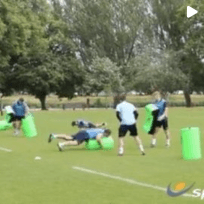
The game is space invaders
What you need-
Have players working in pairs or on their own (depending on fitness levels)
Have the cones set up as shown
A handful of players holding tackle shields -Invaders-
The "invaders" will be holding the tackle shields, they will be side-stepping/skipping from cone to cone, giving themselves enough space between each other for tackles to be made. Once a tackle has been made, the "invader" will get up and return to the starting point waiting until they can head off again.
The tackler has to take out as many invaders as they possibly can, this can be done in pairs or individually. They key points have to be made about the tackle and good or bad form in the tackle (talking about leg drive, the hit with the shoulder, and wrapping the arms around). As a coach, you will time the players for anywhere in between 1 minute, to max 3 minutes per tackler (depending on time frame of session)
I personally would use this as a fun way of introducing conditioning to your session. It's a disguised fitness session, meaning players are more likely to give it their all
Make sure to keep good form in the tackle, even under fatigue.
There will be some "stall tackles" (when the tackler is too tired to take the invader down) ask them how they can take them down, even when tired.
in more ways than one
 sportplan_netball
in more ways than one
sportplan_rugby

Greasy balls and soft pitches turn tidy handling into a lottery. Here is how to coach your players to keep hold of the ball when November conditions bite.
Most line breaks are made by support runners, not ball carriers. Teach the angles, depth and timing that get them there.

The isolated ball carrier is rugby's spookiest turnover. Here is the five-step fix, plus drills that rebuild support lines fast.