Drill to practice kicking accuracy and contesting the ball in the air.
Split the players into two even teams with different coloured bibs (red and blue).
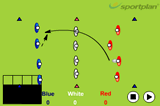
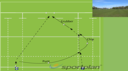
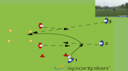
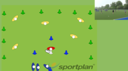
Set up two squares (roughly 15m x 10m, with a 5-10m middle zone - see diagram). Split each team in half so half of each team is in each square.
Players have to try to kick the ball to a player on their team in the opposite area to score a point.
For each kick that is caught on the full by a team mate in the opposite area the team scores one point.
The opposition team are trying to disrupt the catch by competing in the air or trying to distract the player catching the ball.
PROGRESSION:
Use one ball to start with then introduce multiple balls.
Players kick with the ball with their less dominant foot.
Catch with one hand only.
Set a time limit on the time a player is allowed to hold the ball for before kicking it back (e.g. 2 seconds).
The catcher has to pass to another player in their team to kick the ball.
Punt kick - players should hold the ball upright and drop it straight onto their foot from around waist height. Players should kick the ball on the point of the ball and follow through.
Chip kick - Similar technique to punt kick, but kicking the ball with less power.
Techniques to contest the ball in the air.

in more ways than one
 sportplan_netball


in more ways than one
sportplan_rugby

Tacklers are aiming lower, so carriers who dip late put heads at risk. Teach footwork, a strong early body height and leg drive to win the collision safely.

The hooker's brake foot moved from trial into full law in July 2026. Here is how to coach it so your front row stays stable, legal and safe.

Your players can pass beautifully in a warm-up grid. Then a defender closes, their lungs are burning, and the ball goes to ground. Here is how to build catch-pass skills that hold up when it matters.