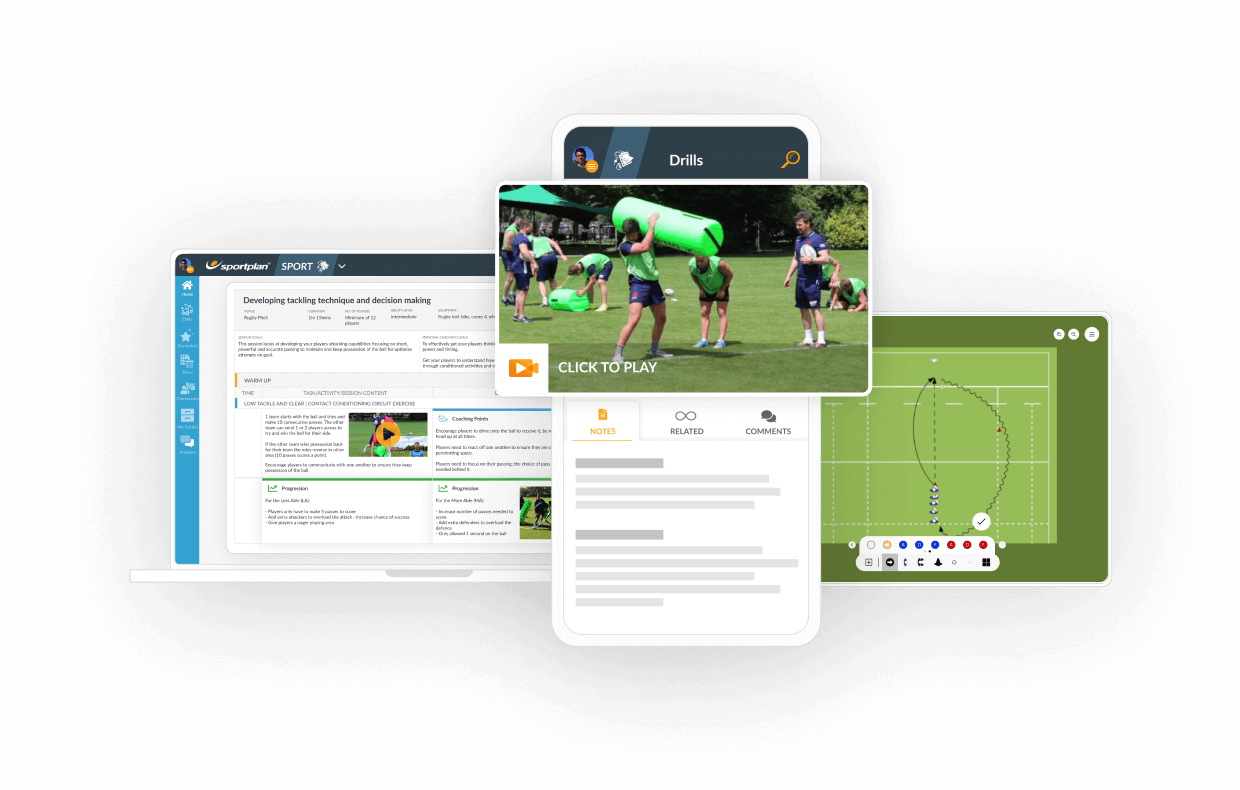
1. Chanel Fix
Groups of 5.
Attack sausages lined up one behind eachother.
They must use footwork to step to a side of the sausage and then give a pass before running into/past it.
2. Passing Grid - Static Defenders
Normal 3 man passing grid, however with sausages placed in the middle.
Players run forward use footwork to beat the bag and give the pass back inside. (pass before the sausage).
3. Passing Grid - Moving defenders.
Same as above but instead of sausages, use moving defenders with bags.
4. Passing Grid - Starting on corners.
Groups of 4 start on each corner with 2 defenders in the middle.
The attacking line must get around the corner and square up to beat the 2 defenders.
At other end give to next group and start again.
Continuous.
5. Final Game
Groups of 3 on all sides of the grid, with 2 defenders in the middle.
Continuous drill to score as many tries as possibel in 1 min.
Focus on all skills above.
1. Chanel fix
Focus on stepping on the inside (fixing defedner) and players coming around the outside for the offload.
2. Passing Grid - Static Defenders
Depth, Communication, Targets.
Focus on stepping inside, and fixing defender.
Hold depth to give more time on ball. (makes pass easier)
3. Passing Grid - Moving defenders.
Now the defendes are moving footwork is essential to beat the player and fix them, or else can drift to next man.
Hold depth to make it easier to transfer ball.
Attack inside shoulder.
4. Passing Grid - Starting on corners.
There must be an urgency to get round the corner and atttack the space.
Players must get around the corner and square up and attack inside shoulders to fix the man.
Depth is key still.
5. Final Game
Urgency
Speed of transfer
Fixing defenders.
Fast accurate.
in more ways than one
The offload is one of rugby's most devastating weapons when executed well, turning a defensive collision into a second-phase attacking opportunity. This article breaks down the technique, timing, and training progressions coaches need to develop confident offloaders at every level.
Defensive line speed is the single most important factor in shutting down attacking opportunities before they develop. This guide explores how to coach your defensive line to push up as a connected unit, communicate under pressure, and deny the opposition time and space.
The teams winning in 2026 aren't taking risks - they're grinding out territory with relentless pick-and-go phases. Here's how to coach it.