







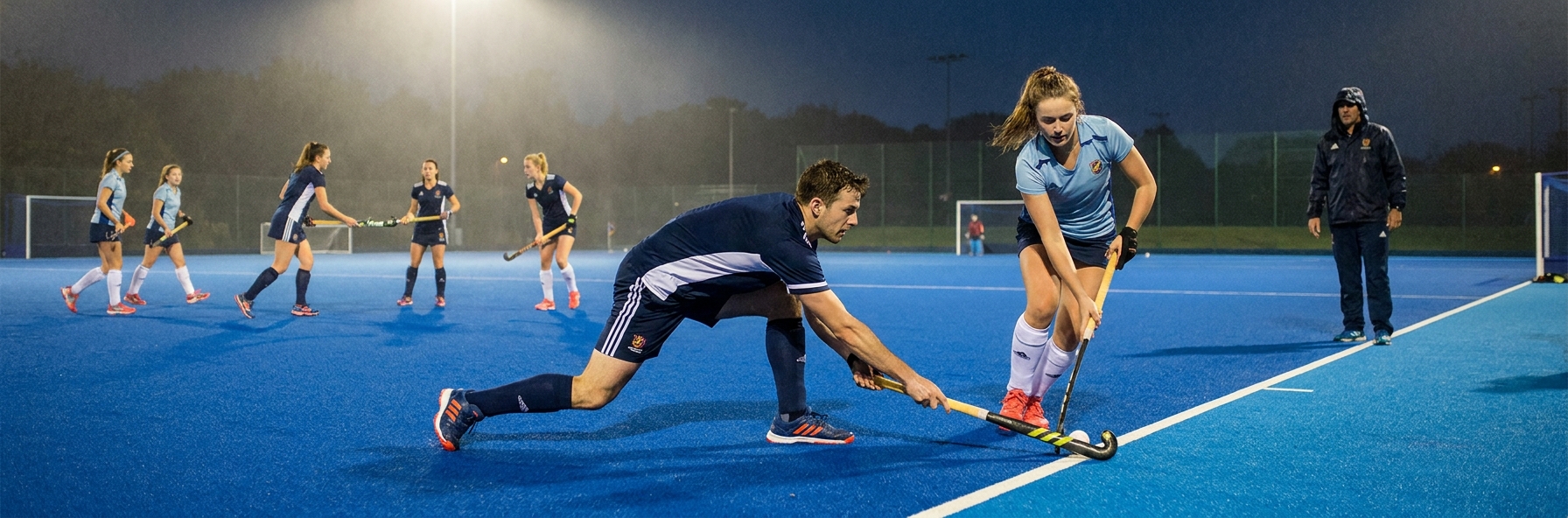
Watch a lower-team defender get beaten and the story is usually the same. They rush in, plant their stick flat in front of the ball and the attacker simply steps round them. If they are lucky, it ends as a free hit. If they are unlucky, it ends in the circle with a penalty corner or a card.
Good tackling in hockey is less about the stick and more about the feet, the body position and the patience to wait for the right moment. The three core tackles, the jab, the block and the reverse-side tackle, all rely on the same foundations.
Why Defenders Get Beaten
There are three common faults. Defenders dive in when the attacker still has the ball under close control. They stand square on, so the attacker can go either way. And they reach with the stick instead of moving their feet, which leads to stick fouls, hacking and body contact.
At the root of all three is impatience. The attacker wants you to commit. Every second you stay balanced and goal-side, the attacker has to make a decision, and that is when mistakes happen.
The Three Tackles and When to Use Them
Step One: Channel first. Before any tackle, get side-on and show the attacker one way, ideally onto your forehand side and away from goal. A defender who dictates the direction is already halfway to winning the ball.
Step Two: The jab tackle. Used to unsettle an attacker or poke the ball away when it moves slightly too far from their stick. Hold the stick in the left hand, keep low, and make a short, quick jab at the ball before recovering straight back into position. It is a nuisance tackle, not a lunge, so never commit your whole body to it.
Step Three: The open-side block tackle. The strongest tackle when the attacker comes onto your forehand. Two hands on the stick, stick low and angled towards the ground, knees bent and eyes on the ball. Put the stick in the ball's path at the moment the attacker's ball is furthest from their stick, and stay firm rather than swinging at it.
Step Four: The reverse-side tackle. For when the attacker goes past your left side. Turn the stick onto its reverse, get low and use your footwork to stay level with the ball. Time it so the stick meets the ball, not the attacker's stick or legs, as this is where most fouls happen.
Step Five: Recover and play. Winning the ball is not the end of the tackle. Get the ball under control, look up and move it on. A turnover that is immediately given back is no turnover at all.
How to Train It
Start with technique in pairs at walking pace. The attacker dribbles slowly, and the defender practises channelling and then the chosen tackle. Build to a jog, then to a 1v1 in a narrow channel where the defender's only goal is to force the attacker one way and win the ball cleanly.
Add consequences that reward good habits. In small-sided games, award a point for every clean tackle and take one away for any foul. Players quickly learn that patience wins the ball and diving in costs the team.
Key Coaching Points
- Channel the attacker before tackling; side-on, balanced and goal-side at all times.
- Move your feet to get into position, rather than reaching with the stick.
- Use the jab to unsettle and recover quickly, never as a committed lunge.
- Keep the block tackle low and firm, with the stick in the path of the ball.
- Time the reverse-side tackle to play the ball only, avoiding stick and body contact.
- Stay patient; fouls and cards come from diving in, not from waiting.
Recommended Drills
VIEW ALL DEFENDING SKILLS DRILLS
Frequently Asked Questions
Which tackle should beginners learn first?
Start with channelling and the open-side block tackle. They teach body position, balance and patience, which every other tackle depends on. Once players can block cleanly on their forehand, introduce the jab and then the reverse-side tackle.
How do I stop my players giving away obstruction and stick fouls?
Most of these fouls come from being out of position and trying to fix it with the stick or body. Coach footwork first, so defenders arrive level with the ball, and insist that the tackle plays the ball only. If a player is beaten, they should track back rather than hack from behind.
Is the reverse-side tackle too risky for club players?
It carries more risk than a forehand block, which is why channelling matters so much. But attackers will go to your left, so defenders need it. Practise it at slow pace until the timing is reliable, and encourage players to use it only when they are level with the ball.

 sportplan_hockey









