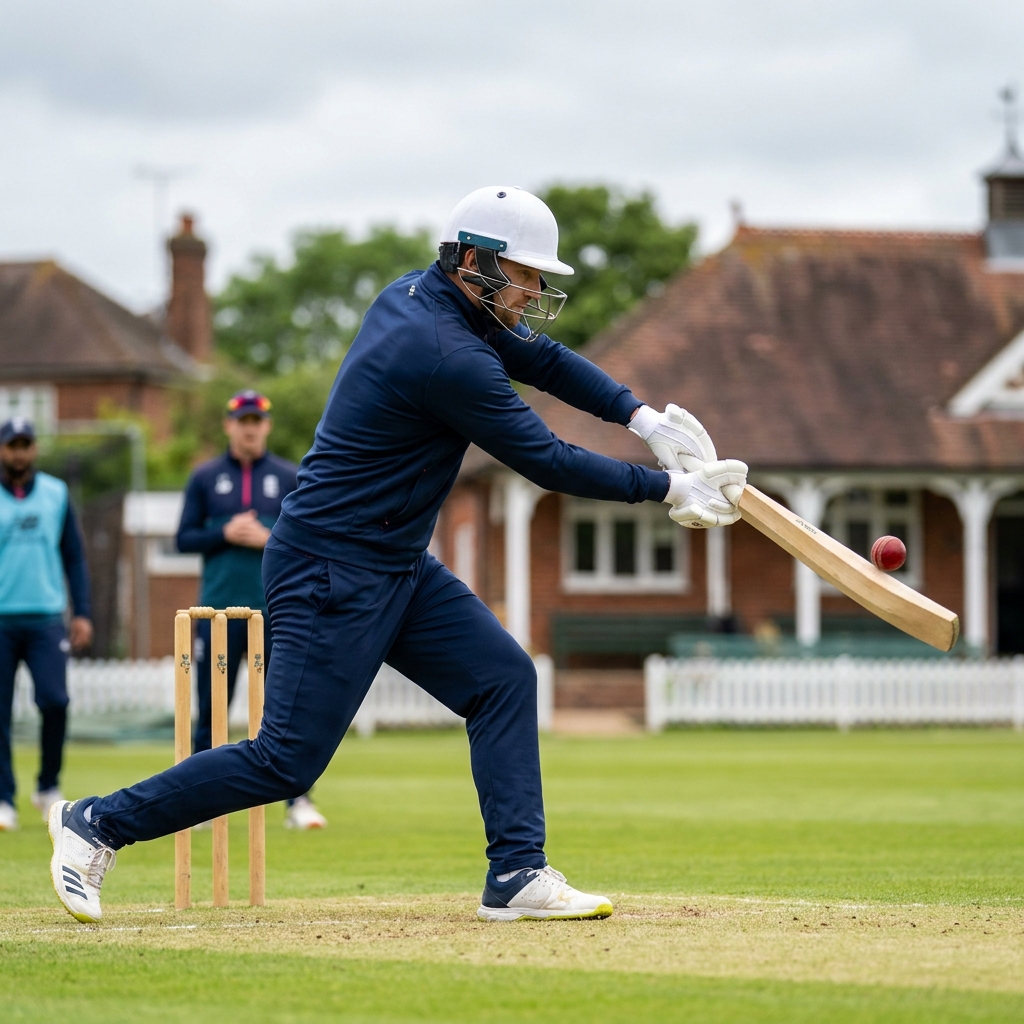
Cricket: group session

August 2026

There is a particular kind of club defeat that happens every August. Your side bowls well, restricts the opposition to something gettable, and then loses by fifteen runs having been ahead of the rate for thirty overs. Nobody did anything obviously wrong. The chase just got away.

Chasing is a genuinely different skill from batting first, and it is barely coached at club level. Batting first is about maximising; chasing is about managing a known target against a moving clock, and the mental demands are entirely different.

Why Chases Are Lost

The most common cause is a misread of the required rate. Batters look at the runs needed and panic at a number that is perfectly manageable, or they coast on a comfortable rate and forget that wickets in hand are the real currency.

The second cause is dot balls in clusters. Three or four consecutive dots does not change the required rate dramatically, but it changes the batters' state of mind, and the shot that follows is usually the one that gets them out.

The third is that nobody has a plan for the middle overs. Club sides often have a plan for the powerplay and a plan for the death, and eighteen overs of vagueness in between where chases quietly slip away.

Breaking the Target Into Blocks

The single most useful thing you can teach is to stop thinking about the total. Divide the innings into blocks of five overs and give each block a target. Suddenly a chase of 180 is not an intimidating number; it is a series of small, achievable jobs.

Within each block, the pair at the crease has a simple contract: reach the block target without losing more than one wicket. That reframes the whole innings around partnership rather than individual scores, which is exactly the mindset a good chase requires.

It also gives you a clear point to reassess. At the end of each block the batters check in, adjust, and continue. No panic, no heroics, just a recalculation every five overs.

The Framework

Step One: Set the block targets before the innings starts, not at the crease. Every batter in the changing room should know what over ten and over twenty are supposed to look like.

Step Two: Protect wickets early. Almost every successful chase is built on having batters in hand at over thirty. Being marginally behind the rate with wickets is far better than being ahead of it with four down.

Step Three: Kill the dot ball. Rotating strike is the most reliable pressure valve in cricket. Use of feet to spin, working the ball into gaps and running hard between the wickets does more for a chase than boundary hitting.

Step Four: Identify the bowler to attack. Every attack has a weak link. Decide who it is early and target their overs deliberately rather than trying to score off everyone.

Step Five: Rehearse the finish. Practise the last five overs as a scenario, with a specific target and real fielders, so the pressure is familiar when it arrives.

Training the Scenario

Scenario batting is the most under-used tool in club coaching. Set a target, set the overs, put fielders out and play it properly. Twenty minutes of that teaches more about chasing than an hour of throwdowns.

Vary the scenario so players experience being ahead, level and behind. Batters who have only ever practised comfortable chases fall apart the first time they are genuinely under the pump.

Key Coaching Points

  • Break the target into five-over blocks with their own mini-targets, and stop thinking about the total.
  • Wickets in hand matter more than being marginally ahead of the required rate.
  • Dot balls in clusters cause dismissals; rotating strike is the primary pressure valve.
  • Identify the weakest bowler early and target their overs deliberately.
  • Give each partnership a simple contract for its block, so the innings is built on pairs.
  • Practise chases as full scenarios with fielders and a clock, including ones you are losing.

Recommended Drills

VIEW ALL BATTING DRILLS

Frequently Asked Questions

Should we always keep wickets in hand, even if we fall behind?

Within reason, yes. A side with six wickets in hand needing nine an over has a genuine chance; a side with two wickets needing six an over usually does not. The exception is a chase where the required rate becomes unreachable, at which point wickets stop having value.

How do I stop my batters panicking at the required rate?

Take the number away from them. If the plan is expressed in five-over blocks, batters focus on the next thirty balls rather than the scoreboard. Most panic comes from looking at a total rather than at the immediate job.

Is it worth practising chases in junior cricket?

Very much so, and arguably more than with seniors. Young players learn game awareness through scenarios far faster than through explanation, and a colts side that has practised chasing will understand run rates and partnerships far earlier than one that only ever nets.


group session DRILLS
View All
Unfortunately there were no results for your search! Please try again
group session ANSWERS
View All

this question is for people who worship cricket.

hi!! to all my dear coaches and people assosiated with this website. i am 20 years old and i am a right arm medium fast bowler and a right arm middle order batsmen from india. i like to hit the ball all over the park as i am a natural hitter of the cricket ball.well i am facing problems with my bowling action as i am not able to practice every day, so there is always gap of 2 or 3 days between my practice sessions,so whenever i go and start bowling in the nets i always get confused and sometimes i even have to start allover again starting from my action!!!i even dont have a coach but i am determined to make to my international squad,every one laughs at me when i say this to them.i have never played a single match till now with the proper cricket ball.but i am hugely appreciated in the nets while i am bowling, as i can swing the bowl both ways with an average speed of 115-120kmph.here in india its very hard for a young player to come up in this game even if he has loads of talent,but no money,i am not even allowed to get into the nets when other clubs are practicing, beacause of that i have to practice before they come, that is from morning 4.00am to 6.00am.and i have to study as well because i am computer science engineer, which is a huge mental pressure as well,so i am not able to practice every day.well thats not an execuse for me though, because no matter how hard it gets i am gonna make to the IPL(indian premier league)and then to my international team.and just a month ago i have been picked by a new local club who were quite impressed by me,i played my first practice match against our oppositon club of under 23 age group,i scored 16 balls 42runs,and got 4 wickets of my four overs and concided 11 runs so i am really happy, i was able to swing the ball both the ways but my problem is whenever there is break in my practice session,as other club people dont allow me in the nets. i cant take my run up properly and i tend to change my action from side on to front on which decreses my speed . so plss give some sugessions on 1.how to take my run up properly. 2.how to increase my bowling speed. 3.how to bowl accurately without changing my action.

Archived User Coach

How do i prepare a 5 minute warm up for a batting session

how do i prepare a 5 minute warm up for a batting session

lee grogan Coach, England

I'm a new assistant coach and manage an u13s team,?

Bowling Wide - What Can I Do? I'm a new assistant coach and manage an u13s team, our lead coach is unable to help with next session and all the kids seem to bowl 4 out of 6 balls wide - whats the easiest way to get them to start bowling accurately?

Archived User Coach

What is optimal length of a junior coaching session??

What is optimal length of a junior coaching session? Debate is 11/2 hours or 2 (midweek evening!)?

Archived User Coach

2day cricket clinic

we are hosting a 2day cricket clinic for children age 8-14years old.any aids drills and idees would be appreciated.

Archived User Coach

Drills for youngsters?

I am about to run my club's frist junior training session of the year and doe anybody know any good ideas for drills or fun games with youngsters (aged between 6-10) who are absolute beginners to cricket?

Archived User Coach

How can I plan sessions for u-23 team?

Please guide me on how to plan my session for an u-23 state team which is going to participate in some important days matches. unfortunately I only have very short time of around 15 or 30 days to do this.

Kamal Goswami Coach, India

40 boys cricket session

Hi Guys. I need to teach a cricket lesson to 40, 11 yr old students with a range of abilities in a sports hall. Need focus as well. I need them all continuosly engaged and all have the opportunity to learn and develop. At the moment i'm thinking starting with fielding games and making them competitive and them moving onto small group exercises of 3's or 4's focusing on one batting shot. I'm open to any ideas and any help of teaching 40 students at once? Thank you for your time and suggestions!

Ryan Cawley Coach, England

Lesson plan for 5 year olds

Hi, can anyone help me with a basic plan for a first session with 5 to 7 year olds in throwing and catching?

james Coach, England

How do I plan for age specific players ?

I’m wanting to plan a session for early years players (8yrs old) Can sportplan give me appropriate drills for this age group please Asked using Sportplan Mobile App

Rupert Bouverie Coach, England

can i save the file?

hallo can i save my plan video on my pc?

Franz Coach Coach, Italy

Start of a Session

What is a good game / drill to have setup at the start of a session so players can join in when they arrive (players arriving in drive/drabs/different times)? we usually have the cricket hockey game but can get a bit messy when no bibs etc.

undefined undefined Coach, United Kingdom

Ideas for Game Scenarios - Spo...

I ran a coaching session on Sunday where I took along a number of handwritten cards, from which the kids (U11s) could randomly choose "Super Over", "Bowl Off" or "Game Scenario". If they chose the latter, I had another set of cards they could choose from "Wicket Target", "Run Target", "Run Target - but boundaries don't count".Finally, they then draw from some more cards - runs (20-30), max wickets (1-3), overs (3-5).Each game scenario lasted around 10-20 mins, so in our session, we had time for about 4 or 5 scenarios. They appeared to enjoy it, but most of them said they wanted to bowl/bat individually for longer! Kids, eh?The idea behind these if to get them thinking about batting intelligently - rotating the strike, keeping the score ticking over, managing achievable run rates, etc. It's also a chance to give some of them some experience at captaining and having to make key decisions (bowling and batting order, how to place a field for different scenarios).Any ideas for variations I could try would be welcome. My session lasts for 2 hours including warm ups and any specific exercises I want to do beforehand.

Matt OToole Coach, England

What should I coach at a begin...

Im coaching an under 9's team ( GOD HELP ME!) and all though i have played extensively i have not coached such a young team before. Can anyone advise on a training plan designed for beginners / young players. Some ideas on how to make it fun and keep them interested would be great... thanks in advance.

Archived User Coach

JOIN SPORTPLAN FOR FREE

  • search our library of 350+ cricket drills
  • create your own professional coaching plans
  • or access our tried and tested plans

Sportplan App

Give it a try - it's better in the app

YOUR SESSION IS STARTING SOON... Join the growing community of cricket coaches plus 350+ drills and pro tools to make coaching easy.
LET'S DO IT