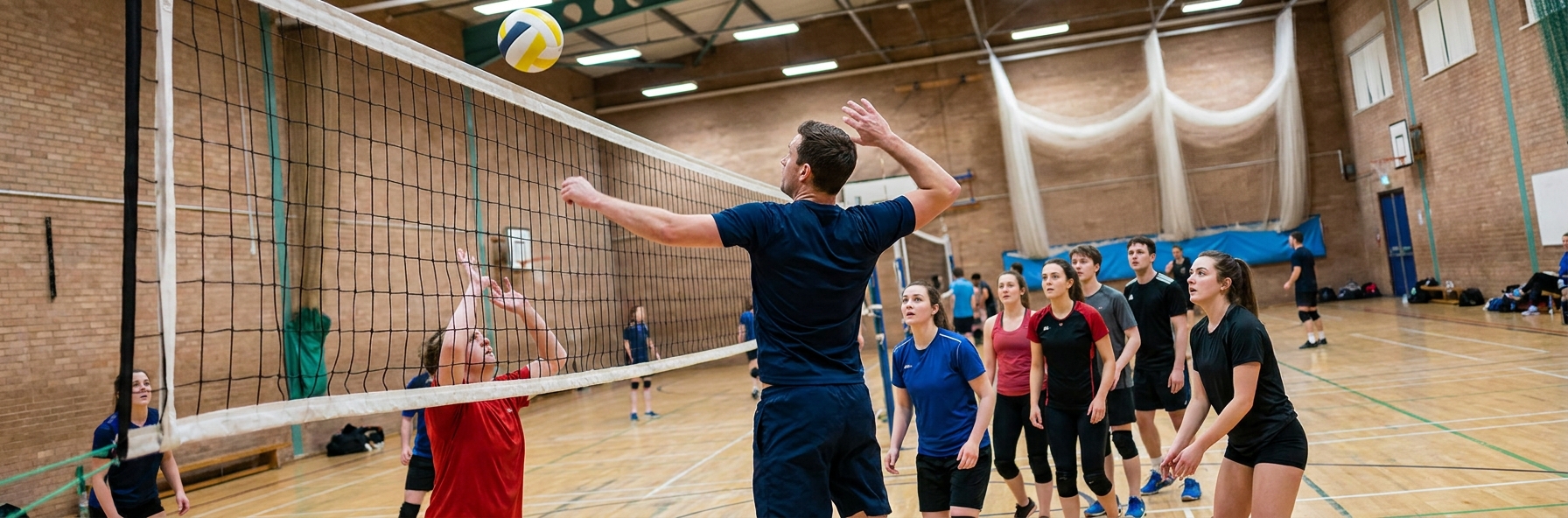
October is when most clubs and university teams fill up with new faces. The National Volleyball League got under way on the first weekend of the month, junior competitions have started, and student sides are preparing for Student Cup qualifiers in November. For many coaches that means a squad full of keen players who want to hit hard but have never been taught how to get to the ball.
The result is familiar. Players run straight at the net, jump off one foot, arrive too early and swing at a ball that has already dropped below them. The fix is not more hitting reps. It is a simple, repeatable approach that every hitter can trust, and a shared sense of timing between hitter and setter.
Why New Hitters Struggle
Most beginners treat the approach as a run-up, when it is really a jump preparation. Speed matters, but only if it can be turned into height. A player who drifts forward on take-off ends up in the net or hitting the ball from behind their head.
The second problem is timing. New hitters tend to leave too early, because standing still while the ball is in the air feels wrong. They reach the net, jump and then wait, so the ball arrives as they come down. Good hitters learn to delay, then accelerate.
Finally, the arm swing is often an afterthought. Without a full backswing and a high elbow, players push the ball rather than hit it, and they lose the ability to place it.
A Five-Step Framework for the Approach
Step One: Start in the right place. Outside hitters should begin behind the attack line and slightly outside the court, so they approach on a gentle angle towards the setter. Starting on the line or too close to the net leaves no room to build momentum.
Step Two: Learn the footwork pattern. For a right-handed hitter, a three-step approach is left, right, left. Left-handers mirror it: right, left, right. The first step is short and sets direction. The last two steps are the important ones: a long, quick second step followed by a closing step that brings the feet together for a two-footed take-off. Once this is solid, more experienced players can add a small first step to make it a four-step approach.
Step Three: Brake and convert. On the final two steps, plant heel first and roll onto the balls of the feet, with the hips sinking and the shoulders staying over the feet. This is what turns horizontal speed into vertical lift. If players are landing well forward of where they took off, they are not braking.
Step Four: Swing the arms with the feet. As the long second step lands, both arms swing back. On the closing step they drive forward and up, which adds height. At the top, the hitting arm draws back with the elbow high, like pulling a bow, while the non-hitting arm points up at the ball.
Step Five: Time it with the setter. Teach hitters to wait until the set is on its way and they have read its height and direction, then go. For a higher, slower set to the outside, that usually means starting later than they expect. Agree simple calls with the setter so both know which ball is coming.
How to Train It
Warm-up (10 minutes): Footwork without the ball. Players walk the pattern, then jog it, then perform it at full speed with an arm swing and a two-footed jump. Call out the steps if needed.
Technical (15 minutes): Jump and throw. Players approach holding a ball, take it behind their head on the jump and throw it over the net. This builds the take-off and the arm position without the pressure of contact. Progress to a coach tossing a ball for players to catch at the peak of their jump.
Decision-making (15 minutes): Introduce a setter. Vary the height and location of the set, so hitters have to read it and adjust when they start their approach. Reward a well-timed approach, even if the hit itself goes wrong.
Game (15 minutes): Small-sided games where points scored from a full approach and attack count double. This keeps the new technique in play rather than letting players fall back on a standing hit.
Key Coaching Points
- Start behind the attack line, so there is room to build speed.
- Make the last two steps the longest and quickest: big step, then close.
- Plant heel to toe and sink the hips to turn speed into height.
- Swing both arms back and through with the final steps.
- Contact the ball high and in front of the hitting shoulder.
- Wait for the set to leave the setter's hands, then accelerate.
Recommended Drills



VIEW ALL VOLLEYBALL TECHNIQUE DRILLS
Frequently Asked Questions
Should beginners use a three-step or four-step spike approach?
Start with three steps. It is easier to learn and still gives enough momentum for a good jump. Once players can perform it consistently with a two-footed take-off, add a short first step to make it a four-step approach for extra speed.
Why do my hitters keep hitting the ball into the net?
Usually they are arriving too early or drifting forward on the jump, so the ball ends up behind or level with their head. Work on starting the approach later and braking on the last two steps, so they contact the ball high and in front of the hitting shoulder.
When should a hitter start their approach?
Not until they have read the set. As a guide, wait until the ball has left the setter's hands and you can judge its height and direction. Higher, slower sets need a later start, while quicker sets need the hitter to be on the move earlier. Practise with the same setter so the timing becomes shared.