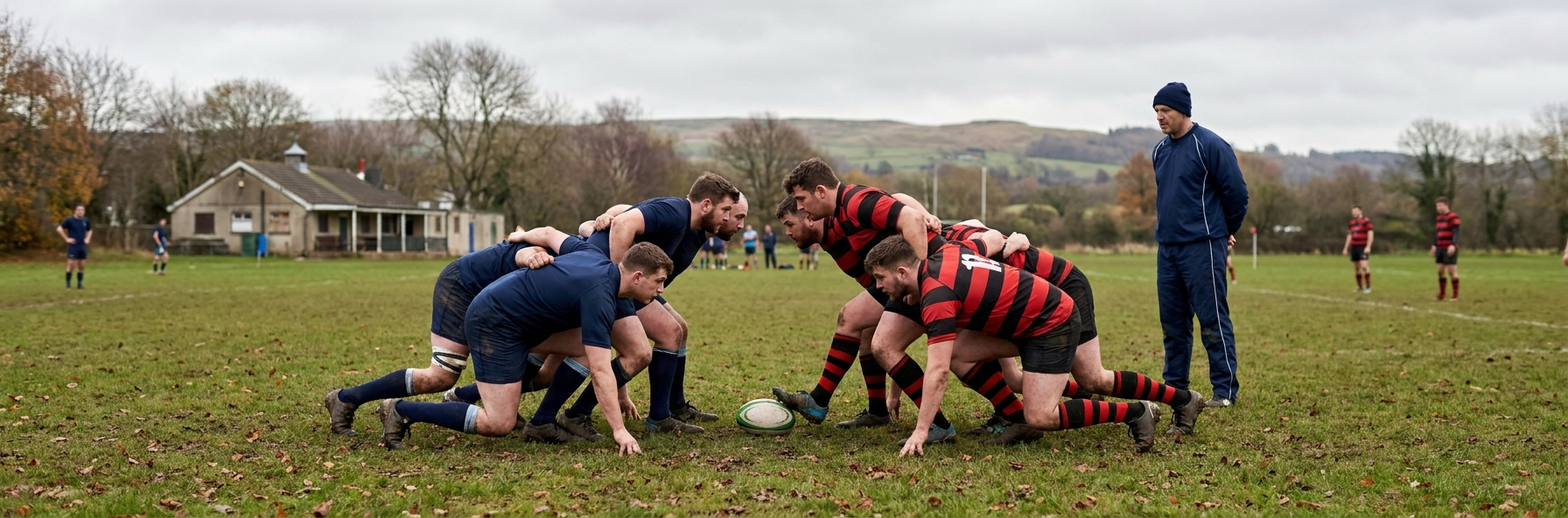
The brake foot has been around as a World Rugby trial for a few seasons, so many front rows will already know it. From 1 July 2026 it is part of the full laws of the game. Both hookers must have one foot extended forward, towards the opposition, through the "crouch" and "bind" calls.
For club coaches, that means it is no longer a detail to pick up on match day. A hooker who forgets the brake foot can be penalised by the referee, and a front row that has never trained with it often feels unbalanced on the engage. A few minutes in every scrum session will make it second nature.
Why the Brake Foot Matters
World Rugby introduced the brake foot to reduce axial loading, the pressure that travels through the head and neck when a scrum drives forward or collapses. Hookers are especially exposed because they sit in the middle with both arms bound and no free hand to support themselves.
The forward foot acts like a prop under the hooker. It stops the front row from tipping forward before the engage, helps both packs stay square and steady, and should mean fewer collapses and resets. It builds on the "crouch, bind, set" sequence, which World Rugby credits with reducing engagement forces and injuries.
The Brake Foot, Step by Step
Step One: Set the base. Before the crouch, the front row forms a stable shape with feet roughly shoulder-width apart, hips just above knee height and backs flat. Props bind on the hooker first, then the locks and back row bind on.
Step Two: Brake foot on "crouch". On the crouch call, the hooker places one foot forward in the middle of the tunnel, towards the opposition. Most hookers find one side feels natural; let them choose and stick with it.
Step Three: Hold through "bind". The brake foot stays in place while the props take their bind on the opposition. World Rugby has clarified that a hooker may adjust to a "half" brake foot during the sequence, but only if it started as a full brake foot and the adjustment does not cause instability, early engagement or extra loading.
Step Four: Withdraw after "set". Once the referee calls "set", the hooker can draw the foot back, ready to strike for the ball. Withdrawing it before "set" is what referees will be watching for.
Step Five: Strike and drive. With the foot back underneath, the hooker strikes when the ball is put in, and the pack drives together with flat backs and the inside leg slightly forward.
How to Train It
Warm-up (10 minutes): Neck and shoulder activation, then 1v1 scrummaging on knees to rehearse body shape and flat backs.
Technical (15 minutes): Three-person front row against a scrum machine or a matched unit at walking intensity. A coach calls the sequence slowly and checks the brake foot on every crouch.
Decision-making (10 minutes): Vary the timing of the calls and the put-in so the hooker learns to keep the brake foot until "set", then react quickly to strike.
Game (10 minutes): Live scrums in a small-sided game. Any brake foot error hands the opposition a free kick, so the habit sticks before match day.
Key Coaching Points
- Brake foot forward in the middle of the tunnel on the "crouch" call, every time.
- Keep it in place through "bind"; only withdraw after "set".
- Flat backs and hips just above knees for all three front-row players.
- Props bind tight on the hooker so the front row moves as one unit.
- Engage with control, not a big hit; stability first, then power.
- Stop and reset in training whenever a scrum goes down or loses shape.
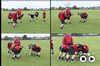
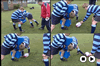
Recommended Drills
Frequently Asked Questions
What is the brake foot in a rugby scrum?
It is the hooker's foot placed forward in the middle of the tunnel, towards the opposition, during the "crouch" and "bind" calls. It gives the front row a stable base and reduces pressure on the head and neck. The hooker can withdraw it after the "set" call to strike for the ball.
What happens if the hooker does not use the brake foot?
Referees can sanction it, so check the current sanction with your society referees. More importantly, a front row without a brake foot is more likely to tip forward early, which leads to collapses and resets. Train it until it is automatic.
Does the brake foot apply in junior rugby?
The brake foot is part of World Rugby's laws, but age grade scrums in England also follow the RFU's age grade regulations, which set out when contested scrums are introduced and how they are run. Check the current RFU regulations for your age group, and teach the brake foot as soon as players start scrummaging so the habit is there from the beginning.

 sportplan_rugby