






Excellent site with easy to navigate pages.

Hi,i see the training but one thing i don't understand why ther is not the time of the session and how big is the field?

Disciplining for misbehaviour? 8-11 year olds, they dont really get bored because i know that sometimes that can be the cause. How or what can i apply a bit of strictness into the team.

Our under 12's have made the jump from 9 a side to 11 a side. We have entered a big city league were results are hard to come by. We play a super 1st half and lose it massively 2nd half, through heads down & fitness. Any suggestions on confidence boosting & training drills to help steady a ship. We are playing a 4 - 2 -3 - 1 formation.Yes we are getting a bit of negativity from the parents to, which does not help. Thank you in advance.
I need some drills to show my team how t keep their head up when dribbling with the ball without the drill being boring for them because when I try the traffic lights drill or something like that they switch off really quickly but I'm also trying to teach them that when someone passes the ball to them they always look what's around them before they get the ball and I want to know if their is any drills I can use
Anyone have a drill for HS boys to help stop other teams players with strong legs from shooting long and scoring
When I share a link to my drill, the link goes to a sign up page...why isn't it showing the drill? Asked using Sportplan on Mobile

I have a player recovering from ACL rupture and would some advice on what passing drill to introduce him to
My team always hesitates on defending corners. We set up right and then don't react. Can you help? Asked using Sportplan on Mobile
Hi all can someone help with how can you challenge all player at the same time within a drill without making anyone standing as they are not as good as others?What is the best way of putting the player into the ugly zone?

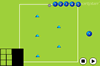
I think I asked once before, but I can't find the answer. On the drill pages there is a grid on field size, how big is each square? I'm thinking it is 5 yards
Hi. I would like to know if anyone can clarify me the drill "1, 2, 3 pass and move". I mean, for example, the players "2" and "3" only have to pass to the middle player? And why is the word move in the drill, if no player is moving after the pass?Thanks in advance.
I am fairly slow and often get outpaced. Any tips?
I can't edit my saved drill. In the folder section, I clicked my drill and then clicked edit option but I can't edit the animation.Thanks

I have Platinum membership for Hockey on Sportplan, but don't appear to have access to a lot of the drill and available content. Do you know why this is?
I have an sketch where the field doesn't show the full field and I don't understand why? I have another similar drill that does show the full field
how to do this
Hello all! My kids aged 9 and 7 are very slow when compared to their peers of the same age. They don't seem to fight for the ball and get and watch others play their game. They seem to lack the urgency (heart) needed for the game. (They LOVE football). How can make them move around and react faster. Any help you are able to provide is greatly appreciated. Thanks O
I usually plan my session the Friday night before Saturday training . I anticipated 12 players but then this sequence of events happened. Friday 8.36pm, parent texts amp; says child can't come as he is doing 11+ mocks (did he only just realise this?). Saturday 8.57am, another parent texts amp; says as they went to a wedding the night before, child is in no fit state to train (again, was this something that only just occured to them may happen?). Saturday 9.26am, parent phones amp; says child is throwing up (fair enough, I guess). Saturday 9.57am, parent texts, another puking child (a bug perhaps doing the rounds? Bit late notice though as we start training in 18 mins). Saturday 9.58am, another text from another child's parent to say child is throwing up (Hmmm, another one. Late notice again?). Saturday 10.15am, training starts but another child is missing. I give it 5 mins then phone. Parent says they are off to theme park amp; he sent me a text. I said that I never received text amp; asked if I sent an acknowledgement to aforementioned text to which he said no which I said meant his text wasn't receieved. I went from 12 players training @ 8.36pm Friday to 6 by start of training in under 10 hours. My session plan went in the bin. I realise the sickness is one of those things but think the last 2 were rather late in notifying me. As for the other 3, I feel these to be lame excuses. What can I implement to try to stop or reduce these issues? Fines? Suspensions? Nothing? #frustrated
Disciplining for misbehaviour? 8-11 year olds, they dont really get bored because i know that sometimes that can be the cause. How or what can i apply a bit of strictness into the team.
Hello, I am currently coaching an u9's boys team and a majority of them are well behaved and want to play football, but the odd 1or2 tend to mess around at training which distracts the others. I have sat them out in training and spoken to the parents but still this goes on. Do I decide to kick them out of the team altogether or does anyone know the miracle cure to stop this happening?


The 2026 World Cup is nearly upon us. Here is Sportplan's preview for the tournament on who we think is going to do well and which teams to look out for.

Discover our new Coaching Trends section - in-depth articles covering the latest tactics, techniques and innovations across Football, Hockey, Cricket, Rugby, Netball, Basketball, Tennis, Handball and Volleyball.
Save yourself a scare this Halloween and ensure your session runs smoothly. No chaos, no fright, just structure.
Coaches from around the world look to Sportplan for coaching confidence.
Excellent site with easy to navigate pages.

The 'My Stuff' feature is amazing! It's a coach's best friend!

Love the site, it's a fantastic learning tool!

Wow what a great website, I have found sportplan an important tool for me when planning my netball sessions with my netball team. There are alot of very helpful tips/ideas/skills that I can learn and teach to my team. Thank you sportplan I hope to continue to use your helpful tips and to learn more about improving my teams netball skills. Thanks again....keep it up....

I have been using Sportplan now for 3 years and can honestly say that I have never repeated the same session twice. My girls are always focused and are improving every year. Thanks Sportplan.
What a fantastic tool. The Chalkboard and session tools make an unbelievable difference in making training plans in both time and organization. I will be instructing all of my assistant coaches that this tool must be used for all sessions during the season, so that we may build a club coaching resource library.
I can't get enough of the Sportplan, It has given me back the enthusiasm i was starting to lose. My girls are so keen and are ready at 14 to take the next up in their game. Sportplan will help no end.


Register for FREE and get coaching tips, top drills, session and more every week!