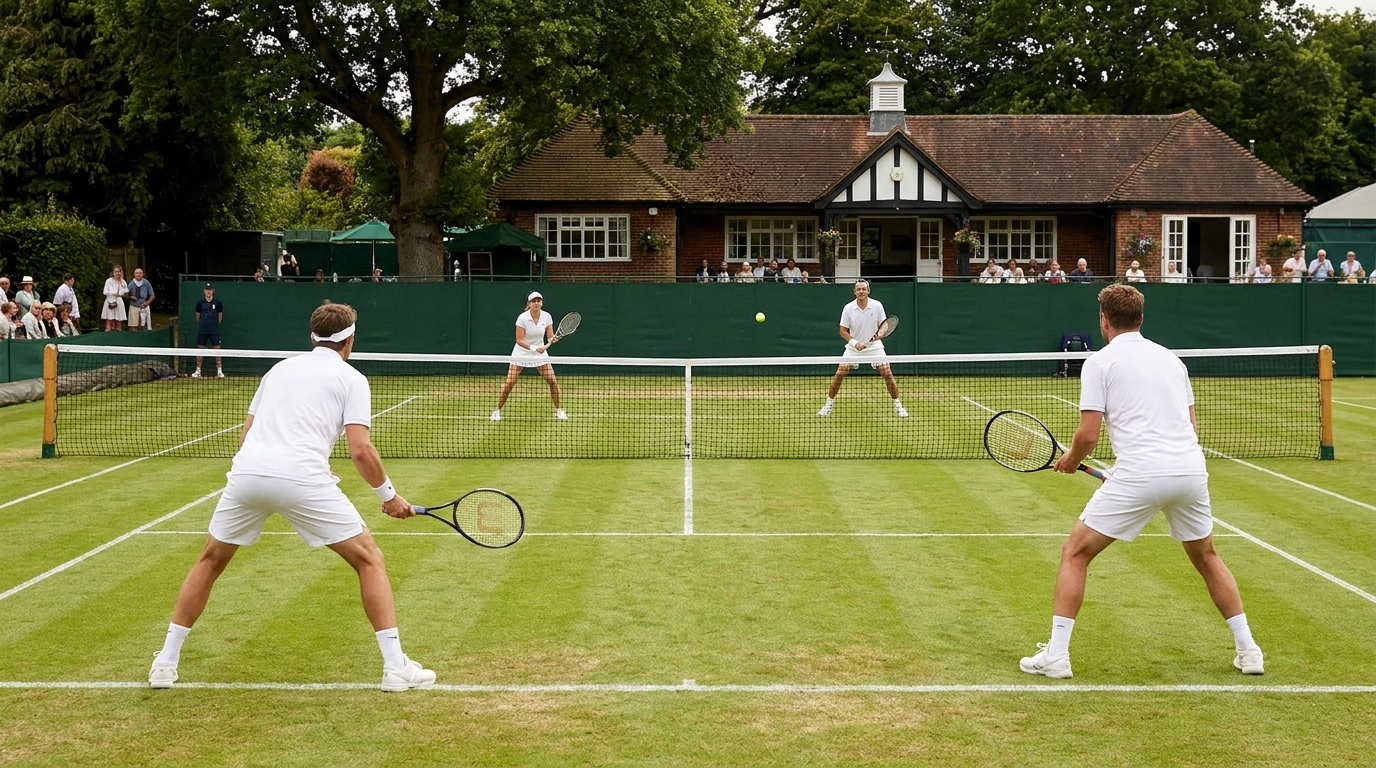
Tennis Without the Confusion
Few sports look as baffling to a newcomer as tennis. The scoring jumps from 15 to 30 to 40, then suddenly someone shouts "deuce", and in doubles there are extra lines, partners swapping ends and players darting across the net for no obvious reason. None of it is as complicated as it sounds. Once you learn a handful of simple rules, every match - your child's first red-ball game or the Wimbledon final - follows exactly the same pattern.
This guide is written for new players and for parents standing on the sideline wondering what is going on. We will start with scoring, building up point by point, then move on to doubles: the court, who serves, where everyone stands, and the well-known formations in plain English. By the end you will be able to follow a match and call the score yourself.
How Tennis Scoring Works
Tennis is scored in four building blocks that stack on top of each other: points make a game, games make a set, and sets win the match. Get those four words clear in your head and everything else falls into place.
Points: 15, 30, 40, Game
Within a single game the points are counted with tennis's famous odd numbers. Win your first point and you are on 15. Win the second and you are on 30. The third takes you to 40. Win a fourth point and, provided you are at least two points clear, you win the game. A score of zero is called "love", so a game often starts "love-all". The historical reason for 15-30-40 is lost in time - most likely an old clock face - but you do not need the history to use it; you just need to know the order.
One golden rule when calling the score: always say the server's score first. So "30-15" means the server has 30 and the receiver has 15. If both players have the same score you add "all" - "30-all" - and if both have 40 you do not say "40-all", you say deuce.
Deuce and Advantage
When the score reaches 40-40 it is called deuce, and this is the bit that confuses everyone. From deuce you cannot win the game with a single point - you must win two points in a row. Win the first point after deuce and you have the advantage (often just called "ad"). Win the very next point and you take the game. But lose that next point and the score returns to deuce, and the tug-of-war begins again. A single game can pass through deuce many times before someone finally edges two points clear.
Games and Sets
Win enough games and you win a set. To take a set you need to win six games and be at least two games clear - so 6-4 wins the set, but 6-5 does not, because you are only one game ahead. If it reaches 6-5, you play on: win the next game for 7-5 and the set is yours; lose it and you are at six games all, which triggers a tie-break (more on that below). Players swap ends of the court after the first game and then after every two games, so neither side is stuck facing the sun or the wind for too long.
Tie-Breaks
A tie-break is the sudden-burst game that decides a set stuck at six games all, so it does not drag on endlessly. Crucially, a tie-break is scored with normal numbers - 1, 2, 3, 4 - not 15, 30, 40. The first player or pair to reach seven points, two clear, wins the tie-break and so wins the set 7-6. Serving rotates in a particular rhythm: one player serves the first point, then serve passes and from there each player serves two points at a time, and the players change ends every six points. If it reaches 6-6 in the tie-break you simply keep going until someone is two points ahead - which is how those marathon scorelines happen.
There is also a longer version called the match tie-break or championship tie-break: first to ten points, two clear. This is commonly used in place of a full deciding final set, especially in doubles and junior events, to keep matches to a sensible length.
Winning the Match
Most matches are the best of three sets, which simply means the first player or pair to win two sets wins the match. So you might see a final score of 6-4, 3-6, 6-2: the winner took the first set, lost the second, then won the decider. (Men's Grand Slam singles use best of five, but you will rarely meet that at club or junior level.) A common shorthand for the whole ladder is: four points win a game, six games win a set, two sets win the match.
Shorter Formats in Junior and Club Tennis
To keep matches moving - and to fit more tennis into a coaching session or a club night - juniors and clubs often use shortened scoring. The most common is no-advantage scoring (no-ad): instead of needing two points clear from deuce, a single sudden-death point is played at 40-40, and the receiver usually chooses which side to take it from. You will also meet short sets (first to four games), FAST4 (first to four games with no-ad and a tie-break at 3-3), and timed formats. The LTA Youth pathway uses red, orange and green balls on smaller courts with their own simplified scoring, so do not be surprised if your child's first matches look different from the adult game - that is by design, to help them learn.
Doubles: Four Players, a Wider Court
Doubles is two against two, and it is where most club and social tennis is played. The basics of scoring are identical - points, games, sets, tie-breaks - but the court gets wider and there are a few extra rules about serving and where to stand.
The Doubles Court and the Tramlines
For doubles the court is widened by bringing the tramlines (also called the doubles alleys) into play. These are the narrow lanes down each side, between the inner singles sideline and the outer doubles sideline. In singles those lanes are out; in doubles they are in. One catch that trips up beginners: the tramlines are never part of the service boxes. A serve must land in the diagonal service box, so a serve into the tramline is a fault even in doubles. The four service boxes are the four rectangles either side of the net, marked off by the centre service line and the service line; the baseline is the back line you serve from.
Serving Order and Sides
In doubles all four players serve a full game each, in a fixed order that the two pairs set at the start of the set. One player from each pair serves first, then the other player from each pair, and that rotation simply repeats. So the serving order over four games might be: Pair A's first server, Pair B's first server, Pair A's second server, Pair B's second server - then back to the start. Each pair also chooses, at the start of every set, who will receive in the right court (the deuce side) and who will receive in the left court (the advantage side). Once chosen, those receiving sides are fixed for the whole set. As in singles, every point is served diagonally and the server alternates between the right and left sides of the baseline after each point.
Where to Stand: Basic Positioning
At the moment of serve, a doubles pair usually sets up with the server back near the baseline and their partner at the net, ready to pounce on a weak return. The receiving pair has one player back to take the serve and, classically, their partner up near the net too. From there, three broad shapes describe most doubles play:
The Three Basic Doubles Shapes
- One up, one back: the most common club shape - one player at the net, one at the baseline. Safe, balanced and easy for beginners. Good for steady, rallying doubles.
- Both back: both players on the baseline. Defensive and forgiving - useful against a big server or when a pair is under pressure - but it gives the net away to the other team.
- Both up: both players at the net. The attacking, "winning" shape of doubles, used once a pair has taken control of the point. It puts huge pressure on opponents but leaves space behind for a lob.
The Formations: Standard, Australian and I-Formation
"Formation" in doubles usually refers to where the serving pair stands, and there are three you will hear named:
- Standard formation: the everyday set-up. The server's partner stands at the net on the same side as the server. Simple and the default for most pairs.
- Australian formation: the net partner stands on the same side as the server (so both are on one half of the court at the moment of serve), which takes away the receiver's favourite cross-court return and forces them to go down the line. It is used to disrupt a returner who is hurting you cross-court.
- I-formation: the net partner crouches low right next to the centre line, near the server, so the receiver cannot tell which way they will move. At the last second the net player darts left or right. It sows doubt in the receiver's mind and is a favourite at higher levels.
The aggressive move that ties all this together is the poach: the net player suddenly crosses in front of their partner to intercept the return and put it away. A good poach - or even the threat of one - rushes the returner into mistakes, which is why the net player is so often the busiest member of a doubles pair.
A Doubles Court at a Glance
The diagram below shows a tennis court from above, set up for doubles. You can see the outer doubles lines, the singles sidelines (with the tramlines in between), the net across the middle, the four service boxes split by the centre service line, and the baselines. The four dots mark a typical doubles start: the server and their net partner on one side, the returner and their net partner on the other.
S = server · SP = server's partner at the net · R = returner · RP = returner's partner at the net. The tramlines down each side are in play in doubles only.
A Quick-Reference Scoreboard
When you next watch a match, this is the ladder the score climbs. Each level resets the one below it, which is exactly why a player can win fewer points overall and still win the match.
Point → Game → Set → Match
- Point: counted 15, 30, 40 - and "love" for zero. Win the rally, win the point.
- Game: win four points, two clear. At 40-40 it is deuce, then advantage, then game (or one sudden-death point under no-ad).
- Set: win six games, two clear. At six games all, play a tie-break (first to seven, two clear).
- Match: best of three sets - first to two sets wins. A match tie-break (first to ten, two clear) may replace a deciding set.
Practise It on Court
The fastest way for any new player to understand scoring and doubles is to play games where the score actually matters, rather than just hitting. The drills below put points on the line and get partners working together at the net. Start with a simple rally game, then build into doubles movement and a fun, competitive finisher.
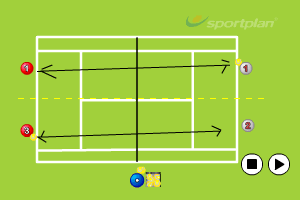
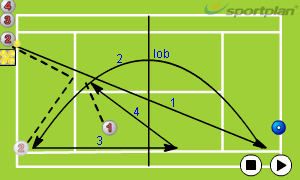
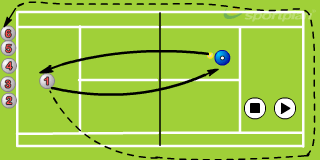
Where to Go Next
Once the scoring clicks, the next step is simply more time on court playing points. If you are coaching or helping out with juniors, our tennis drills for juniors guide gives you ready-made practices that build rallying and match play, and you can slot any of them into the structure in our free tennis session plan template. For coaches juggling several groups, the guide to squads, groups and availability helps you keep everyone organised across the week. And when you want fresh ideas, browse the full Tennis drills library for hundreds of practices sorted by skill.
Frequently Asked Questions
How does tennis scoring work?
Tennis is scored in points, games, sets and then the match. Within a game the points go 15, 30, 40 and then game - so the first point is 15, the second 30, the third 40 and the fourth wins the game (you must be two points clear). Win six games (two clear) and you take the set. Most matches are best of three sets, so the first player or pair to win two sets wins the whole match. Always read the server's score first.
What is deuce and advantage in tennis?
When both players reach 40-40 the score is called deuce, and from there you must win two points in a row to take the game. Win the first point from deuce and you have the advantage; win the next as well and you take the game. If you lose the point on advantage, the score goes back to deuce, and this can repeat several times. In many junior and club matches a quicker no-advantage rule is used, where a single sudden-death point at deuce decides the game.
What is a tie-break in tennis?
A tie-break is played when a set reaches six games all, to decide the set without it going on forever. It is scored in normal numbers - 1, 2, 3 and so on - and the first to seven points wins, as long as they are two points clear. Players swap serve after the first point and then every two points, and change ends every six points. A longer match tie-break (first to ten points, two clear) is often used in place of a deciding final set in doubles and junior tennis.
How does serving work in doubles?
In doubles all four players take turns to serve a whole game in a fixed order: one player from each pair, then the other player from each pair, repeating through the set. Each pair also decides at the start of every set who will receive in the right court (deuce side) and who will receive in the left court (advantage side), and they must keep those sides for the whole set. As in singles, the server starts each point from behind the baseline, serving diagonally and alternating sides after every point.
What are the tramlines for in tennis?
The tramlines are the narrow lanes down each side of the court between the singles sideline and the outer doubles sideline. In singles they are out, so the court is narrower. In doubles they are in play, making the court wider to suit four players. One simple rule to teach a new player: the tramlines only count in doubles, and only for shots in open play - the service boxes never include the tramlines, so a serve landing in the tramline is a fault in both singles and doubles.