From a Group of Keen Players to a Real Club
Most tennis clubs begin the same way: a handful of people who love the game, a set of courts somewhere, and a shared frustration that there is nowhere local to play properly. Turning that into a constituted, registered, insured club is entirely doable - but it is far more paperwork than forehands. The good news is that almost none of it is difficult once you tackle it in order, and the Lawn Tennis Association (LTA), the governing body for tennis in Britain, gives you a clear framework to work within.
This guide is a working checklist. Read it through once to see the whole picture, then work down it step by step. Two things sit at the heart of it and deserve genuine care: LTA venue registration (which also gets you set up on ClubSpark, the LTA's official booking and membership system) and safeguarding, which is non-negotiable the moment a single child walks onto your courts. We will treat both seriously.
The Master Checklist
Here is the full sequence in one place. Each item is explained in more detail below, but if you only take one thing away, take this list and work down it.
Starting a Tennis Club: The Checklist
- 1. Form a committee: Recruit a core group and elect, at minimum, a Chair, Secretary and Treasurer who will carry the club.
- 2. Adopt a constitution: Agree a written constitution setting out the club's aims, membership rules, how decisions are made and how money is handled.
- 3. Open a club bank account: A dedicated account in the club's name, with at least two signatories - never run club money through a personal account.
- 4. Secure your courts: Confirm access to courts (owned, leased or hired) and plan for floodlighting and ongoing maintenance.
- 5. Take out insurance: Public liability insurance is essential; LTA registration includes cover, but check what it covers and top up if needed.
- 6. Register the venue with the LTA: Become an officially recognised venue and get set up on ClubSpark for court booking, membership and online payments.
- 7. Sort safeguarding: Appoint a Welfare Officer, run DBS checks, adopt a safeguarding policy and codes of conduct (full checklist below).
- 8. Build a coaching team: Recruit LTA-accredited, DBS-checked coaches and agree how programmes and fees work.
- 9. Get equipment: Balls, nets, court markings, junior equipment and storage.
- 10. Recruit members and join leagues: Open membership, run taster sessions, and enter local leagues and box leagues.
1-3: The Foundations - Committee, Constitution, Bank Account
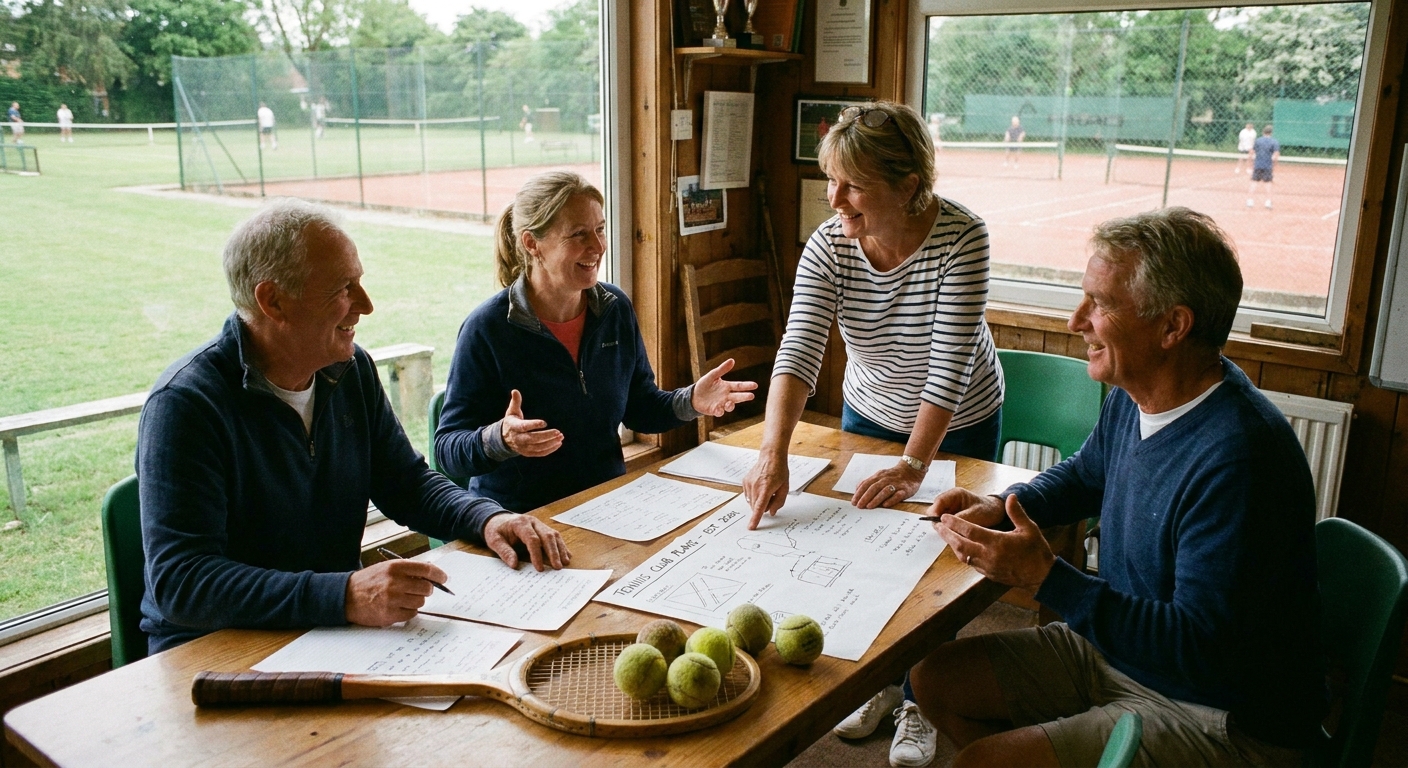
Every club needs a few people willing to do the unglamorous jobs. At a minimum, elect a Chair to lead, a Secretary to handle correspondence and records, and a Treasurer to look after the money. Spread the load - clubs that rest on one heroic volunteer tend not to last.
Next, adopt a constitution: a short written document setting out the club's purpose, who can be a member, how the committee is elected, how decisions are made and how funds are used. It sounds bureaucratic, but it is what turns an informal group into a proper club, and it is usually required before you can open a bank account, claim Gift Aid or apply for grants. Many clubs adopt a model constitution and tweak it. If you intend to claim Gift Aid on membership and donations, structure the club appropriately from the start - our guide to Gift Aid for tennis clubs covers what to set up.
Then open a dedicated club bank account in the club's name, with at least two signatories required for payments. Never run club money through someone's personal account - it muddles the finances, raises safeguarding-of-funds concerns and makes the Treasurer's life impossible.
4-5: Courts and Insurance
You cannot run a tennis club without courts. Confirm exactly how you will access them: a club may own its courts, lease them from a local authority or school, or simply hire public courts by the hour to begin with. Whatever the arrangement, get it in writing. Factor in floodlighting if you want to play through winter evenings, and budget for ongoing court maintenance - surfaces, nets, fencing and line repainting all cost money over time.
You also need public liability insurance. This protects the club if a player, parent or member of the public is injured or their property damaged. LTA venue registration includes a level of public liability cover, which is one of the practical benefits of registering - but read what it covers and arrange additional cover if your situation needs it. Do not let a single session run without insurance in place.
6: Register the Venue with the LTA (and Get Set Up on ClubSpark)
This is the step that ties everything together. LTA venue registration makes your club an officially recognised tennis venue with the governing body. Registration brings real benefits: public liability cover, access to LTA competitions and the British Tennis structure, eligibility for funding and grants, and the LTA's safeguarding standards and support. There are accreditation requirements to meet - including having the right safeguarding measures in place - so registration and safeguarding go hand in hand.
Registering also sets your venue up on ClubSpark, the LTA's official venue management platform, which is free to LTA-registered venues. ClubSpark is genuinely excellent and comprehensive: its standout feature is online court booking, and it also handles membership, online payments, coaching-programme management and entry into LTA competitions and box leagues. For most British tennis venues, ClubSpark is the system of record for court booking and LTA registration, and it should be. Get your venue registered and your ClubSpark site set up early - it underpins how members book courts and join the club.
7: Safeguarding - Done Properly
The moment a child sets foot on your courts, safeguarding becomes the single most important thing your club does. It is also an LTA accreditation requirement, so it is not optional. Do not treat it as a form to file and forget - treat it as a live responsibility. Here is the mini-checklist every junior-facing club should be able to tick off.
The Safeguarding Checklist
- Appoint a Welfare Officer: A designated, named person responsible for safeguarding, trained and DBS-checked, whose contact details are visible to members and parents.
- DBS checks for everyone in regulated activity: Every coach, assistant and volunteer working with children needs a valid, in-date enhanced DBS check arranged through the LTA's process.
- Adopt a safeguarding policy: A written safeguarding and child-protection policy that meets the LTA safeguarding standards, reviewed regularly and shared with everyone.
- Codes of conduct: Clear codes for coaches, players, parents and volunteers, agreed when people join, so everyone knows what is expected.
- A reporting procedure: A simple, known route for raising a concern - who to tell, how, and what happens next - so nothing gets brushed aside.
- Consent and emergency contacts: Up-to-date consent, medical information and emergency-contact details for every junior, stored securely and in line with GDPR.
- Safe communication: Communication with children kept open and visible, with parents/guardians able to see it - never private, one-to-one adult-to-child messaging.
That last point - safe communication and properly captured registration and consent - is where club admin and safeguarding overlap, and it is worth getting right from day one. The volume of children's data a club holds (consent, medical notes, emergency contacts) sits squarely under GDPR, and how adults message juniors is a genuine child-protection issue.
This is one area where a dedicated club app can help. Teamo handles online member and programme registration with emergency-contact and consent details captured properly and stored in line with GDPR, gives you child-safe communication with guardian visibility rather than private adult-to-child chats, and provides a branded club app and mobile-first parent comms (most parents will only ever open it on their phone). It is, in fairness, made by the Sportplan team behind this site, so weigh that accordingly - but it is worth knowing that it was nominated best safeguarding app by England Athletics' Head of Safeguarding, which speaks to how seriously the safeguarding side is built. One honest clarification: Teamo is a comms, registration and payments layer - it does not do court booking, and it does not replace LTA venue registration. ClubSpark remains the LTA's official system for court booking and your venue record; many clubs keep ClubSpark for booking and registration and use a tool like Teamo for the squad communication, parent comms and coaching-fee collection around it.
8: Build a Coaching Team
Good coaching is what keeps members - especially juniors - coming back. Recruit LTA-accredited coaches, who hold the relevant qualifications and, crucially, a valid DBS check as part of their accreditation. Never let an unchecked adult run sessions with children. Agree clearly how coaching programmes are structured and how fees work - what the club charges, what coaches keep, and how it is all collected. Our guide to setting subs and coaching fees walks through the money side, and if you are building a junior section the how to run a junior tennis programme guide covers the LTA Youth pathway in detail.
9-10: Equipment, Members and Leagues
Equipment for a starter club is mercifully simple: a steady supply of balls, good nets, court markings, junior-sized rackets and low-compression balls for the LTA Youth red, orange and green stages, and somewhere secure to store it all. Build the kit as the club grows rather than buying everything at once.
Then comes the fun part - recruiting members. Run free taster sessions and open days, promote them locally and through your ClubSpark site, and make joining easy. Once you have a core of players, enter local leagues and box leagues to give members competitive tennis and a reason to keep their membership. Box leagues in particular are a brilliant, low-pressure way to get everyone playing matches; our guide to running tournaments and box leagues shows how to set them up.
Keep the Communication Flowing
A club lives or dies on how well it keeps people informed - sessions, fixtures, fee reminders, social events. Get a clear communication system going early so members never feel out of the loop; our tennis club communication guide covers the practical side. And once your courts are booked and your members are signed up, the real reward begins: getting people on court and playing. Browse the full Tennis drills library for hundreds of practices to fill your sessions and keep coaching sharp.
Frequently Asked Questions
How do I start a tennis club?
Start by gathering a small group of committed people and forming a committee with a constitution, then open a dedicated club bank account. Secure access to courts, take out public liability insurance, and register your venue with the LTA - which also sets you up on ClubSpark, the LTA's official system for court booking, membership and online payments. Recruit LTA-accredited, DBS-checked coaches, appoint a Welfare Officer and put your safeguarding policy in place, then start recruiting members and entering local leagues. Work through it as a checklist rather than trying to do everything at once.
Do you need a DBS to coach tennis?
Yes. Anyone coaching children or vulnerable adults in regulated activity must have an enhanced DBS check, and LTA-accredited coaches are required to hold a valid, in-date DBS as part of their accreditation. A club should never let an unchecked adult run sessions with juniors. The same applies to other adults in regulated roles, such as your Welfare Officer. DBS checks are arranged through the LTA's process and must be renewed periodically, so keep a record of every check and its expiry date.
What is LTA registration and ClubSpark?
LTA venue registration is how your club becomes an officially recognised tennis venue with the Lawn Tennis Association, the governing body for tennis in Britain. Registration brings access to LTA support, competitions, funding routes and safeguarding standards. ClubSpark is the LTA's official venue management platform, free to LTA-registered venues, and handles court booking - its standout feature - alongside membership, online payments, coaching-programme management and entry into LTA competitions and box leagues. Registering your venue is the framework everything else sits within.
How much does it cost to set up a tennis club?
It varies enormously depending on whether you already have courts. If you can use existing public or hired courts, set-up costs can be modest - mainly public liability insurance, balls and basic equipment, and any coaching fees. LTA venue registration and ClubSpark are free to registered venues. If you need to build, resurface or floodlight courts, costs run into the tens of thousands and you would look at LTA funding, grants and fundraising. Budget realistically for insurance, equipment, court maintenance and coaching, and keep a contingency for repairs.
What safeguarding do you need to run a junior tennis club?
At a minimum you need a designated Welfare Officer, enhanced DBS checks for everyone in regulated activity with children, a written safeguarding and child-protection policy that meets the LTA safeguarding standards, and codes of conduct for coaches, players, parents and volunteers. You should also have a clear reporting procedure for concerns, take consent and emergency-contact details for every junior, and make sure communication with children is open and visible rather than private and one-to-one. Treat safeguarding as a live, ongoing responsibility, not a one-off form.