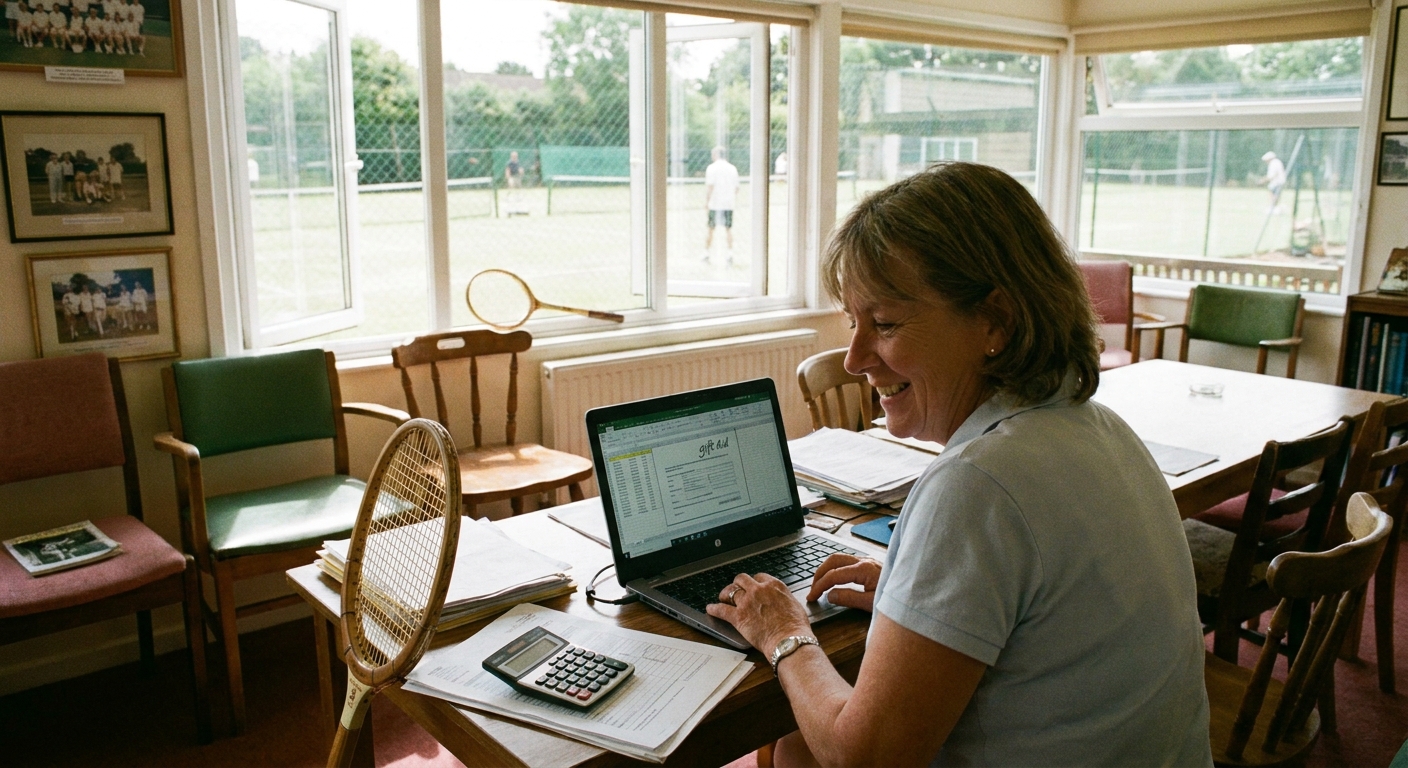
What Gift Aid Actually Is
Gift Aid is a UK government scheme that lets eligible clubs and charities reclaim the basic-rate tax a donor has already paid on a donation. In plain terms: when a UK taxpayer gives your club £1 as a genuine donation, HMRC will add another 25p on top, at no cost to the donor. Over a season of fundraising, junior tournaments and clubhouse appeals, that 25% uplift adds up to real money - and it is money your members have effectively already earned for you, sitting unclaimed with HMRC.
But Gift Aid is precise, and getting it wrong can mean repaying HMRC later. Two things trip clubs up most often: assuming any club can claim, and assuming Gift Aid applies to membership subscriptions and coaching fees. Neither is true. This guide walks through the rules carefully so you know what you can and cannot claim - and, just as importantly, where to get proper advice before you rely on any of it.
Step One: Are You Even Eligible?
This is the question that catches clubs out, so settle it first. To claim Gift Aid, your tennis club must be registered with HMRC as either a Community Amateur Sports Club (CASC) or a charity. An ordinary, unregistered members' club - however well run - cannot claim Gift Aid on anything.
The good news is that many tennis clubs already hold CASC status. A CASC is a sports club that HMRC recognises as open to the whole community, organised on an amateur basis and set up to promote participation in an eligible sport - which tennis is. Registering as a CASC unlocks a set of tax reliefs, and Gift Aid on qualifying donations is one of the most valuable. If you are not sure whether your club is a registered CASC, check before you do anything else: it is the foundation everything below stands on.
One reason CASC status matters especially for tennis clubs is property. Many clubs own or lease their courts and a clubhouse, which means they receive a business-rates bill. Registered CASCs are entitled to mandatory 80% business-rates relief on premises used for the club's purposes - a saving that, for a club with its own courts, can dwarf the Gift Aid recovered in a typical year. So CASC registration is worth understanding in the round, not just for Gift Aid. The trade-off is that CASC status comes with conditions on membership costs, income and how surpluses are used, so it is a committee decision to take with proper advice.
Step Two: What Counts - and What Does Not
Here is the part clubs most often get wrong. Gift Aid applies to genuine voluntary donations - gifts where the donor receives nothing significant in return. It does not normally apply to ordinary membership subscriptions or coaching fees, because those are payments for a benefit or a service: the right to play, to use the courts, to enter the clubhouse, or to receive coaching. A payment that buys something is not a gift, and Gift Aid is a scheme for gifts.
So a parent's £25 contribution to your "resurface the courts" fund can usually be Gift-Aided; their child's £180 annual junior membership generally cannot. A donation to a clubhouse appeal qualifies; the £8 a week someone pays for a coaching session does not. The line is whether the payment is a true gift or a purchase.
There are nuances. Some carefully structured arrangements can bring certain payments within scope, and the HMRC rules on "member benefits" - what a donor may receive in return for a Gift-Aided donation before it stops qualifying - are detailed and have monetary limits. This is exactly the territory where a qualified accountant or HMRC's own guidance earns its keep. Do not assume a subscription is Gift-Aidable because a neighbouring club told you theirs is; confirm it for your own club's specific setup.
If you are reviewing how your club charges members in the first place, our guide to setting tennis subs and coaching fees is a useful companion - it covers the pricing side, while this article covers what of that income, if any, can attract Gift Aid.
Step Three: The Gift Aid Declaration
You cannot claim Gift Aid on a donation without a valid Gift Aid declaration from the donor. The declaration is the donor's confirmation that they are a UK taxpayer and that they want your club to reclaim the tax on their gift. It can be made in writing, online or even verbally (with a written confirmation sent back), and one declaration can cover a single gift or be an enduring declaration covering past, present and future donations.
A valid declaration must contain certain details, or HMRC can reject the claim. At a minimum it needs to make clear:
Gift Aid Claim Checklist
- Confirm your status: the club is a registered CASC (or charity) with HMRC and is registered for Gift Aid. No registration, no claim.
- The donor's name and home address: at least their first initial, surname and house number or name and postcode - HMRC needs enough to identify them.
- Your club's name: the declaration must say which club it benefits.
- The donations it covers: a specific gift, or all gifts past, present and future under an enduring declaration.
- A clear Gift Aid statement: the donor wants the club to reclaim Gift Aid on their donations.
- The taxpayer confirmation: a statement that the donor is a UK taxpayer and understands that if they pay less Income Tax and/or Capital Gains Tax than the Gift Aid claimed on all their donations in a tax year, it is their responsibility to pay the difference.
- Keep the records: retain every declaration and a record of each donation to support your claims - generally for at least the last four years.
HMRC publishes model declaration wording, and it is sensible to start from theirs rather than inventing your own. Keep the signed or recorded declarations safe: in a Gift Aid audit, the declaration is the evidence that the claim was valid.
Step Four: Submitting the Claim Through HMRC Charities Online
Once you are registered, have qualifying donations and hold valid declarations, you claim through HMRC Charities Online. This is HMRC's digital service for charities and CASCs to reclaim Gift Aid. In outline, the process is:
Making the Claim, Step by Step
- Register for Gift Aid with HMRC if you have not already - this is separate from CASC registration and gives you access to claim.
- Record qualifying donations: donor name, amount and date, matched to a valid declaration.
- Log in to Charities Online through your Government Gateway account, or submit via compatible software that connects to HMRC.
- Enter the donation schedule using HMRC's spreadsheet template or your software's export, then submit the claim.
- Receive the repayment: HMRC pays 25p per qualifying £1, usually within a few weeks, straight into the club's bank account.
It is not difficult once set up, but it is fiddly, and the schedule of donations has to be formatted exactly as HMRC expects or the claim bounces. Most clubs claim once or twice a year and treat it as a treasurer's job - which is fine, but it does mean the money only lands when someone finds the time to do the paperwork.
A Word on the Small Donations Scheme
Worth knowing about, especially around open days and matchday collections, is the Gift Aid Small Donations Scheme (GASDS). This lets eligible CASCs and charities claim a Gift-Aid-style top-up on small cash and contactless donations - think collection tins and bucket collections - without needing a declaration for each one. It has its own annual limits and eligibility conditions and is separate from ordinary Gift Aid, but for a club that takes cash at events it can be a tidy extra. As with everything in this scheme, check the current limits and your eligibility with HMRC before you rely on it.
Take the Paperwork Off Your Plate
The single biggest reason eligible clubs leave Gift Aid unclaimed is not ineligibility - it is that nobody has the time to format the schedules and file the claim. This is one area where club software genuinely helps. Teamo (a club app made by the Sportplan team, the same company behind this site - so do weigh that) can automate the HMRC Gift Aid claim for your club via a partner integration, collecting declarations and filing the claim for you rather than leaving the treasurer to wrestle with spreadsheets twice a year.
One honest clarification, because the two are easy to confuse: Gift Aid is the tax reclaim described above. Separately, Teamo also offers a fundraising extension called Teamo Rewards, which is a different thing entirely - it can earn a club around £10 to £15 per adult member per season through partner offers. That is fundraising income, not Gift Aid, and the two should not be lumped together. We mention it only so you can tell them apart when you come across both.
The Cautious Bottom Line
Gift Aid can be a meaningful, recurring boost to a tennis club's finances - 25% on top of every qualifying donation, plus, for CASCs, the far larger prize of mandatory business-rates relief on your courts and clubhouse. But it rewards getting the details right: be a registered CASC or charity, claim only on genuine donations rather than subs and coaching fees, hold a valid declaration for every donor, and keep your records.
Because the rules on eligibility and member benefits are detailed and do change, treat this guide as an informed starting point, not formal advice. Before you build Gift Aid into your club's budget, confirm your specific position with HMRC or a qualified accountant. Get that right once and the claiming becomes routine.
If you are setting a club up from scratch, our starting a tennis club checklist covers CASC registration alongside the other founding steps, and if your fundraising is geared around the next generation, the guide to running a junior tennis programme shows where that money tends to go. When you are ready to plan the coaching itself, browse the full Tennis drills library for hundreds of practices sorted by skill.
Frequently Asked Questions
Can a tennis club claim Gift Aid?
Only if it is registered as a Community Amateur Sports Club (CASC) with HMRC, or as a charity. Many tennis clubs are registered CASCs, which is what makes Gift Aid possible. An unregistered, ordinary members' club cannot claim Gift Aid on anything. If your club has CASC status, you can claim 25p from HMRC for every £1 of qualifying donation a UK taxpayer gives you, provided they have made a valid Gift Aid declaration. Check your registration status before assuming you are eligible.
Does Gift Aid apply to membership subs or coaching fees?
Generally no. Ordinary membership subscriptions and coaching fees are payments for a benefit or a service - the right to play, use the courts or receive coaching - so they are not gifts and do not normally qualify for Gift Aid. Gift Aid applies to genuine voluntary donations where the giver receives nothing significant in return, such as a contribution to a clubhouse fund or a one-off gift. Some structured arrangements can qualify, but the rules on member benefits are strict, so check with HMRC or a qualified accountant before treating any subscription as Gift-Aidable.
What is a CASC?
A CASC is a Community Amateur Sports Club - a status a sports club can register for with HMRC if it is open to the whole community, organised on an amateur basis and exists to promote participation in an eligible sport such as tennis. Registering as a CASC unlocks tax reliefs, including the ability to claim Gift Aid on qualifying donations and, importantly for clubs that own their courts and clubhouse, mandatory 80% business-rates relief. CASC status is not the same as charity status, and the two cannot be combined.
How do I claim Gift Aid for my club?
You claim through HMRC Charities Online, the digital service for charities and CASCs. First make sure your club is registered with HMRC for Gift Aid and has collected a valid Gift Aid declaration from each donor. Then record the qualifying donations, log in to Charities Online (or submit through compatible software), enter the donation details and submit the claim. HMRC repays 25p for every qualifying £1. You must keep declarations and records to support each claim, usually for at least the last four years.
What is the Gift Aid Small Donations Scheme?
The Gift Aid Small Donations Scheme (GASDS) lets eligible CASCs and charities claim a Gift-Aid-style top-up on small cash and contactless donations without needing a declaration for each one - useful for collection tins and matchday buckets. It has its own annual limits and eligibility rules and is separate from ordinary Gift Aid. As with everything here, confirm the current limits and your eligibility with HMRC before relying on it.