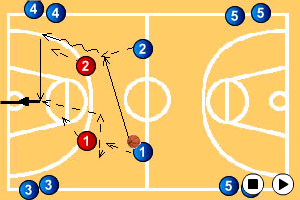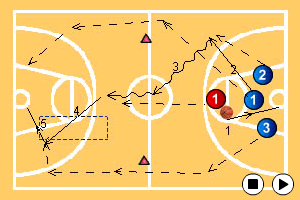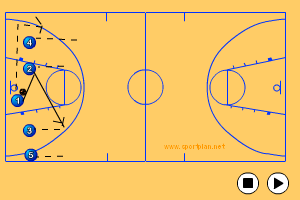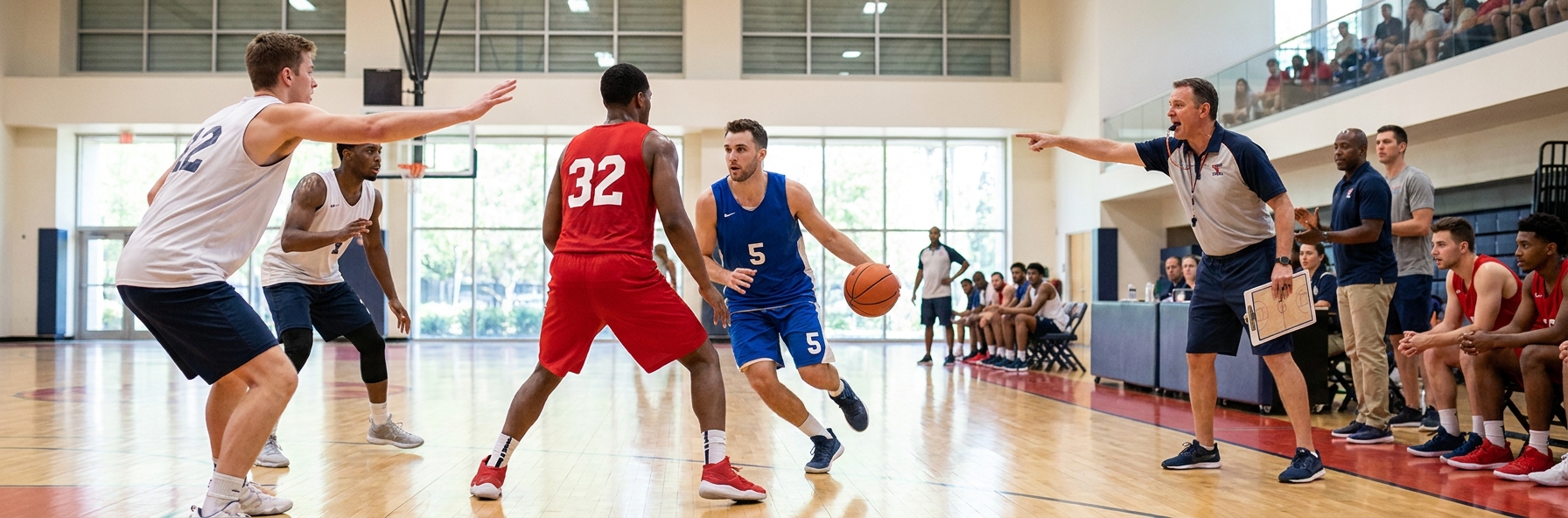
Almost half of every professional possession features a ball screen, and the rest of the game world has followed. Youth leagues, university programmes, and grassroots clubs all run ball screen offence as their primary action. Yet the way most teams teach it has not kept up. Coaches still draw set plays on the whiteboard, players memorise the route, and when the defence does something the play did not predict, the offence dies.
The teams winning in 2026 have moved on from memorised plays. They teach the read. They build a framework of decisions, repeat the framework in small-sided games until it is second nature, and then let the players choose the right answer in real time. This is the shift from "running offence" to "playing offence," and it is the most important conversation in coaching right now.
Why Set Plays Are Losing Their Edge
A set play is a script. It works beautifully against a defence that does not know what is coming, but modern defences scout, switch, and adapt. Defensive coaches now show their players the opposition's top five sets on video before every game. Once the defence recognises the action, the script falls apart and the player with the ball has nowhere to go because they were trained to follow steps, not to read.
A read-based offence is different. The ball handler is given a small number of triggers - what the on-ball defender does, what the screener's defender does, what the help is doing - and a small menu of responses to each trigger. The defence cannot scout the response because the response only happens once the defender commits. This is why the same five players can run effective offence against any coverage if they are taught to read.
The key shift: Stop calling the play. Start coaching the response. The play call becomes the starting position, not the script.
The Four Coverages Every Player Must Read
Before a young player can read the ball screen, they must recognise what they are reading. Teach the four core coverages explicitly. Use video. Walk through each one. Get the players to call out the coverage by name as soon as they see it. Until the defender's action becomes obvious to the offensive player, no read will be made.
Drop: The screener's defender sags into the lane and stays low. The on-ball defender chases over the screen. This coverage gives up the pull-up jumper above the screen and the pocket pass to the rolling big.
Hedge or Show: The screener's defender steps out hard at the ball handler, attempting to slow them down before recovering. This coverage gives up the snake dribble back to the middle and the short roll into the lane.
Switch: Both defenders exchange assignments. This coverage gives up the immediate mismatch - the small defender on the big in the post, or the big defender on the quick guard in space.
Blitz or Trap: Both defenders attack the ball handler aggressively. This coverage gives up the four-on-three behind the ball, with the screener slipping to the basket and a shooter relocating off-ball.
How to Coach It: Three Steps
The pathway from set play to read-based offence is shorter than coaches think. It does not require a different system. It requires a different question in practice.
Step one - Name the coverage: Start every ball screen drill by asking the player with the ball, "What coverage is that?" If they cannot answer, the drill stops. The cognitive task of recognising the defence must come before the physical task of attacking it. Do this for two or three sessions until naming the coverage is instant.
Step two - Constrained games: Run small-sided games where the defence is told what coverage to play, but the offence is not. Three-on-three with one screener. Tell the defence "drop tonight" or "switch tonight," and let the offence work out the answer through repetition. Then change the coverage without warning. The offence must read again.
Step three - Free play: Move to five-on-five where the defence can play any coverage. The offence has the same menu of responses they have rehearsed in the constrained games. The coach stops the play only when a clear read was missed, never to call a different action.
The Communication Layer
Read-based offence depends on communication. Silent teams are slow teams, regardless of talent. Players must talk in real time about what they are seeing and what they are about to do.
The ball handler should call out the coverage as soon as they see it - "drop," "switch," "blitz." The screener should call their decision - "roll" or "pop" - based on what their defender did. The off-ball players should call their movement - "lift," "corner," "45-cut" - so the ball handler knows where the safety valves are. This running conversation looks chaotic at first, but within two months a team that talks beats a team that does not, even with less talent on the floor.
Key Coaching Points
- Teach the four coverages by name before teaching any response - recognition comes first
- Replace set plays with small-sided games where the defence is constrained
- The play call is the starting position, not the script - the read decides what comes next
- Talking is non-negotiable - ball handler calls the coverage, screener calls the decision
- Stop the drill when the read is missed, not when a different play is wanted