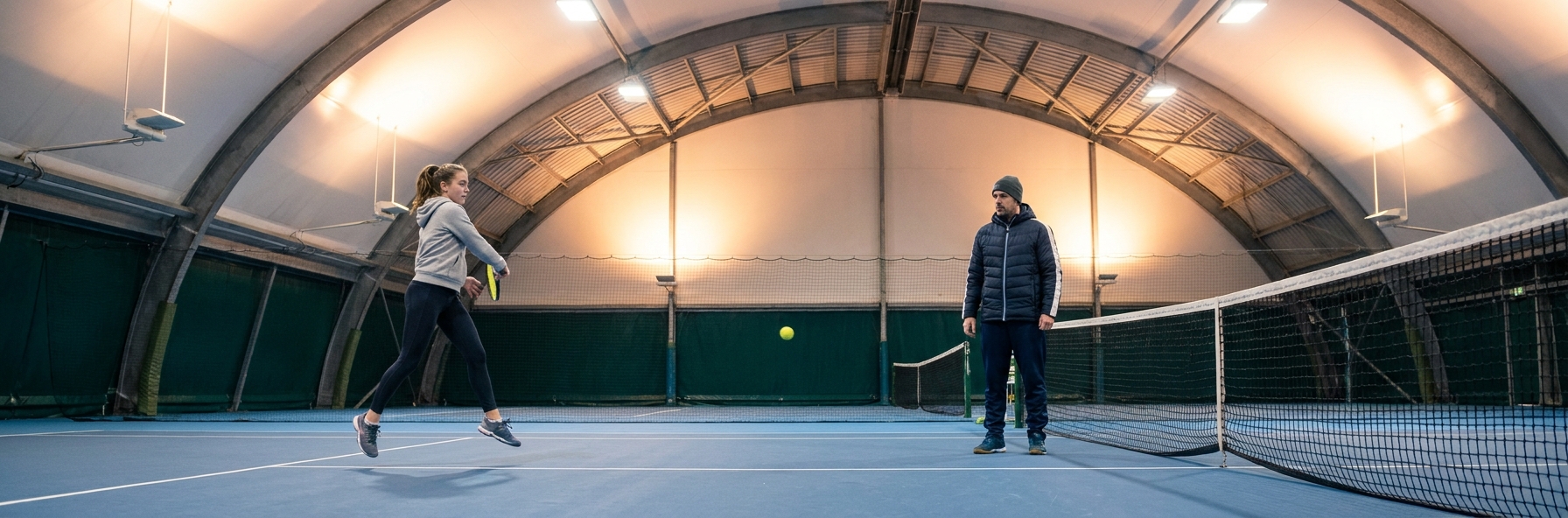
Every autumn the same thing happens. Players who were moving freely on outdoor courts in September step inside a dome or sports hall and suddenly look rushed. Balls skid through, swings arrive late, and the confident baseliner from the summer starts framing forehands and getting frustrated.
With the LTA winter competition season under way and many junior and club events now played at indoor venues, this is the moment to help players adjust. The good news is that indoor tennis rewards exactly the habits we want them to build anyway: early preparation, sharp footwork and a calm, organised mind.
Why Players Struggle When They Move Indoors
Indoor courts vary a lot, but many play quicker and lower than a damp outdoor court in autumn. There is no wind to slow the ball and the surface is often consistent, so the ball keeps its pace. That takes time away from the player, and a full, loopy summer swing simply does not fit.
Space changes too. Many indoor courts have less room behind the baseline and at the sides, so players who like to defend from deep get pushed into a position they are not used to. Add unfamiliar lighting, darker backdrops and the echo of other courts, and it is easy to see why some players lose confidence quickly.
Most of the problems are not technical faults. They are timing and positioning issues that show up as technical faults. Fix the footwork and the timing, and the strokes usually come back.
A Four-Step Framework for Winter Courts
Step One: Split earlier. The split step must land as the opponent strikes the ball, not after it. Indoors, a late split step costs a whole stride. Ask players to say "hit" out loud as the opponent makes contact and to be landing on that word.
Step Two: Turn first, swing second. Get the shoulders turning as soon as the direction of the ball is read. A quick unit turn sets the racket back without a big take-back, which keeps the swing compact and on time.
Step Three: Hold your ground. With less room behind the baseline, encourage players to stay closer to the line and take the ball earlier, on the rise where they can. Small adjustment steps matter more than big recovery runs.
Step Four: Reset between points. Indoor matches can feel fast and noisy. A simple routine of turning away, adjusting the strings and taking one slow breath before the next point helps players play the next ball rather than the last one.
Managing the Mental Shift
Many players judge their game by how it felt in the summer. Remind them that the first few indoor sessions are a period of adjustment, not a sign that they have got worse. Set process goals such as "split on every ball" or "early turn on every forehand" rather than outcome goals like winning sets.
Indoor tennis also takes away excuses. No wind, no sun and a true bounce mean that players can see the results of good habits quickly. Frame winter as a chance to build a sharper, more compact game that will travel back outdoors in the spring.
How to Train It
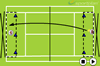
Warm-up (10 minutes): Mini tennis in the service boxes with an emphasis on a quiet split step and short, controlled swings. This also lets players adjust to the light and the bounce.
Technical (15 minutes): Shadow movement with split steps, followed by fed balls taken from on or just inside the baseline. Reward compact preparation over power.
Decision-making (15 minutes): Live cross-court rallies with a target zone just inside the baseline. Players score when they take the ball early and keep it deep, but lose the point if they retreat behind a marked line.
Game (15 minutes): Tiebreak play where each player must complete their between-point routine. The coach watches for players who rush the next point after a mistake.
Key Coaching Points
- Land the split step as the opponent strikes the ball, every single time.
- Turn the shoulders early to create a compact backswing that fits faster conditions.
- Stay closer to the baseline and use small adjustment steps rather than big retreats.
- Take the ball earlier where possible, keeping the head still through contact.
- Use a short, consistent routine between points to stay calm in a busy hall.
- Set process goals for the first weeks indoors so players judge effort, not results.
Recommended Drills
Frequently Asked Questions
Why do I keep hitting late on indoor courts?
Usually because the split step and turn are happening too late for the faster conditions. Split as your opponent hits the ball, turn your shoulders as soon as you read the direction and shorten the backswing. The swing itself rarely needs rebuilding.
Should I change my racket or strings for indoor tennis?
Most club and junior players do not need to. Focus on movement and timing first. If a player is consistently struggling for control after a few weeks, it is worth discussing string tension with their coach or stringer, but technique and footwork should come first.
How can I practise footwork if I only get one indoor session a week?
Shadow footwork at home works well. Practise split steps, unit turns and small adjustment steps for ten minutes a few times a week. It keeps the patterns sharp so your court time can be spent hitting balls rather than relearning movement.