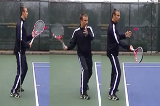
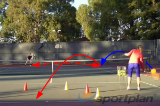
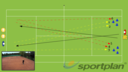
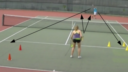
2 players use backhands to rally together in cross court direction . Player A picks the right moment to surprise the opponent and hits forehand angle inside out. After putting the opponent outside of the alley player A takes the next ball and finishes with backhand down the line.
Drill specifications:
1-2 minutes and switch
2 players can work on forehands and backhands at the same time so 1-2 minutes periods for switching are appropriate. Waiting players can perform some footwork exercises with the emphasis on running around footwork patterns based on crossover steps to improve the effectiveness of the angle shot while hitting.
Element of surprise doesn’t always have to be related just to picking the right shot. Sometimes specific and planned depth of the ball is not expected by the opponent so it can create a really offensive situation for the player. Only small group of the players know how to execute the forehand angle inside out and they are ready to use this skill when the pressure is on. As difficult this shot is players should train this ability that can be effectively used not only in individual matches but also while playing doubles. Roger Federer and Rafa Nadal are masters of this shot so their opponents never know what type of ball they will receive.
In this drill players work on adding surprising element into a tactical pattern. Running around the backhand and hitting forehands is mostly used to execute powerful shots into the opponents backhand to put the pressure and receive an easy ball to finish. That is why most of the players move few steps back behind the baseline if they see that opponent wants to use forehands stroke from the backhand side. Hitting forehand angle inside out is the last option that rival is considering so reaction and shot selection will be always impaired. Coach should explain to players that they should look for the right ball and use heavy spin to put the opponent outside the alley. After the successful shot player prepares to finish the pattern with the next down the line shot. Coach should encourage players to hit the ball as early as possible to cut the opponent’s recovery time. Power of the last shot has to be adjusted to the positioning of the rival.
Indoor courts give players less time and less room. Help them sharpen their split step, shorten their swing and stay calm, and winter becomes a season of real progress.
A tiebreak is a short sprint where every point is worth the same as a break of serve. The players who win them are rarely the ones who hit hardest. Here is how to coach the patterns, habits and scoreboard thinking that win the big points.
Most club players practise the serve on its own and then have no idea what to do with the ball that comes back. Serve plus one is the pattern that turns a good serve into a won point.


Register for FREE and get coaching tips, top drills, session and more every week!