You Have Said Yes. Now What?
Somebody had to do it, and that somebody is you. Maybe your own child wanted to play and there was no team, or the coach who used to run the group stepped down, or you simply put your hand up at the wrong moment in a meeting. Either way, you are now responsible for a group of young basketballers - and most of what that involves has nothing to do with basketball.
The good news: thousands of volunteers do this every season with no special background, and a first season is far more manageable when you tackle it in order. This guide walks through that order - getting set up properly, solving the one hurdle that trips up every new basketball team (court time), buying sensible kit, planning sessions, handling parents and fixtures, and keeping the money straight. Take it a step at a time and none of it is as daunting as it looks from the outside.
Step One: Get Set Up Properly
Before a single ball bounces in a competitive fixture, a handful of foundations need to be in place. None is complicated on its own; the mistake is leaving them too late.
Affiliate and register through a club
Basketball England is the governing body for the sport in England, and competitive junior basketball runs through clubs affiliated to it. In practice you do not affiliate as a lone team - you either join an existing affiliated club or, if you are genuinely starting from scratch, set one up. Affiliation brings the things you cannot easily arrange yourself: player registration, eligibility to enter sanctioned leagues, and crucially the insurance cover that lets you run sessions and fixtures. If you are building a club rather than joining one, work through our starting a basketball club checklist first - it covers the constitution, committee and registration steps in order.
The coaching qualification
You do not need to be a former international to coach juniors, but you do need the entry-level coaching qualification. Basketball England runs an introductory coaching award designed exactly for new volunteers - it gives you the basics of running a safe, fun session and the credibility leagues and parents expect. Book onto a course early in your planning; spaces fill up before the season starts, and most leagues will want at least one qualified coach attached to the team.
DBS and safeguarding
This one is non-negotiable. Anyone coaching or regularly helping with under-18s needs an enhanced DBS check, arranged through your club rather than applied for personally, plus safeguarding training. Your club should also have a nominated welfare officer. None of this is bureaucratic box-ticking - it is the basic duty of care that protects the children, the volunteers and the club itself, and most venues and leagues will ask to see that it is in place before you take to the court.
Find a league
Junior teams need somewhere to play beyond training. Most areas have a local junior or schools league, an age-group festival circuit, or development sessions run through Basketball England's local network. Find yours early, because the fixture calendar and age-group rules will shape everything from how you select your squad to when your season actually starts.
Step Two: Secure Court Time (The Real Hurdle)
Here is the truth no recruitment leaflet tells you: in basketball, the single hardest and most expensive thing to organise is somewhere to play. Unlike grass sports with a field at the end of the road, basketball needs an indoor sports hall with marked courts and decent hoops - and those are in short supply and high demand. Securing a regular slot is the make-or-break task of your first season, so start on it before almost anything else.
Work through the likely venues in order. Local secondary schools and academy sports halls are usually the best bet - many hire out evenings and weekends, and a fixed weekly booking is far cheaper per hour than ad-hoc hire. Leisure centres and sixth-form or further-education colleges are the next ports of call. When you find a slot, book it as a regular fixed time rather than week by week, so families can plan their lives around it and you are not gambling on availability each Saturday.
Get the hire agreement, the cancellation terms and the insurance requirements in writing, and budget honestly - hall hire will almost certainly be your single biggest cost, often the bulk of your entire season's outgoings. If nothing is available locally, the quickest route in is frequently to share a venue and a slot with an existing club. It is less than ideal, but a shared court beats no court.
Step Three: Kit and Equipment
You can run your first sessions with surprisingly little, and you should resist the urge to over-buy before you know your numbers. A sensible starter kit for a junior team looks like this:
Your First-Season Kit List
- A matched set of reversible vests or strips: reversibles are the single best value buy - one set covers both "teams" in training and saves you owning two strips. Get enough for your largest likely session.
- A bag of balls sized for the age group: juniors use smaller, lighter balls than adults (size 5 for younger children, size 6 for older juniors and girls, size 7 for older boys). One ball per two players is the realistic minimum for a good session.
- A pump (and spare needles): obvious, easily forgotten, and the difference between a session and a sulk when half the balls are flat.
- Cones: a couple of dozen for marking out drills, channels and stations. Cheap and endlessly useful.
- A first-aid kit: properly stocked and checked, taken to every session and fixture. Non-negotiable.
That is genuinely enough to start. Bibs, scoreboards, portable hoops and branded kit can all come later, funded as your subs settle and you know how many children are actually turning up each week.
Step Four: Planning Sessions
With the foundations and court sorted, the part you signed up for begins. The trap most new coaches fall into is winging each session, which burns you out and bores the players. A simple repeatable structure fixes that: a short warm-up, a skill focus, a small-sided game that applies the skill, and a cool-down. Plan it once, reuse the shape every week, and just swap the skill focus.
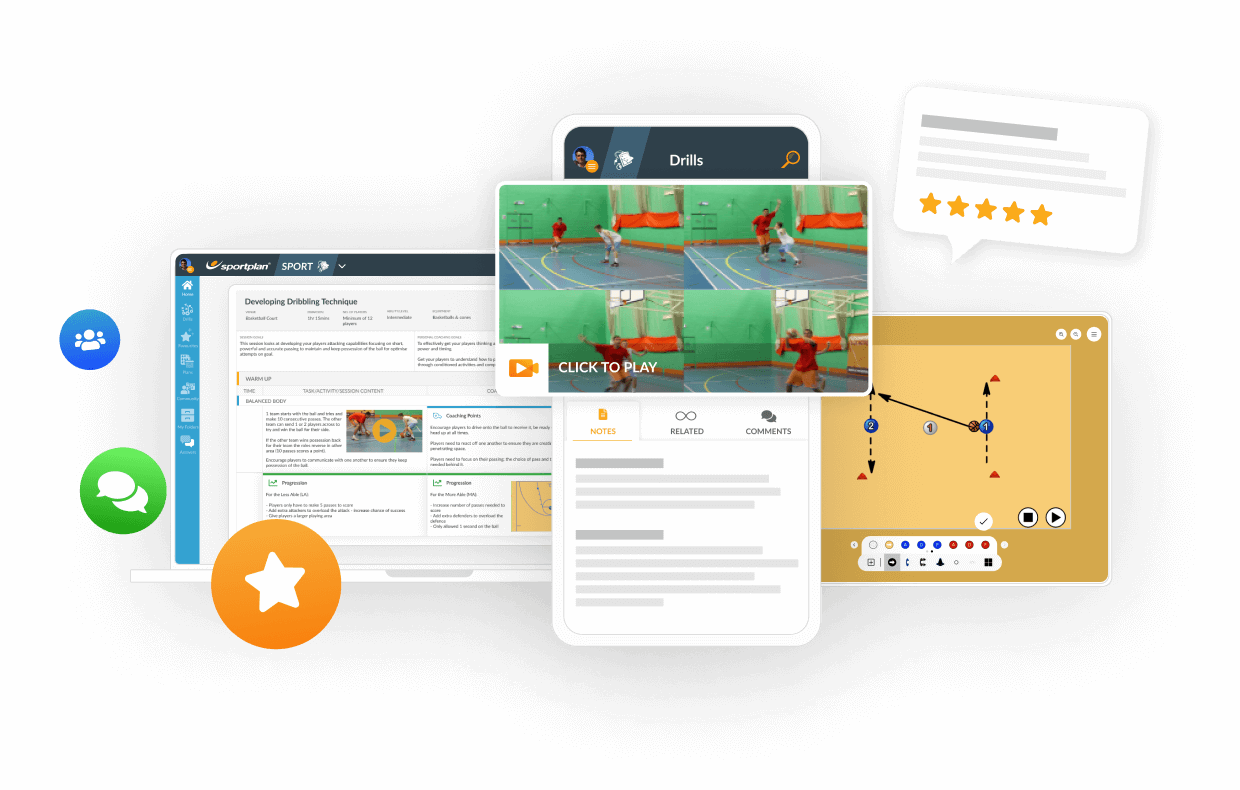
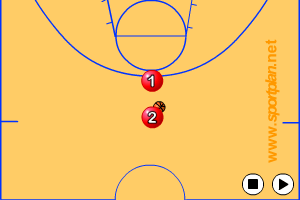
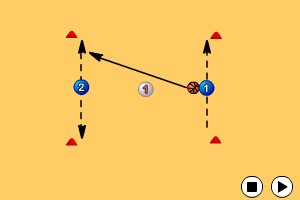
Our free basketball session plan template gives you that structure ready to fill in, and the junior basketball drills guide is full of age-appropriate practices to drop straight in. Two reliable starting points for a young squad:
Browse the full Basketball drills library for hundreds more sorted by skill and theme as your players progress.
Step Five: Managing Parents
Parents can be your greatest asset or your biggest headache, and which one usually comes down to how clearly you set expectations at the start. At your very first session, be upfront: arrival times, what to bring, behaviour on the sideline, how subs are paid and how you will communicate. Written down once, this heads off most of the friction before it starts.
Then recruit. You cannot run a junior team alone, and you should not try. A team manager to handle fixtures and logistics and a treasurer to handle the money will transform your season - and the parents are right there. Ask early, ask specifically, and most will say yes if the job is well defined.
Step Six: Fixtures and the Admin Bridge
Once the league starts, the weekly churn kicks in: who is available this Saturday, has everyone paid their session fee, where is the fixture and who is giving lifts. This is where most volunteers quietly drown - not in the coaching, but in the chasing.
The traditional answer is a WhatsApp group for chat and a spreadsheet for the money, and for a brand-new team that is a perfectly reasonable start - it is free and everyone already has it. The catch is that everything is manual. You re-ask availability every week and count thumbs-up emojis, you chase unpaid fees by hand, and important notices vanish into a 200-message scroll. Most teams outgrow it within a season.
A purpose-built club app pulls availability, subs and session fees, registration and parent communication into one mobile-first place - which matters when roughly nine in ten parents will only ever open it on a phone. One option worth a look is Teamo, which keeps the whole club's admin in one app: availability, payments and notices together, with online registration and a treasurer view, free for up to 25 members with no adverts. In fairness we should say it openly - Teamo is built by the Sportplan team behind this site, so weigh that and trial a couple of tools before you commit. Whatever you choose, just be consistent: one channel, used every time, beats three channels used half-heartedly.
A quick word on fixtures specifically: a club app helps you run them as a shared calendar with availability and automatic reminders, but it is not your governing-body record. Basketball England affiliation, player registration and your league's official results system remain the system of record - keep them running alongside whatever app you pick, and do not confuse the two.
Step Seven: The Money and Admin
Finally, the money - which underpins everything above. Court time, affiliation, registration, insurance, qualifications and kit all cost real pounds, and a junior team that does not set its subs to match those costs runs out of road by spring. Build a simple budget early: add up your fixed annual costs and your weekly hall hire, divide across your expected squad, and set termly or monthly subs plus a modest per-session fee accordingly. Keep a small buffer for kit replacement and the odd extra hall booking.
Our guide to setting basketball subs and session fees walks through the sums in detail, including how to keep collection painless and what a fair fee actually looks like. Get the budget right at the start of the season and the money side quietly takes care of itself - which is exactly what you want, because you signed up to coach basketball, not to chase fivers.
You Can Do This
It is a lot on paper, but it comes in order and most of it is once-a-season setup. Sort the foundations, fight hard for a good regular court slot, buy sensible starter kit, build a repeatable session shape, set expectations with parents and get the admin onto one tidy system. Do that, and by mid-season the running of the team fades into the background and the bit you came for - watching young players fall in love with the game - takes over. Welcome to coaching.
Frequently Asked Questions
What do I need to start a junior basketball team?
At a minimum you need: a venue with court time booked, affiliation through a club registered with Basketball England, at least one coach holding the entry-level coaching qualification, a DBS check and safeguarding training for anyone working with under-18s, public liability insurance (usually covered by affiliation), and basic kit - a matched set of reversible vests, a bag of age-appropriate balls, a pump, cones and a first-aid kit. A league or local festival circuit to play in completes the picture. None of it has to be perfect for your first session; court time and a safeguarding-checked coach are the two things you genuinely cannot start without.
Do basketball coaches need a DBS?
Yes. Anyone coaching or regularly supervising children in basketball needs an enhanced DBS check, almost always arranged through the club you affiliate with rather than applied for personally. Alongside the DBS you should complete safeguarding training and the club should have a nominated welfare officer. This is not optional box-ticking - it is the baseline that protects the children, the volunteers and the club, and most leagues and venues will ask to see that checks are in place before you play.
How do I find court time for a basketball team?
Court time is the scarcest, most expensive resource in junior basketball, so start early. Approach local secondary schools and academy sports halls first - many hire out evenings and weekends and a regular weekly booking is cheaper than ad-hoc hours. Leisure centres and sixth-form colleges are the next port of call. Book a fixed regular slot rather than week-by-week so families can plan, get the hire agreement and insurance requirements in writing, and budget realistically - hall hire is usually your single biggest cost. If nothing is available locally, sharing a venue and slot with an existing club is often the quickest way in.
How much does it cost to run a junior basketball team?
The big recurring cost is court time, which in many areas runs anywhere from £25 to £60 or more per hour for a sports hall, so a weekly session quickly becomes the bulk of your budget. On top of that you have annual affiliation and player registration through Basketball England, insurance (often bundled with affiliation), coaching qualifications and DBS checks, and one-off kit - reversible vests, a bag of balls, a pump, cones and a first-aid kit. Most junior teams cover this through termly or monthly subs plus a small per-session fee. Build a simple budget early, set subs to match real costs, and keep a modest buffer for kit replacement.
How do I manage parents and communication for a junior team?
Set expectations at the very first session: arrival times, kit, behaviour, how subs are paid and how you will communicate. Then pick one channel and stick to it. Many new teams start with a WhatsApp group and a spreadsheet, which is free and familiar but quickly becomes a manual grind of chasing payments and re-asking availability every week. A purpose-built club app keeps availability, payments and notices in one place and cuts the admin dramatically. Whatever you choose, be consistent, give parents plenty of notice for fixtures, and recruit one or two of them early as helpers - a team manager and a treasurer will save your season.