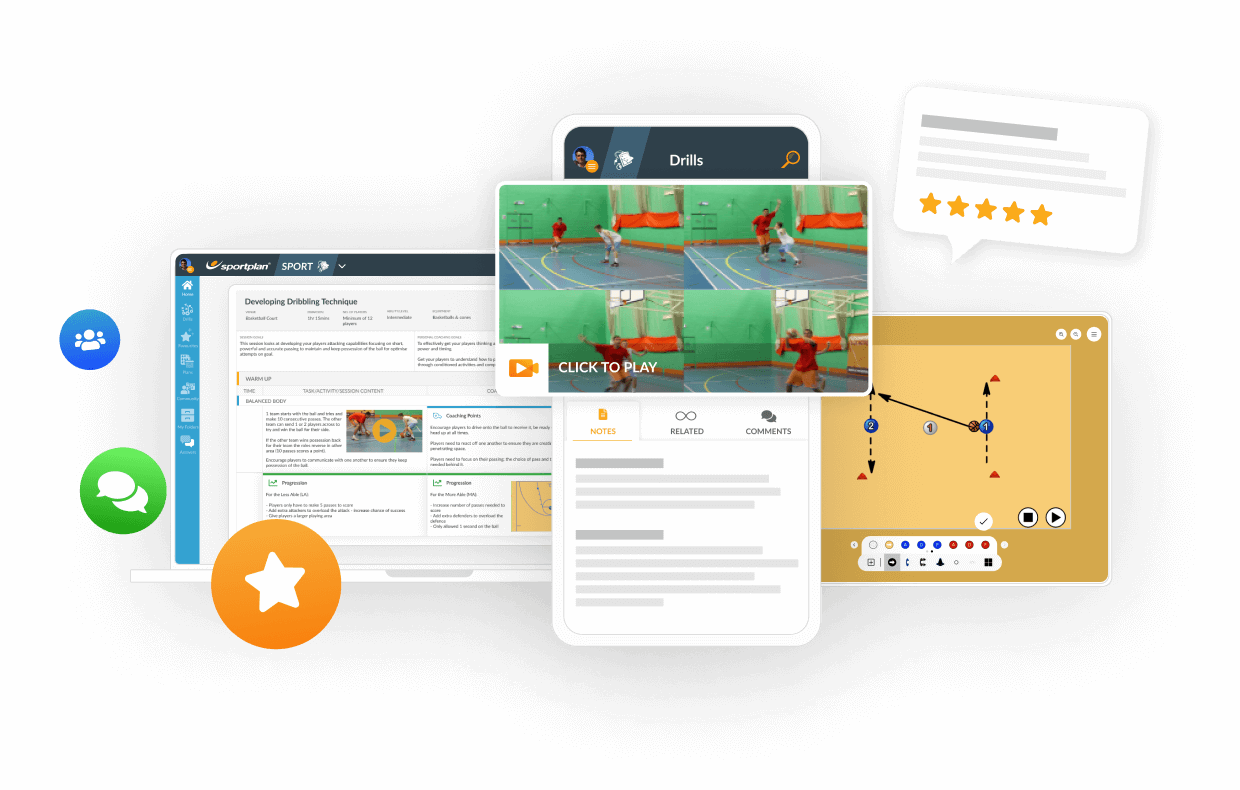
A Session You Can Run Every Week
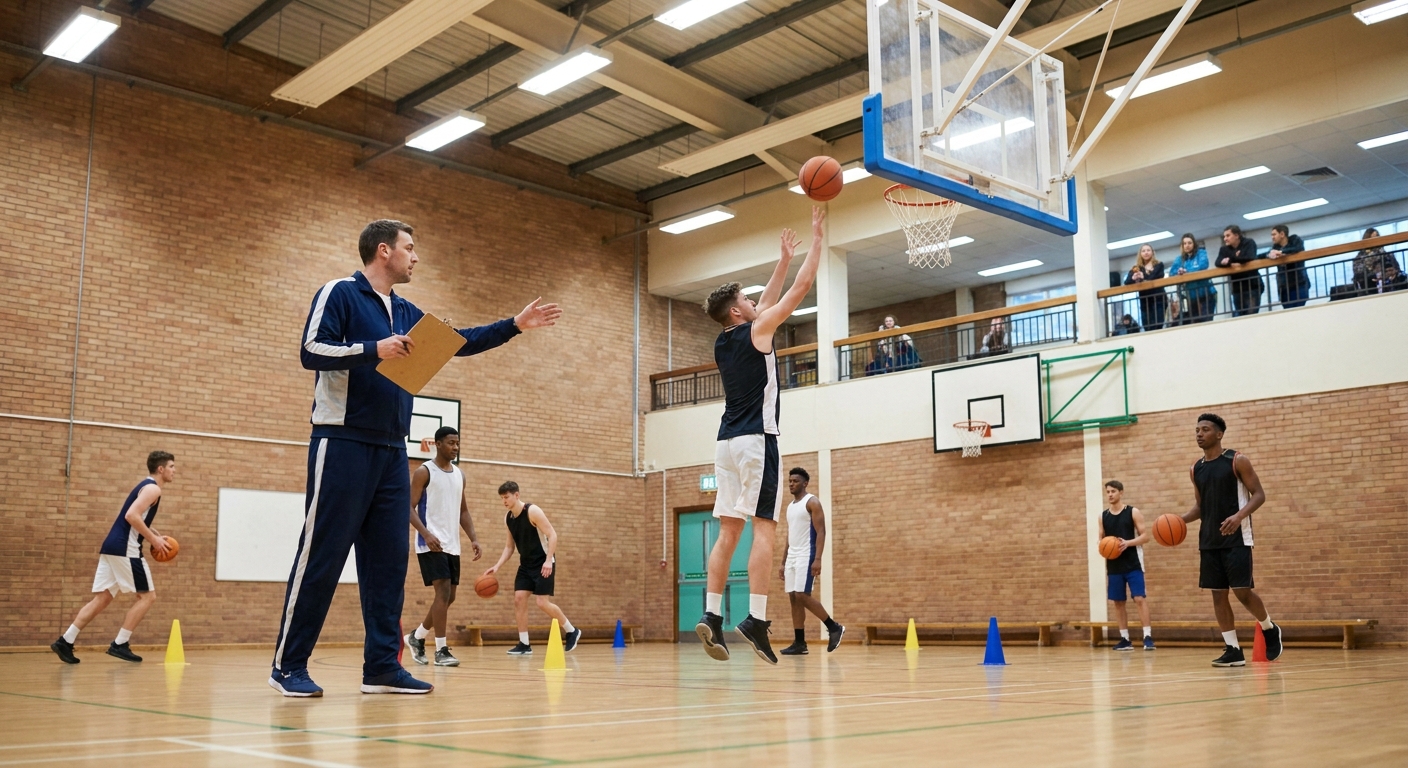
Most club basketball happens in a hired sports hall, in a slot of 60 to 90 minutes, with more players than baskets. That combination shapes everything. Court time is expensive and short, so the cardinal rule of a good session is simple: keep everyone busy and minimise queueing. A drill where eight players watch one player shoot is a drill that wastes seven-eighths of your evening.
This template gives you a repeatable five-phase structure you can lean on every week. You keep the shape the same - warm-up, individual skill, skill under pressure, game, review - and simply swap the drills inside it to match your theme. Players quickly learn the rhythm of the session, which means less time spent explaining and more time spent playing. Below we explain why each phase exists, how to run stations so a big group stays active on limited hoops, and how to adapt the whole thing for mini-basketball juniors versus older, competitive players. Then we drop a complete worked example into the skeleton.
The Five-Phase Template
Here is the skeleton. The minute ranges flex to fit a 60-minute or a 90-minute slot - tighten the game and skill phases for a shorter session, stretch them for a longer one. Pick one theme for the night and make sure each phase feeds into it.
60-90 Minute Club Session Skeleton
- 1. Warm-up & ball-handling (10-15 min): Raise the heart rate, mobilise ankles, knees and hips, and get a ball in every pair of hands from the first minute.
- 2. Individual skill - dribbling, shooting, footwork (15-20 min): Maximum touches on the core technique you are developing. Run this as stations so nobody waits.
- 3. Skill in pairs or small groups under pressure (15 min): Add a defender or a decision, so the skill has to hold up against live opposition.
- 4. Small-sided game / scrimmage (15-20 min): 1v1, 2v2 or 3v3 so players apply the theme in a real, competitive context with far more touches than 5v5.
- 5. Cool-down & review (5 min): Lower the heart rate, light stretching, and three sentences on what went well and one thing to work on next week.
Phase 1 - Warm-up & ball-handling: why it matters
The warm-up does two jobs at once. It physically prepares the body - basketball is full of sudden stops, jumps and changes of direction, and cold ankles and knees get hurt - and it switches players on technically. Hand every player a ball in the first minute so you warm up the hands and eyes alongside the legs. Light jogging, defensive slides and dynamic stretches mobilise the joints; ball-handling and partner passing wake up the touch. It also sets the tone: a busy, ball-in-hands start tells the group this is a no-standing-around session.
Phase 2 - Individual skill: why it matters
This is where players actually get better. Dribbling, shooting and footwork improve through volume of repetition, so this phase is all about maximising touches. With a big group and few hoops, you must run it as stations (more on that below). Reserve the baskets for shooting and finishing work and put the non-shooting skills - ball-handling, dribble moves, footwork - in the open floor where no hoop is needed.
Phase 3 - Skill under pressure: why it matters
A skill that only works unopposed is not yet a skill. Adding a defender or a decision turns a clean technique into something that holds up in a game. Pairs and small groups are ideal here: a 1v1 with a passer, a 2v2 keep-away, a defender closing out. Players keep the high touch count of phase two but now have to read, time and execute against live resistance.
Phase 4 - Small-sided game: why it matters
Small-sided games are the single best use of limited court space. A 5v5 full-court game gives each player relatively few meaningful touches; a 1v1, 2v2 or 3v3 gives them many times more involvement, more decisions and more shots. Keep the game tied to the night's theme - if you have been working on finishing, score it so that completed finishes count double. This is where the evening's learning gets tested under genuine competition, and it is usually the part players enjoy most.
Phase 5 - Cool-down & review: why it matters
Five minutes well spent. A light jog and some static stretching bring heart rates down and help recovery. The review matters just as much: name one thing the group did well and one focus for next time. Keep it short and specific. Players leave knowing what they were working on and why - which makes the next session easier to set up.
Running Stations on Limited Hoops
The single biggest practical problem in club basketball is too many players and too few baskets. Stations are the answer. Split the squad into small groups and set up a circuit where some stations use a hoop and some do not, then rotate the groups on a timer - every five or six minutes works well - so every hoop is always busy and no queue is more than two or three players deep.
The trick is remembering how much good work needs no basket at all. Ball-handling, dribbling channels, passing in pairs, footwork patterns and defensive slides can all happen in empty floor space. Reserve your baskets purely for shooting and finishing, and keep the rest of the group active on those non-shooting skills, swapping groups round on the whistle. With two baskets and twelve players you can run, say, four stations of three: one finishing at each hoop, one ball-handling and one passing-under-pressure in the middle - and nobody stands still.
Adapting for Mini-Basketball vs Competitive Players
The same skeleton serves a mini-basketball session and an under-16s competitive squad - you simply change the dials.
For mini-basketball juniors, shorten everything and make it playful. Use lower baskets and smaller, lighter balls, keep each activity to a few minutes before you change it, and lean on games and tag-style drills rather than long technical explanations. Demonstrate rather than talk, keep instructions to one or two cues, and prioritise fun and a high number of touches over polished technique. A noisy, smiling, busy hall is exactly what you want.
For older and competitive players, lengthen the phases, add tactical detail, and make the contest harder. The game phase can grow to a full 3v3 or a small-sided game with specific scoring conditions, the skill work can carry more decision-making, and the review can go deeper into what to fix. These players can hold concentration for longer blocks, so you get more out of fewer, longer drills. Our guide to basketball positions is useful here if you want to start tailoring skill work to the role a player will fill.
Worked Example: "Sharpening 1v1 Attacking and Finishing"
Here is the template brought to life. The theme is one-on-one attacking and finishing at the basket - a skill that runs right through the session, from the warm-up touch to the final game. Every drill below is a real, verified Sportplan practice; drop them straight into the five phases. This example assumes a 75-minute slot and a group split across two baskets.
Phase 1 - Warm-up & ball-handling (12 min)
Get balls in hands immediately and warm up the hands, eyes and legs together with partner passing on the move.
Phase 2 - Individual skill: finishing off the dribble (18 min)
Run this at the baskets as a station, rotating small groups so each hoop stays busy. Players drive in and finish, working the footwork and the shot under control. Keep non-shooting groups on a ball-handling station in the open floor and swap every five or six minutes.
Phase 3 - Skill in pairs under pressure (15 min)
Now add a live defender. Players attack one-on-one from the wing, reading the defence and finishing against real resistance. High touch count, clear contest, and a direct rehearsal for the game phase to come.
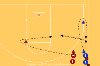
Phase 4 - Small-sided game: continuous 1v1 (20 min)
Apply it all in a competitive, high-volume game. Continuous one-on-one keeps every player involved with very few standing still, and you can score it so a clean finish counts double to reward the theme.
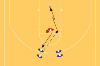
Phase 5 - Cool-down & review (5 min)
Light jog and static stretching, then a quick huddle. Praise one thing the group did well - perhaps the change of pace into the finish - and set one focus for next week, such as finishing with the weaker hand. Done.
Swap those four drills for a different theme and the same five phases serve you all season. If you want a deeper bank of practices to plug in, the basketball drills for juniors guide is full of session-ready ideas, and you can browse the full Basketball drills library for hundreds more sorted by skill - dribbling, shooting, passing, footwork, defence and games.
Frequently Asked Questions
How long should a basketball training session be?
For most club sessions, 60 to 90 minutes is the sweet spot. A 60-minute slot works well for younger juniors whose concentration fades, while 75 to 90 minutes suits older or competitive players who need time for a proper game phase. Whatever your slot, build in a warm-up of 10 to 15 minutes, a chunk of individual and small-group skill work, a small-sided game, and a short cool-down and review. The key with any sports-hall booking is to keep everyone moving - court time is expensive, so design the session so nobody is standing in a queue waiting for a turn.
How do I run a basketball session with limited hoops?
Run stations. Split the group across the hoops you have and add stations that do not need a basket at all - ball-handling, dribbling channels, passing in pairs and footwork can all happen in open floor space. Rotate small groups round the stations on a timer so every hoop is always busy and no line is more than two or three players deep. If you only have one or two baskets for a big group, reserve them for shooting and finishing work and keep the rest of the squad active on non-shooting skills, swapping groups every five or six minutes.
What should a basketball warm-up include?
A good basketball warm-up raises the heart rate, mobilises the ankles, knees and hips, and gets a ball in every player's hands early. Start with light movement - jogging, side-steps, defensive slides - then add dynamic stretches, and finish with ball-handling and partner passing so players are switched on technically as well as physically. Giving each player a ball from the first minute means you warm up the hands and eyes at the same time as the legs, and it sets the tone that this is a busy, no-standing-around session.
How many drills should be in one basketball session?
Fewer than you might think. Four to six drills across a 60 to 90 minute session is plenty. Each phase needs enough time for players to get repetitions and actually improve, so cramming in eight or nine drills usually means nobody masters any of them. Pick one clear theme for the session, choose drills that build towards it, and let players get hundreds of touches on a small number of well-chosen practices rather than a handful of touches on lots.
How do I adapt a session for mini-basketball juniors?
For mini-basketball, shorten everything and make it playful. Use lower baskets and smaller, lighter balls, keep each activity to a few minutes before changing, and lean on games and tag-style drills rather than long technical breakdowns. Keep instructions short, demonstrate rather than explain, and prioritise fun and lots of touches over polished technique. Older and competitive players can handle longer phases, more tactical detail and a bigger, more contested game at the end.