The Two Main Serve Types and Their Tactical Roles
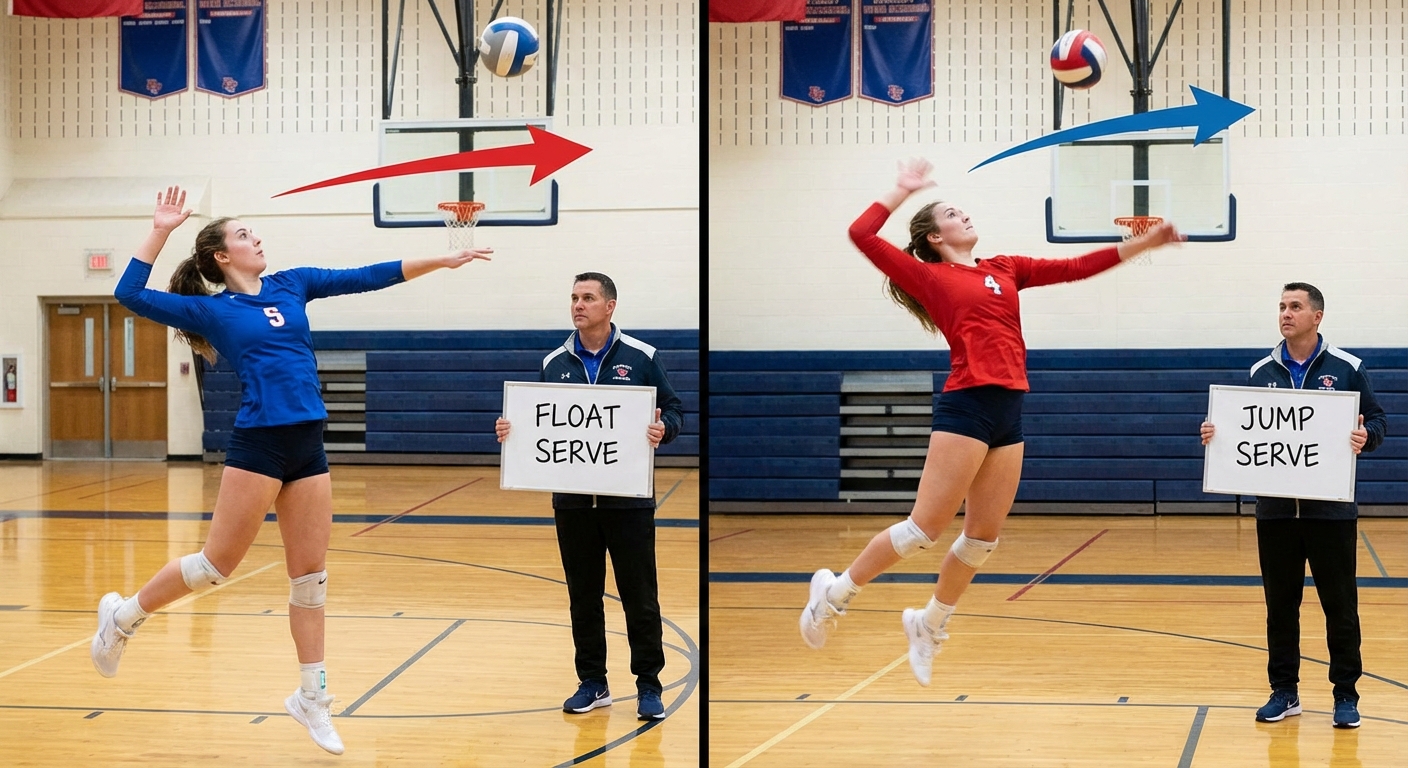
Every volleyball serve falls into one of two fundamental categories: the float serve and the jump serve. Each has distinct mechanical characteristics that produce different ball behaviours, and each is tactically suited to different match situations. The best serving teams in volleyball do not rely exclusively on one type - they develop players who can execute both and make intelligent choices about which to use based on the score, the opponent, and the match situation.
Understanding these two serve types, their strengths, their weaknesses, and the situations that favour each one is essential knowledge for every coach. The serve is the only skill in volleyball where one player has complete control of the outcome, and maximising that advantage through smart serve selection can be the difference between winning and losing tight sets.
The Float Serve: Technique and Why It Works
The float serve is characterised by the absence of spin on the ball. When a volleyball travels through the air without rotation, it becomes subject to aerodynamic forces that cause it to move unpredictably - drifting left, right, dropping suddenly, or accelerating. This movement is caused by the same principle that makes a knuckleball in baseball so difficult to hit: the seams of the ball interact with the air differently depending on their orientation, creating irregular pressure zones that push the ball in varying directions.
The Standing Float Serve Technique
The standing float serve begins with the player behind the end line, feet shoulder-width apart, with the non-hitting hand holding the ball at shoulder height. The toss is low and consistent - only one to two feet above the hitting hand's contact point. A high toss introduces unnecessary variables. The hitting arm draws back with the elbow high, and the hand contacts the ball with a firm, flat palm directly through the centre of the ball. The critical point is that there must be no wrist snap at contact. The hand must remain rigid and flat, pushing through the ball rather than wrapping around it. Any wrist action creates spin, and spin defeats the entire purpose of the float serve.
The Jump Float Serve
The jump float adds a small approach and jump to the standing float, generating more power while maintaining the spinless ball flight. The player takes a two or three-step approach, tosses the ball slightly forward and above, and contacts it at the peak of a controlled jump. The contact point and hand position are identical to the standing float - firm, flat, no wrist snap. The jump float is the most commonly used serve in competitive volleyball because it combines the unpredictable movement of the float with enough velocity to challenge passers.
Why the Float Serve Is So Hard to Pass
Passers rely on reading the trajectory of the ball to position their platform and absorb the serve. A spinning ball follows a predictable arc - topspin pulls the ball down, sidespin curves it laterally. Passers can read these trajectories and adjust. But a float serve has no predictable trajectory. The ball can change direction multiple times during its flight, making it almost impossible for the passer to set their platform accurately until the ball is very close. This late adjustment leads to shanked passes, overhand passing errors, and poor first-ball contact that limits the opposing team's offensive options.
The Jump Serve: Power and Risk
The jump serve is volleyball's most aggressive serving weapon. It combines a full approach, a powerful jump, and a topspin arm swing to produce a serve that can reach speeds of over 100 kilometres per hour at the professional level. The ball arrives faster, with heavy topspin that pulls it down sharply after clearing the net, compressing the passer's reaction time to fractions of a second.
Jump Serve Technique
The jump serve uses an approach similar to a spike. The player stands behind the end line, tosses the ball high and forward (approximately two to three metres in front of them and four to five metres above), then executes a full attacking approach. The contact is made at the peak of the jump with a full arm swing and aggressive wrist snap over the top of the ball, creating heavy topspin. The player lands inside the court, which is legal because the ball must only be contacted while the server is behind or above the end line.
The Risk-Reward Equation
The jump serve's greatest strength is also its greatest weakness: it is high-risk. Because the toss is higher and further from the body, and because the full approach and swing introduce more variables, the jump serve has a significantly higher error rate than the float serve. At most competitive levels, a jump serve error rate of 15-20% is considered acceptable, meaning one in every five or six serves goes into the net or out of bounds. A float serve error rate, by contrast, is typically below 5%.
This risk equation means that the jump serve must generate enough direct points and poor passes to offset the free points given away through errors. If a jump server is acing the opponent or forcing broken plays regularly, the error rate is justified. If they are making errors without generating corresponding pressure, the float serve becomes the smarter tactical choice.
Match Situations That Favour Each Serve Type
When to Float Serve
Late in close sets: When the score is tight (22-22, 24-23), the cost of a serving error is catastrophic. The float serve's reliability makes it the preferred choice in high-stakes situations where keeping the ball in play is more important than generating an ace.
Against strong passing teams: Teams with elite passers can handle the speed of a jump serve because they have the reaction time and platform control to absorb it. Against these teams, the float serve's unpredictable movement is often more effective than raw power because it disrupts their passing rhythm at the source.
After a timeout or substitution: These stoppages break the serving rhythm. Starting with a reliable float serve after a break ensures the server gets back into the game smoothly and puts the ball in play, maintaining pressure without risking an error on the first serve back.
When targeting a specific passer: The float serve offers more directional control than the jump serve, making it easier to target a weak passer or a seam between two passers. When the tactical priority is placement over power, the float serve is the better tool.
When to Jump Serve
Early in sets when confidence is high: The first few points of a set are a good time to establish the jump serve because the risk of an error is less consequential than at 23-all, and a strong serve run early can set the tone for the entire set.
Against weak passing teams: If the opposing team's passers struggle with speed and power, the jump serve exploits this weakness directly. There is no tactical reason to reduce pressure on a team that cannot handle it.
When your team needs momentum: An ace or a service error create energy in different ways. When your team is flat and needs a spark, an aggressive jump serve - even with the risk of an error - can shift the emotional momentum if it produces a point or forces a broken play.
When you have a comfortable lead: Leading 20-15 provides a cushion where the risk of a serving error is manageable. This is the time to be aggressive and try to close the set quickly with jump serve pressure rather than allowing the opponent back into the set with conservative serving.
Training Both Serve Types
Float Serve Training Priorities
The float serve is a consistency skill. Training should focus on repetition with targets. Place cones or towels in the six zones of the court and have servers aim for each zone in sequence. Track accuracy percentages over time. A competitive float server should be able to hit their intended zone 60-70% of the time while maintaining an error rate below 5%. The key technical focus in practice is the toss - a consistent, low, controlled toss is the single biggest factor in float serve accuracy.
Jump Serve Training Priorities
The jump serve is a power skill that requires athletic development alongside technical refinement. Training should begin with the toss, which is the most variable element. Players should practise the toss alone - without hitting - until they can place the ball in the same spot consistently. Then add the approach and swing progressively. Track both error rate and quality of serves that land in (did they create pressure or were they easily passed?). A useful metric is the "impact rate" - the percentage of jump serves that result in either an ace or a poor pass.
Decision-Making Training
The most overlooked aspect of serving training is decision-making practice. During practice sets, give servers specific match scenarios (score, set number, opponent tendencies) and ask them to choose their serve type before executing it. After the serve, discuss whether the choice was tactically appropriate. This develops the serve selection intelligence that separates good servers from great ones.
Session Structure: Comprehensive Serving Training
Sample Session Plan (60 minutes)
Warm-Up: Controlled Serving (10 min)
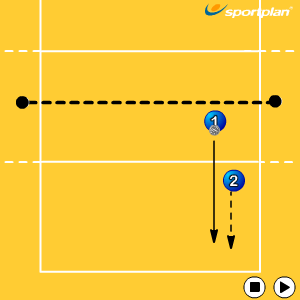
All players serve float serves to targets, starting with zone 1 and progressing through all six zones. Each player must hit three targets in each zone before moving on. Focus on toss consistency and clean contact without wrist snap. This establishes rhythm and reinforces the float serve mechanics.
Technical Work: Jump Serve Progressions (15 min)
Players who are developing the jump serve work through progressions: 10 toss-only repetitions (no hit, just practise the toss placement), 10 standing topspin serves (no approach, just arm swing and wrist snap), then 10 full jump serves. Coach monitors toss placement, contact point, and wrist snap quality. Track error rate.
Pressure Serving: Scenario Training (20 min)
The coach calls out a match scenario before each serve: "Set 5, score is 12-13, you are serving." The server must announce their serve selection (float or jump) and explain why before executing. After 5 serves, the server rotates out and a new server takes over. Coach provides feedback on both the decision and the execution.
Game Play: Serve and Score (15 min)
A competitive serving game: Server earns 3 points for an ace, 2 points for a serve that causes a poor pass, 1 point for a serve in play, and minus-2 for a service error. First server to 15 points wins. This scoring system incentivises aggressive but controlled serving and naturally punishes excessive errors.
Serving Under Pressure: The Mental Side
The serve is the most mentally demanding skill in volleyball because the player is completely alone. There is no teammate to compensate for an error, no defender to make a recovery play. The server stands behind the line with the ball, and every eye in the gymnasium is on them. For many players, this isolation creates anxiety that degrades their technical execution precisely when they need it most.
The Pre-Serve Routine
Every player should develop a consistent pre-serve routine that they follow before every single serve, regardless of the score or situation. This routine might include bouncing the ball three times, taking a deep breath, looking at the target zone, and then executing. The routine serves as a mental anchor, giving the player a familiar sequence to follow that reduces the cognitive load of the pressure moment. The specific actions do not matter - what matters is that they are the same every time.
Process Over Outcome
Coaches should train players to focus on the process of serving rather than the outcome. Instead of thinking "I must not miss," the player focuses on "firm hand, low toss, step through." Process-focused thinking keeps the mind on controllable actions rather than uncontrollable outcomes, which reduces the performance anxiety that causes serving errors in pressure situations.
Simulating Pressure in Practice
The best way to prepare for pressure serving is to create it in practice. Assign consequences to serving errors in training: if a server misses, their team does five press-ups. Play serving games where the last server standing wins a reward. Create point-scoring scenarios where serving errors have real consequences within the training context. The more often players experience and overcome serving pressure in practice, the better they will manage it in matches.
Common Mistakes and Corrections
Mistake 1: Inconsistent Toss
Both serve types depend on a consistent toss, and this is the most common source of serving problems. Coaches should dedicate the first five minutes of every serving practice to toss-only work, where players toss the ball 20 times and let it bounce, checking that it lands in the same spot each time. A consistent toss makes everything else easier.
Mistake 2: Defaulting to One Serve Type
Many players develop a comfort zone with one serve type and refuse to use the other, even when the tactical situation calls for it. Address this by requiring players to alternate serve types during practice: float, jump, float, jump. This builds competence and confidence in both options and prevents over-reliance on a single serve.
Mistake 3: Serving Without a Target
Players who serve into the general area of the court without a specific target in mind are wasting the tactical advantage that the serve provides. Every serve should be aimed at a specific zone, seam, or player. In training, never allow a serve without a declared target. This builds the habit of intentional serving from the earliest stages of development.
Frequently Asked Questions
At what level should players start learning the jump serve?
Players should have a reliable standing or jump float serve and a strong attacking arm swing before attempting the jump serve. This typically means players aged 14 and above who have been playing competitively for at least one to two seasons. Introducing the jump serve too early, before the player has the physical strength and coordination to execute it consistently, leads to bad habits and high error rates that are difficult to correct later. Start with the float serve and build toward the jump serve as a progression.
Is the float serve becoming obsolete at higher levels?
Not at all. Data from professional volleyball shows that the float serve remains one of the most effective serving strategies even at the elite level. While the jump serve generates more aces, it also produces more errors. The float serve's value lies in its consistency and its ability to disrupt passing rhythm through unpredictable movement. Many of the best servers in the world use a combination of both, switching between them based on the match situation. The float serve is not obsolete - it is an essential tactical tool.
How do I choose which serve type to use in a specific rotation?
Consider three factors: the opponent's passing strength in that rotation, the score and set situation, and your own confidence level. If the opposing rotation has a weak passer, target them with a controlled float serve for placement accuracy. If the rotation has strong passers but you have a lead and can afford risk, use a jump serve to apply maximum pressure. In critical moments (set point, tight scores), default to whichever serve type you execute most reliably under pressure. Over time, develop a serving plan for each rotation of each opponent.
How much of practice time should be dedicated to serving?
A minimum of 10-15 minutes per practice should be spent on serving, and ideally 20 minutes for teams where serving is a priority area. This should include both technical practice (working on mechanics and consistency) and tactical practice (scenario-based decision-making and pressure serving). Many coaches make the mistake of only practising serves at the end of sessions when players are fatigued. Serving practice should occur when players are physically and mentally fresh, so the quality of repetitions is high and good habits are reinforced.