For years, conventional wisdom said net play was dead in modern tennis. Powerful groundstrokes and topspin passing shots made approaching the net seem suicidal. But watch the best players today - they come forward more than ever, just more selectively and with better preparation.
Net play hasn't died; it's evolved. The opportunistic approach, chip-and-charge, and serve-and-volley all have their place in the complete player's arsenal.
Why Come to Net?
The tactical advantages of net play:
Shortened points: Coming forward compresses time. Opponents have less time to set up passing shots.
Pressure creation: Your presence at net forces opponents into low-percentage shots. Even unsuccessful approaches create pressure.
Variety: Baseline rallies can become predictable. Net approaches change the pattern and rhythm.
Court position: From the net, you can put balls away that would be neutral from the baseline.
When to Approach
Approach shot selection is crucial:
Short balls: Any ball landing inside the service line is an approach opportunity. The shorter, the better.
Weak replies: A floating ball without pace or spin invites forward movement.
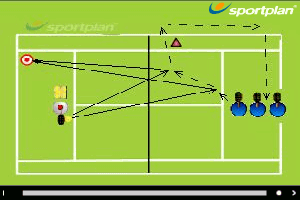
Pattern completion: After moving the opponent wide, the open court invites an approach.
Opponent positioning: If your opponent is deep behind the baseline, approach. They have too much ground to cover for passing shots.
The Modern Approach Shot
Approach technique has evolved:
Deep and heavy: The ideal approach is deep with topspin, pushing the opponent back and giving you time to close.
Direction: Approach to the weaker side or stay crosscourt from where the ball came. Down the line approaches are higher risk.
Split step: After hitting the approach, split step as the opponent hits. This ready position enables reaction to passing shots.
Court position: Close to the net but not on top of it. Position yourself to cover the most likely replies.
Volley Fundamentals
Effective net play requires solid volleys:
Compact preparation: No backswing on volleys. The racket starts in position; the ball is punched or redirected.
Continental grip: One grip for both forehand and backhand volleys. There's no time to change grips at net.
Firm wrist: The wrist stays stable through contact. Let the ball come to the racket.
Move forward: Step into volleys. Body weight transfers into the shot, not away from it.
The First Volley
Often the most challenging shot in the approach sequence:
Transition zone: The first volley often comes while you're still moving, in the middle of the court - the most vulnerable position.
Low contact: Passing shots typically come low. Getting down to the ball is essential.
Depth over winner: The first volley is rarely a winner. Aim for depth to set up the second volley.
Split step timing: The split step before the first volley is critical. Must be complete before you need to move.
Overhead and Lob Defence
Lobs test net players:
Positioning: Position far enough back to cover lobs while close enough to reach low volleys.
Overhead technique: Turn sideways, track the ball, hit at full extension. The overhead should be a weapon, not a weakness.
Letting lobs go: If a lob is going out, let it go. Desperation overheads often go wrong.
Recovery from deep lobs: When the lob pushes you back, consider a high defensive lob reply to reset position.
Serve and Volley
The classic net approach pattern:
First serve: Big serve followed by immediate approach. Less common but still effective on fast surfaces.
Second serve: Riskier but can surprise opponents expecting a baseline rally.
Surface considerations: More effective on grass and fast hard courts. Less viable on slow clay.
Opponent analysis: Against weak returners, serve and volley is devastating. Against great returners, be selective.
Key Coaching Points
- Net play is selective, not constant - choose the right moments
- The approach shot sets up everything - prioritise depth and placement
- Split step timing is crucial for first volley success
- The first volley is about positioning for the second, not winning immediately
- Overhead competence is essential - lobs will come