Tennis: tennis doubles

June 2026

If you watch the data, restart kicks happen more often than any other set-piece in a modern rugby match. A Six Nations game produces around twelve to sixteen restarts, more than the average lineout count and far more than scrums. Yet most teams - especially below elite level - still treat them as an afterthought. That is the gap top coaches are now closing.

The phrase "restart is the third set-piece" has become a coaching slogan in 2026 for good reason. The team that wins the restart battle controls field position, momentum and the opening sixty seconds of every passage of play. Conceding a try and then conceding the restart immediately afterwards is one of the most common ways to lose a match.

Why Restarts Are Suddenly Critical

Two things have changed. First, kickers have become more accurate. Restarts now land precisely on the 10-metre line and in the 15-metre channel, contested by tall, athletic chasers who jump for the ball. The days of a 22-metre dollop into the middle of the pitch are gone.

Second, the reward for retention has grown. With modern attacking shapes, a team that retains its own restart is straight into structured phase play in the opposition half. A team that loses the restart is defending in their own 22 with a disorganised line. The swing between those two outcomes is enormous.

Building a Reception Pod

Top teams now train a dedicated restart reception pod, exactly as they train a lineout pod. The pod typically has four roles, and every player must know which role they have before the kick is taken.

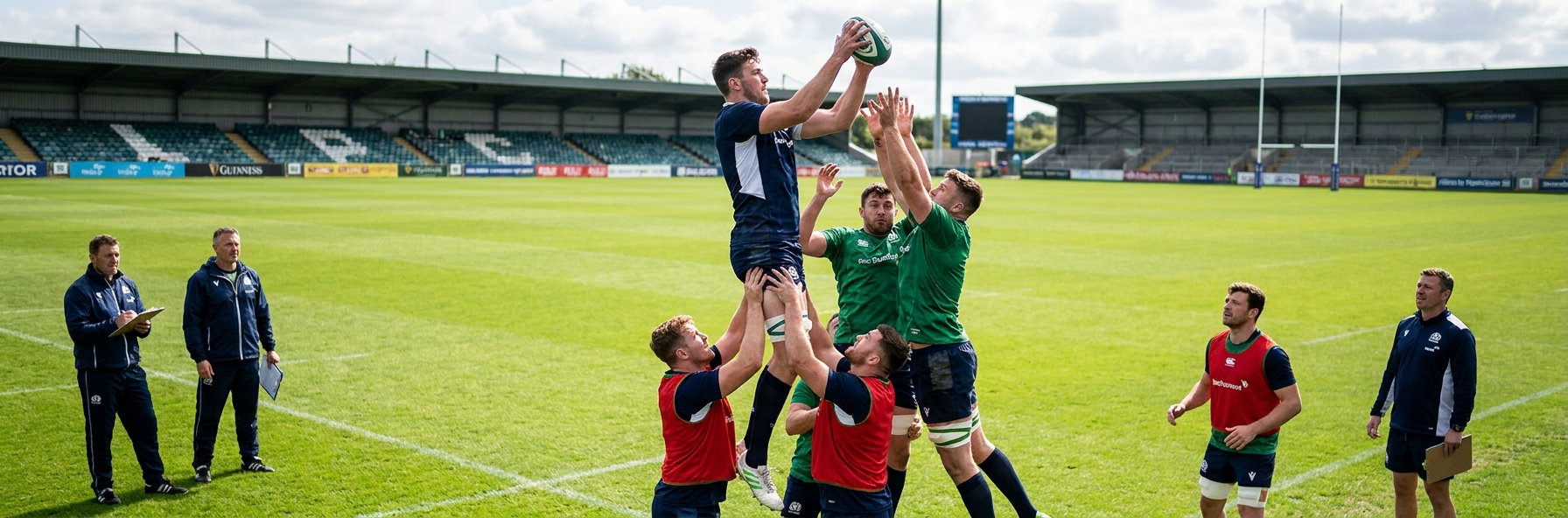
The catcher: Usually a lock or back-rower, chosen for height and timing. They call early - "mine" or the channel number - and commit to the catch.

The lifter: A prop or hooker who arrives at the catcher's side, hands ready, to give a lift on the contested ball. Lifting is legal at restarts and dramatically improves your win rate against good chasers.

The protector: A second forward who stands between the catcher and the chase, taking the contact if it comes and forming the first ruck cleanly.

The exit option: A back, usually the fly-half or full-back, in position to receive the next pass and either kick to touch or launch a counter.

How to Coach Restart Reception

Restart skills are perishable. Train them every week, even if only for ten minutes. Build the session in three blocks.

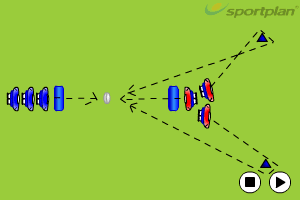
Block 1 - Catching under contest (5 minutes): One coach kicks high balls from the halfway line. Your designated catchers work in pairs - one catches, one acts as a chaser jumping to contest. Rotate every two reps. The focus is timing the jump, not winning every ball.

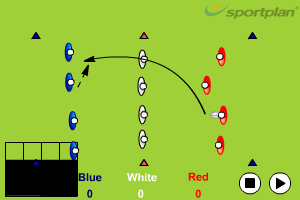
Block 2 - Receiving as a unit (10 minutes): Full pod of four sets up. Coach kicks restarts. Pod must catch, secure, ruck and recycle clean ball to a back. Add an opposition chase line of three after five reps.

Block 3 - Restart-to-exit scenarios (10 minutes): 12v12 or 10v10 game starting from a restart. After receiving, the team in possession has one rule: get out of their own half within three phases. This trains the link between reception and territorial exit.

Attacking Restarts - The Other Half

Receiving is half the picture. The other half is recovering your own restart. Modern restart kicks are aimed at one of three landing zones: short on the 10 (5-7 metres beyond the kick mark), mid-deep at the 15-metre line, or long into the far corner. Each option requires a different chase pattern.

The short restart is the highest-percentage recovery option but the hardest to execute accurately. Reserve it for moments when you genuinely need the ball back - after conceding a try, with time running out, or to disrupt a stronger opponent. Drill the kicker until they can land a restart in a one-metre window on demand.

Key Coaching Points

  • Restarts are the most frequent set-piece - train them weekly
  • Build a named reception pod with four clear roles: catcher, lifter, protector, exit
  • Lifting is legal at restarts - use it
  • The exit kick after a clean catch is as important as the catch itself
  • Reserve the short restart for moments when winning it really matters
Recommended Drills

VIEW ALL KICKING DRILLS

tennis doubles DRILLS
View All
Unfortunately there were no results for your search! Please try again
tennis doubles ANSWERS
View All

WHAT WOULD BE A KEY SKILL FOR A TENNIS COACH

WHAT WOULD BE A KEY SKILL FOR A TENNIS COACH

Archived User Coach

13 round tennis roster

Hi there Just wondering if anyone has a tip on making a fair tennis player roster for 6 players over 13 rounds Much appreciated

Archived User Coach

What is my fault? Difficulty coaching some of the older players - advice?

Helo, my name is Fernando, I am a Spanish tennis teacher who started teaching six months ago. I am working in a public sportcenter and I am having some problems with adults. When I started I realiced that the students were used to playing tennis without any control. Young students told me that the other teacher only used to leave them play - he rarely explained them how to hit the ball. Consequently the do enjoy my clases and they are learning a lot and impoving their level of tennis. So far so good, but the problem is that with the adults I have the impression that they don´t like my clases. In fact some of them left the group at the begining. I try to mix different kinds of drills during the class and I usually finish it with a game like for example 21, winner........ But it seems that they don´t enjoy it. During the exercises most of them don´t try to do what I tell them. As a result, they don´t have a good level of tennis. But as far as I know, the other teacher was a tennis player who uses to play against them during the clases. As this is my first time teaching tennis, I don´t fell confidence and that is the reason whay I do´t like to play against them. Appart from that I think that this is not my role as a teacher. So I would like you to tell me how to deal with that situation. I don´t care if they leave me because this is not going to affect my job, but i wouldn´t like them to leave just because I like tennis and I like teaching tennis. Thank you very much for your help. I am sorry for my English. Best wishes!!!!

Fernando Coach, Spain

I'm coaching middle school tennis for the first time. Where to begin?

Coaching tennis to middle school athletes for the first time. How do I begin?

Rhonda R Lang Coach, United States of America

I'm coaching middle school ten...

Coaching tennis to middle school athletes for the first time. How do I begin?

Rhonda R Lang Coach, United States of America

Psychology in tennis HELP! My ...

Psychology in tennis HELP!!! I have a daughter who is an excellent player who only started playing tennis seriously last yr at the age of 13. She is a much better player than all the people she has completed against in matches but always loses due to over hitting and getting upset if the wrong call is made (which happens frequently due to how fast she hits and serves) do we need some sort of psychological help for this. what is the best way to get this... books, councilling ??? any help would be most appreciated thanks

Archived User Coach

What is my fault? Difficulty c...

Helo, my name is Fernando, I am a Spanish tennis teacher who started teaching six months ago. I am working in a public sportcenter and I am having some problems with adults. When I started I realiced that the students were used to playing tennis without any control. Young students told me that the other teacher only used to leave them play - he rarely explained them how to hit the ball. Consequently the do enjoy my clases and they are learning a lot and impoving their level of tennis. So far so good, but the problem is that with the adults I have the impression that they don´t like my clases. In fact some of them left the group at the begining. I try to mix different kinds of drills during the class and I usually finish it with a game like for example 21, winner........ But it seems that they don´t enjoy it. During the exercises most of them don´t try to do what I tell them. As a result, they don´t have a good level of tennis. But as far as I know, the other teacher was a tennis player who uses to play against them during the clases. As this is my first time teaching tennis, I don´t fell confidence and that is the reason whay I do´t like to play against them. Appart from that I think that this is not my role as a teacher. So I would like you to tell me how to deal with that situation. I don´t care if they leave me because this is not going to affect my job, but i wouldn´t like them to leave just because I like tennis and I like teaching tennis. Thank you very much for your help. I am sorry for my English. Best wishes!!!!

Fernando Coach, Spain

Permanent lines for U10 tennis...

I would like to add permanent lines for Under 10 tennis and am wondering if anyone has any experience doing this and can help me avoid problems with adult members?

Archived User Coach

JOIN SPORTPLAN FOR FREE

  • search our library of 1100+ rugby drills
  • create your own professional coaching plans
  • or access our tried and tested plans

Sportplan App

Give it a try - it's better in the app

YOUR SESSION IS STARTING SOON... Join the growing community of football coaches plus 500+ drills and pro tools to make coaching easy.
LET'S DO IT