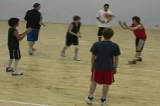
Players run around, avoiding the hoops on the floor. When they hear the whistle they must perform a stride stop (this is where their first foot lands inside the hoop and second outside). The foot inside the hoop is not allowed to move.
The player must then pivot on their standing leg before then jogging off in another direction.
When players hear two whistles they must jump stop, landing inside a hoop with both feet together. Player then select their pivot foot, moving the non-pivoting foot out of the hoop in order to pivot and change direction.
Stride stop: Land in a 1, 2 pattern. Only the first foot goes in the hoop
Jump stop: Both feet together landing at the same time in the hoop.
Progression:
Only half the player have a ball, upon hearing the whistle ball carrying players must perform the pivot before passing to a player without a ball.
The player who receive the ball must also perform the same stop (stride or jump), catching the ball in the air, before dribbling the ball off again, awaiting the next whistle.
A common mistake in children is to catch the ball, land and then perform the steps (which is a travel).
Four players standing still make every ball handler's job harder. Teach V-cuts, L-cuts and back cuts so your team gets open and punishes defenders who overplay.
Good team defence is five players guarding the ball, not five separate one-on-ones. The shell drill is where that starts, so here is how to teach help-side positioning and rotations from the first week of the season.
Rebounding is the least glamorous thing in basketball and one of the most decisive. It is also almost entirely a habit, which means it is entirely coachable.


Register for FREE and get coaching tips, top drills, session and more every week!