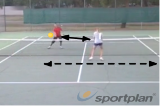
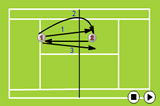
Player stands at the net. Coach feeds first ball into the legs to the 'deuce' side. Player hits forehand half-volley deep cross-court and moves forward. Coach feeds second ball to the deuce side. Player finishes using forehand stop volley cross-court.
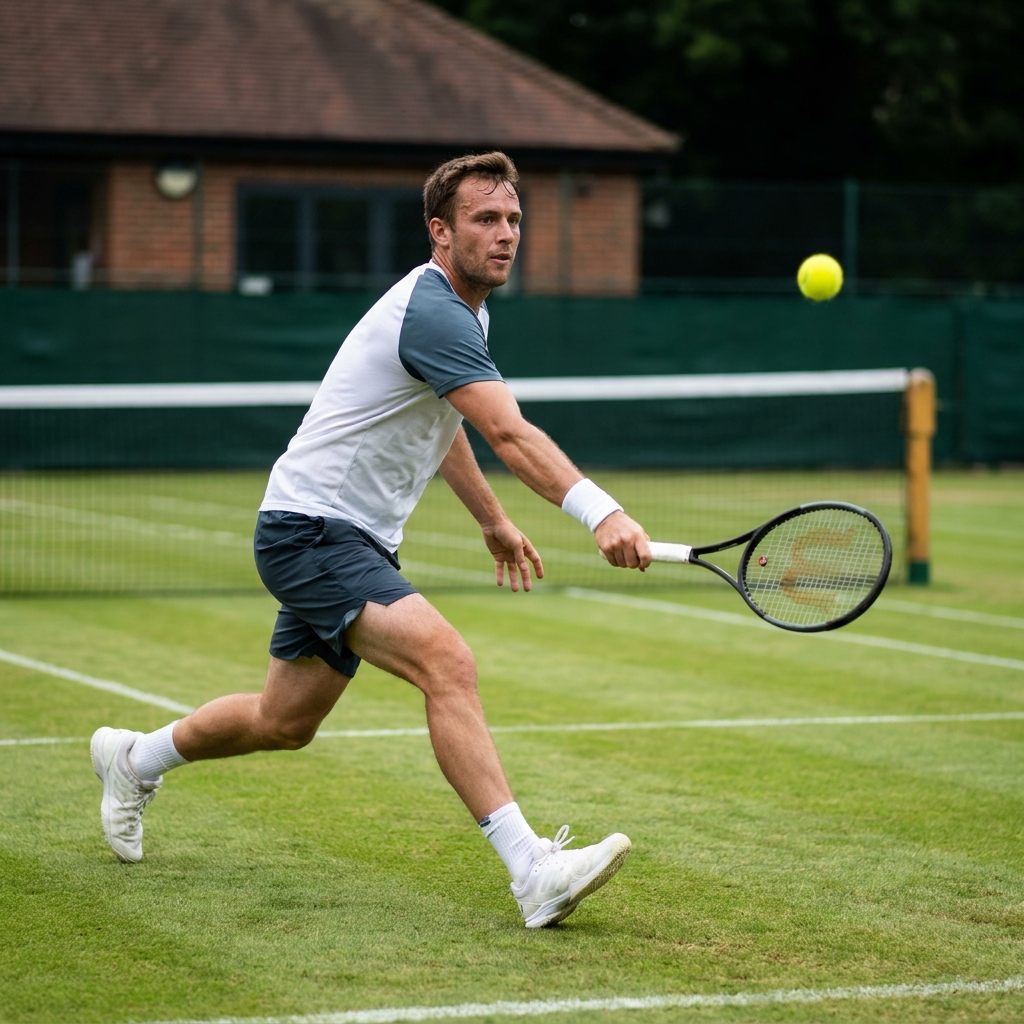
More and more players are starting to use net-game skills in their games as they see benefits of moving forward. Approaching the net provides opportunities to finish the point quicker and also to put more pressure on the opponent due to less time react and make decisions. Good net players use volleys to make opponents run and put them into uncomfortable positions, so it is important to understand how we can use balls in the air to gain an advantage and force opponents to make more mistakes.
Coaching Points
In this drill, Player creates simple tactical patterns using volleying skills. Player starts off hitting a half-volley which is a tactically-demanding skill, so Coach should make sure that Player understands all the technical nuances. After this shot, Player should take-up a proper position at the net and finish the pattern using a stop volley. Coach should explain to players that the first shot is used to push the opponent behind the baseline so that for the second shot, Player is in a good position to go for a winner. Using a combination of deep and short volleys forces the opponent to cover big distances, inducing more mistakes from the opponent.
Indoor courts give players less time and less room. Help them sharpen their split step, shorten their swing and stay calm, and winter becomes a season of real progress.
A tiebreak is a short sprint where every point is worth the same as a break of serve. The players who win them are rarely the ones who hit hardest. Here is how to coach the patterns, habits and scoreboard thinking that win the big points.
Most club players practise the serve on its own and then have no idea what to do with the ball that comes back. Serve plus one is the pattern that turns a good serve into a won point.


Register for FREE and get coaching tips, top drills, session and more every week!