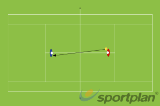
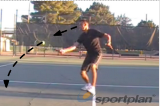
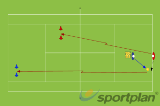
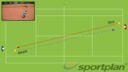
2 zones are set on player B side (deep corner and angle). Players rally together in cross court direction. Player A can pick one of 2 options. If the player hits deep zone 2 times in a row, he finishes the next ball with a down the line shot. If the player hits an angle zone, he finishes the next ball with a drop shot down the line.
Drill specifications:
1 min and switch
Only 2 players can work on one court so time changes are working perfectly for this type of drill. Rest of the players should perform physical exercises e.g footwork on the ladder or jumping rope while waiting for own turn.
Having an idea in mind while rallying cross court is a necessity to make proper tactical decisions. Building the point means that every ball has a purpose and is connected with the next one. By repeating the same decisions during the practice session players create patterns that can be used automatically during the tournament matches. Giving players the opportunity to pick between two different options (power vs control) is an important step to create responsible and successful athletes. The best players in the world like Roger Federer or Novak Djokovic know a lot of patterns that they are using according to the situation or to the opponent. Having different possibilities and not relying just on one shot is a skill that helps to beat different rivals.
In this drill players work on offensive methods related to the power or control. By setting the zones players have a visual feedback about their accuracy so they can constantly adjust their shots according to the previous ball. Coach should observe which options are chosen more so he can understand each player’s approach. By incorporating 2 different options players start to understand that there are a lot of variations to win the point so if something is going wrong there is also another shot that can lead to the win. Coach should explain to players that each shot needs a purpose so players should never just hit the cross court shot.
Indoor courts give players less time and less room. Help them sharpen their split step, shorten their swing and stay calm, and winter becomes a season of real progress.

A tiebreak is a short sprint where every point is worth the same as a break of serve. The players who win them are rarely the ones who hit hardest. Here is how to coach the patterns, habits and scoreboard thinking that win the big points.
Most club players practise the serve on its own and then have no idea what to do with the ball that comes back. Serve plus one is the pattern that turns a good serve into a won point.


Register for FREE and get coaching tips, top drills, session and more every week!