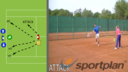
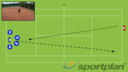
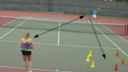
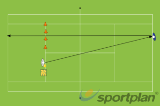
2 players play points against each other. Player B feeds an easy ball. Player A attacks it and the point begins. Player A has to play the point all the time inside the baseline.
Drill specifications:
2-3 points and switch
Points are short so players can play few rallies in a row before they switch. Playing inside the baseline requires great footwork skills and many shots played in low position so lunges can be performed by waiting players to improve legs’ strength and become more natural while playing shots in really low position.
It is important to understand which factors will benefit our offensive shots. Player can put more pressure on the rival by hitting the ball more powerfully or by taking the ball earlier to cut the opponent’s recovery time. To increase efficiency of offensive shots player should always try to take the ball inside the baseline and take the ball in the highest possible point of contact by moving towards the ball. Players who stay on the baseline have to use much more power to finish the point so there is a bigger chance for a mistake.
In this drill players work on offensive skills in a match situation. Playing the points inside the baseline requires good footwork, quick reaction and proper technical adjustments. By playing without moving back, player understands that he has to play offensively because any other tactic will decrease his chances for winning. Additionally, closer distance to the net opens different situational offensive responses so player can use drop shot or come to the net more easily. Other player works more on defensive skills so depth should be a main goal during the points. Coach should explain to players that points will be short so they have to maintain high level of focus from the first shot.
Indoor courts give players less time and less room. Help them sharpen their split step, shorten their swing and stay calm, and winter becomes a season of real progress.
A tiebreak is a short sprint where every point is worth the same as a break of serve. The players who win them are rarely the ones who hit hardest. Here is how to coach the patterns, habits and scoreboard thinking that win the big points.
Most club players practise the serve on its own and then have no idea what to do with the ball that comes back. Serve plus one is the pattern that turns a good serve into a won point.


Register for FREE and get coaching tips, top drills, session and more every week!