Rugby: wings

The 50:22 law, introduced as a trial and now a permanent fixture, has fundamentally changed how teams approach tactical kicking. A kick from your own half that bounces in-field, crosses the 22, and finds touch rewards the kicking team with the lineout throw-in. This single law change has altered both attacking and defensive strategies across the game.

Understanding the Law

The requirements:

  • Kick must originate from behind your own 10-metre line
  • Ball must bounce in the field of play (not direct to touch)
  • Ball must cross the opposition's 22-metre line
  • Ball must then go into touch
  • Kicking team retains the throw at the lineout

These requirements create specific technical demands. The kick must be long enough to reach the 22, accurate enough to hit the corner, and struck correctly to bounce in-field first.

Why 50:22 Matters

Before the 50:22, kicking from your own half that went to touch gave the throw to the opposition. The only benefit was territorial gain. Now, an accurate 50:22 delivers both territory AND possession - a game-changing combination.

The tactical impact:

  • Lineout attacking platform in the opposition 22
  • Defensive scramble if full-back fails to cover
  • Forces back three to position wider, creating space elsewhere
  • Punishes lazy defensive positioning

Executing the 50:22

The Grubber Option

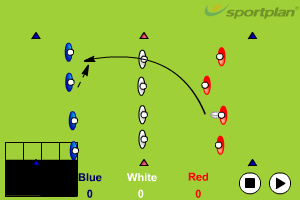
A well-struck grubber can beat the full-back to the corner. The low trajectory keeps the ball in play, and end-over-end rotation makes the bounce predictable.

Grubber technique:

  • Strike through the middle of the ball, toe down
  • Generate end-over-end spin for predictable bounce
  • Aim for the gap between full-back and touchline
  • Follow up - if it doesn't reach touch, contest the chase

The Chip and Chase

A chip kick over the defensive line that bounces in the 22 and reaches touch. Higher risk - defenders can field it before it reaches touch - but effective against narrow defences.

Chip technique:

  • Get under the ball with angled foot
  • Enough height to clear defenders, not so much that chase time is lost
  • Backspin for controlled bounce toward touchline

The Cross-Field Kick

Against a defence shifted to one side, the cross-field kick to the far corner can find space. This is a longer kick requiring more accuracy but exploits defensive imbalance.

Defensive Adjustments

The 50:22 has forced defensive positioning changes. Full-backs can no longer sit narrow - they must cover the width. Wings must be aware of their touchline responsibilities.

Defending against 50:22:

  • Full-back positions wider to cover both corners
  • Wings drop deeper to provide secondary cover
  • Communication about kick threats: "Watch grubber!"
  • Quick identification and reaction to kicks

These defensive adjustments create space elsewhere. If the full-back is wide, the central channel opens. If wings drop deep, the defensive line loses numbers.

When to Attempt 50:22

Good opportunities:

  • Full-back positioned narrow or deep
  • Wide channel space visible
  • Defence rushed up, leaving back field exposed
  • Slow ball where running attack is risky

Poor opportunities:

  • Full-back already covering the corner
  • Quick ball with attacking momentum
  • Wind against making accurate kicking difficult
  • Kicker not in optimal position

Training 50:22 Execution

Individual kicking practice:

  • Set targets at the corner - grubber to specific zones
  • Practice both feet (advantage when on either side)
  • Vary distances - not every 50:22 opportunity is from the same position

Team practice:

  • Live scenarios with defence - read the full-back position
  • Decision-making: kick, run, or pass?
  • Chase organisation when the kick doesn't reach touch

Alternative Outcomes

Not every 50:22 attempt succeeds. But the threat creates secondary benefits:

If fielded before touch: You've still gained territory and forced the opposition to start from deep. Apply chase pressure and compete for their exit kick.

If it bounces out before 22: Opposition throw, but you've gained significant ground. Reset defensive line.

If full-back covers: Your threat has pulled them wide. Subsequent attacks may find more space centrally.

The Mental Game

The 50:22 threat changes how oppositions defend, even when you don't kick. Simply having players capable of executing the kick forces wider positioning and changes defensive dynamics.

Make sure your opposition knows you have this weapon. Execute it successfully early in matches, and they'll respect the threat throughout.

Key Coaching Points

  • The 50:22 rewards accurate kicking with possession AND territory
  • Grubbers are highest percentage - practise them
  • Read the full-back position before deciding
  • Even unsuccessful attempts gain territory
  • The threat changes defensive positioning
Drills to Master the 50:22

VIEW ALL KICKING DRILLS

JOIN SPORTPLAN FOR FREE

  • search our library of 1100+ rugby drills
  • create your own professional coaching plans
  • or access our tried and tested plans
wings DRILLS
View All
Unfortunately there were no results for your search! Please try again
wings DRILL CATEGORIES
View All
wings ANSWERS
View All

Does anyone have any good drills for keeping the defensive?

Does anyone have any good drills for keeping the defensive line?

Archived User Coach

devise a four man line out game throwing two opstions

Ask a question and have it answered by Coaches from around the world and Sportplan's team of Experts.

Archived User Coach

Where can i find a detail description of the abillities?

Where can i find a detail description of the abillities and duties for the different positions in the backline?

Archived User Coach

Improving game awareness. How can I improve players?

Improving game awareness. How can I improve players insight into "what happens next", besides by whatching (games)? Players tend to be fixed on the ball(situation) and seldom look at what is in front of them%3A how can I stimulated them to take time to quickly look around and assess the situation?

Yvonne Bouman Coach, Netherlands

Flooding the zone with both the weak side wing and fullback leaves you vulnerable

If one were to really flood the back line by bringing in the weak side wing AND fullback (off a scrum), who would you recommend using to cover for kicks on turnover ball? I'm thinking the blind side flanker could loop around to do it, but then you lose his services at the breakdown. Thoughts?

Baird Blake Coach, United States of America

My son has played all season U9's on the wing and has?

My son has played all season U9's on the wing and has now be brought into a inside centre role. What are the key differences he needs to make to be successful in his new position

Archived User Coach

please how do idefine the players in the pitchie. who?

please how do idefine the players in the pitchie. who is the flanker, hooker, fly half etc

Archived User Coach

I'm working with kids aged 10 and 11. A major problem?

I'm working with kids aged 10 and 11. A major problem is getting them to have some sense of position on the pitch. In other words how do I stop them all running after the ball.e

Cameron Taylor Coach, Scotland

First time coaching U9 and U10s - anyone got any backline coaching tips?

Hi im a first time coach and is still getting the hang of how the technical details of the game works the back line is my department and whould like any help i can get to know what drills to do and anything helpfull in the backline im currently coaching for the under 9 and 10

Archived User Coach

Trouble gettng the ball to our...

We have two very fast wingers but we cannot get them the ball . Teams are coming up fast and we are lucky to get the ball to the O. C. We have tried setting up further back but too many times we are getting caught behind the gain lines when we do that. Any ideas?

john mcmullen Coach, United States of America

Blindside position - I'm new t...

This is my first year playing on a rugby team for my school, grade 9, im much smaller than everyone else but i run fast and can be strong. my position is the blind side wing, and i dont understand what im supposed to do. it seems like i just jog and stay far away, but i dont know what im supposed to do if someone from the opposite team comes near me and noone else is one them, am i supposed to tackle? i also have trouble tackling cause my arms dont rap fast enough when they run into me, any advice?

Archived User Coach

U10s organisation in defence. ...

I have started an under 10s team up, and I would say about 8 from the 13 children I have , did not play rugby until about 6 months ago. Of these players, there seems to be a lot of potential, as we are scoring tries against teams, that very rarely concede tries.the problem I got with them, is that we are very poor at organising our selves in defense when the opposition has the ball, which does result in us conceding quite a few tries. We have some very good tacklers in the team. Can anyone offer some ideas on how I can get them to organise themselves? Thanks . Chris.

christopher jenkins Coach, Wales

How can I get players (U15s) t...

How can I get players (U15s) to take the initiative and to go looking for the ball? They have the skills to use the ball when they get it but remain waiting for a pass. This applies especially to the wings and fullbacks. The same is true about backs getting involved in rucks and forwards not picking up loose ball. (I've only just inherited this team).

Andy Stephens Coach, Wales

What does the "T Bone" concept...

What does the "T Bone" concept mean when defending?

Olivier Guitart Coach, New Zealand

Positional rotation at U9 leve...

Positional rotation at U9 level... I originally posted this as answer to a question about squad rotation, but thought I might get a better response if I posted it as a question in its own right... I have an 8 year old at the age level you are talking about - he isn't the best player at the club by any means, but has his good moments. He loves watching the game, he has a good understanding of the way it is played (to the extent that he has often shouted at the telly over recent weeks at some of our illustrious stars when they're out of position) and he has good handling skills - to be honest he's just not brave enough in the tackle yet, but I know it'll come so I'm not making a big thing of it. However, he and a couple of others are constantly stuck on the wing, and are getting fed up with the fact that they don't get the opportunity to get involved much. The coaches seem to have their "big names" and as you say seem more interested in the short term aims of winning each game rather than trying to keep the lads interested and challenged each week. I know my son's aware that I think they should move them all around, although I have made a point of not criticising the coaches at all - I think he heard me talking about it to someone else. The coaches have talked about moving players to different positions, but haven't done it, and aren't really receptive when they are asked about it. There are two coaches, and the one that seems to have the "casting vote" is pretty autocratic and doesn't seem to accept criticism or suggestions. My son has mentioned about moving to another club, where he may or may not get more of a chance to shine, but I am not sure this is the right move as it may teach him to give up rather than sticking with something. Any thoughts please?

Archived User Coach

forwards positions in open pla...

Hello, in open play i want to have my forwards split up across the field not just chasing the next ruck. im not sure exactly how to teach them where they should be standing. (positional play) (Dane coles always seems to be a wing in open play)

dan Coach, Germany

Openside flanker position afte...

My coach has put me at openside flanker and I'm confused of where i should be after the scrum. Should I be attacking the opposing scrum half or just trailing behind the backs waiting to clean up/ form a ruck? It would be great to know what I'm doing !

Archived User Coach

Advice on playing flyhalf | Sp...

Tomorrow i am going for rugby trials and i wanna play flyhalf. What do i have to do to get the position

sima Coach, South Africa

tackling for U12's who don't l...

I've a few players who genuinely do not like tackling but love the game in every other facet. Does anybody have experience indealing with this predicament. We have practiced the basic techniques repeatedly but when it comes to game time these kidsjust won't engage with the shoulder but use outstretched arms in a feeble attempt to tackle.It can be very frustrating ....

Bernard O'Doherty Coach, Ireland

I am coaching the U11 this sea...

U11 Rugby I am coaching the U11's this season. There are some significant rule changes from U10. Please can I get some advice on what lessons were learned from coaches who have been through a similar experience.

William OBrien Coach, England

JOIN SPORTPLAN FOR FREE

  • search our library of 1100+ rugby drills
  • create your own professional coaching plans
  • or access our tried and tested plans

Sportplan App

Give it a try - it's better in the app

YOUR SESSION IS STARTING SOON... Join the growing community of rugby coaches plus 1100+ drills and pro tools to make coaching easy.
LET'S DO IT