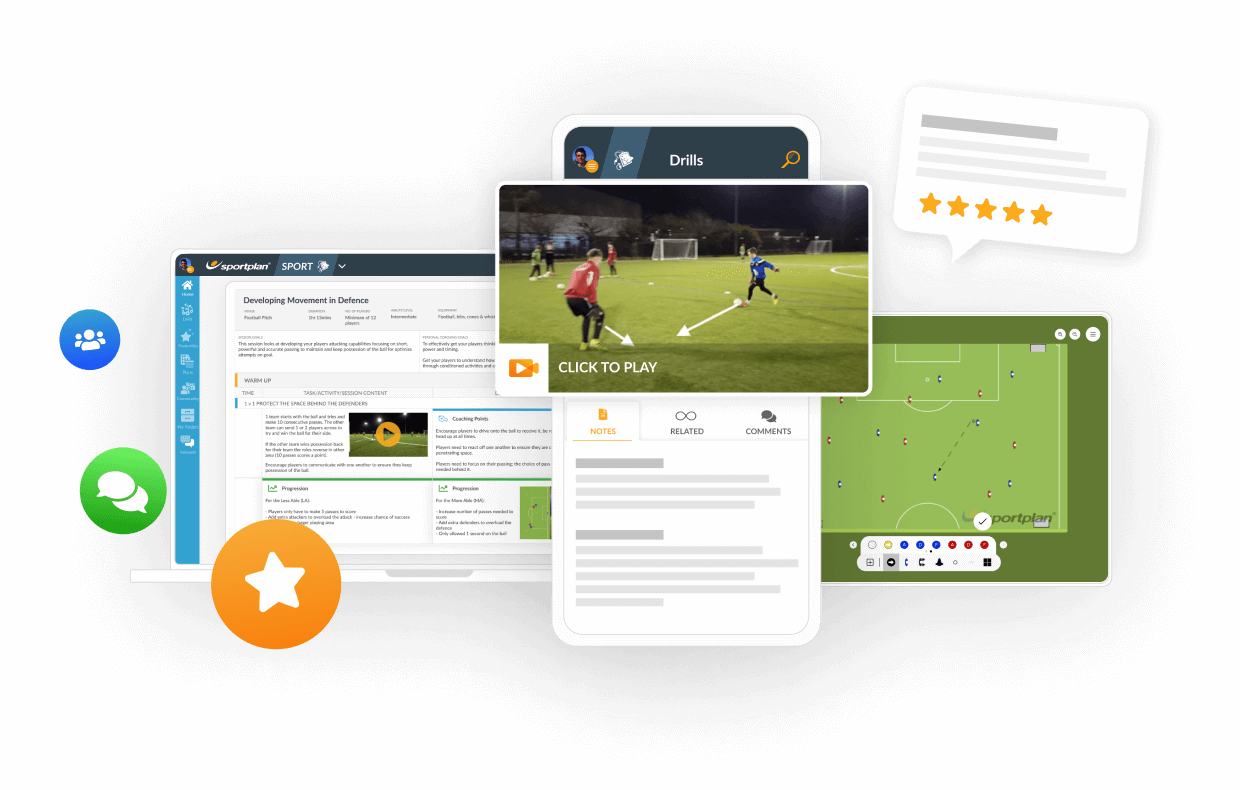
F1 passes into A1 after A1 has made movement towards ball, A1 takes and lays off to F2, F2 takes touch and plays ball into space for A2 to run onto, A2 takes touch and crosses to A3 or A4, A4 should make run in behind A3 to back post or towards A2 pull back to edge of box.
Alternate A1 and A3, D1 and D3, F2 and A4, F1 and A2 to learn both roles within each position/area of pitch.
Change to 1 touch dependant on ability.
F1 pass to A2 then make run inside fullback, A2 pass into A1, use F1 as 3rd man run to alternate full back and winger 3rd man run, could also have full back run outside winger for 3rd man overlap run.
in more ways than one
 sportplan_netball


in more ways than one
sportplan_football

Deliberate heading is now out of U11 grassroots matches. Here is how to coach chest, thigh and foot control so your players still win the ball in the air.

Long-range goals doubled at the 2026 World Cup as teams sat deep. Here is how to coach when to shoot from distance, the technique, and the follow-up.

Under FutureFit, your Under-9s stay at 5v5, your Under-11s stay at 7v7 and your Under-13s stay at 9v9. Same pitch, same numbers, one more year. Here is how to make sure that year feels like a step forward rather than a repeat.