The Object of this drill is to retain the ball whilst moving it from end to end.
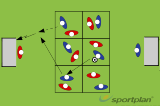
The Setup requires 6 grids and 3 groups of 4 player arranged as the diagram shows. In each central grid there is an attacker marked by a defender. The end grids contain neutral players as a passing option.
The attackers start with the ball and work together to create passing channels to manover the ball towards the opposite end. When the defenders win the ball they immediatly become the attackers. The neutral players are always a passing option to the current attackers
Attckers
The key is to move off the ball to drag the defender out the way. This opens up a through pass either the middle or the side. It also frees you up for the pass if the defender doesn't follow you. when recieving the ball always look for the foward pass, but if there isn't one available then think about passing back or across to reset the play and open up space.
Defenders
In order to force the turn over you need to be able to stop the foward pass. This involves pressuring the player with the ball in order to force them to pass back. By sticking with the attacker you will shut off the passing channel and be able to challenge for the ball.

in more ways than one
 sportplan_netball


in more ways than one
sportplan_football

Deliberate heading is now out of U11 grassroots matches. Here is how to coach chest, thigh and foot control so your players still win the ball in the air.
Long-range goals doubled at the 2026 World Cup as teams sat deep. Here is how to coach when to shoot from distance, the technique, and the follow-up.

Under FutureFit, your Under-9s stay at 5v5, your Under-11s stay at 7v7 and your Under-13s stay at 9v9. Same pitch, same numbers, one more year. Here is how to make sure that year feels like a step forward rather than a repeat.