Why First Touch Is the Foundation of Everything
Watch any professional match and you will notice something that separates the best players from the rest: the quality of their first touch. It is not speed, strength, or even tactical intelligence that creates the most visible gap between levels. It is the ability to receive the ball cleanly, quickly, and with purpose while an opponent is breathing down your neck.
A good first touch buys time. It creates space where none existed. It turns a pressured situation into an attacking opportunity. Conversely, a poor first touch forces the player into a rushed second action, invites the press, and often results in a turnover. At every level of the game, from under-10s to the professional ranks, first touch quality is the single most reliable predictor of a player's ability to influence the game.
The problem is that many coaches still train first touch in static, unpressured environments. Players stand in lines, receive a pass, control it, and pass it back. The technique looks clean, but it bears almost no resemblance to the chaotic, contested moments where first touch actually matters in a match.
Types of First Touch and When to Use Each
Effective first touch coaching means helping players understand that there is no single correct technique. The right touch depends entirely on the situation: where the pressure is coming from, where the space is, and what the player wants to do next.
The Cushion Touch
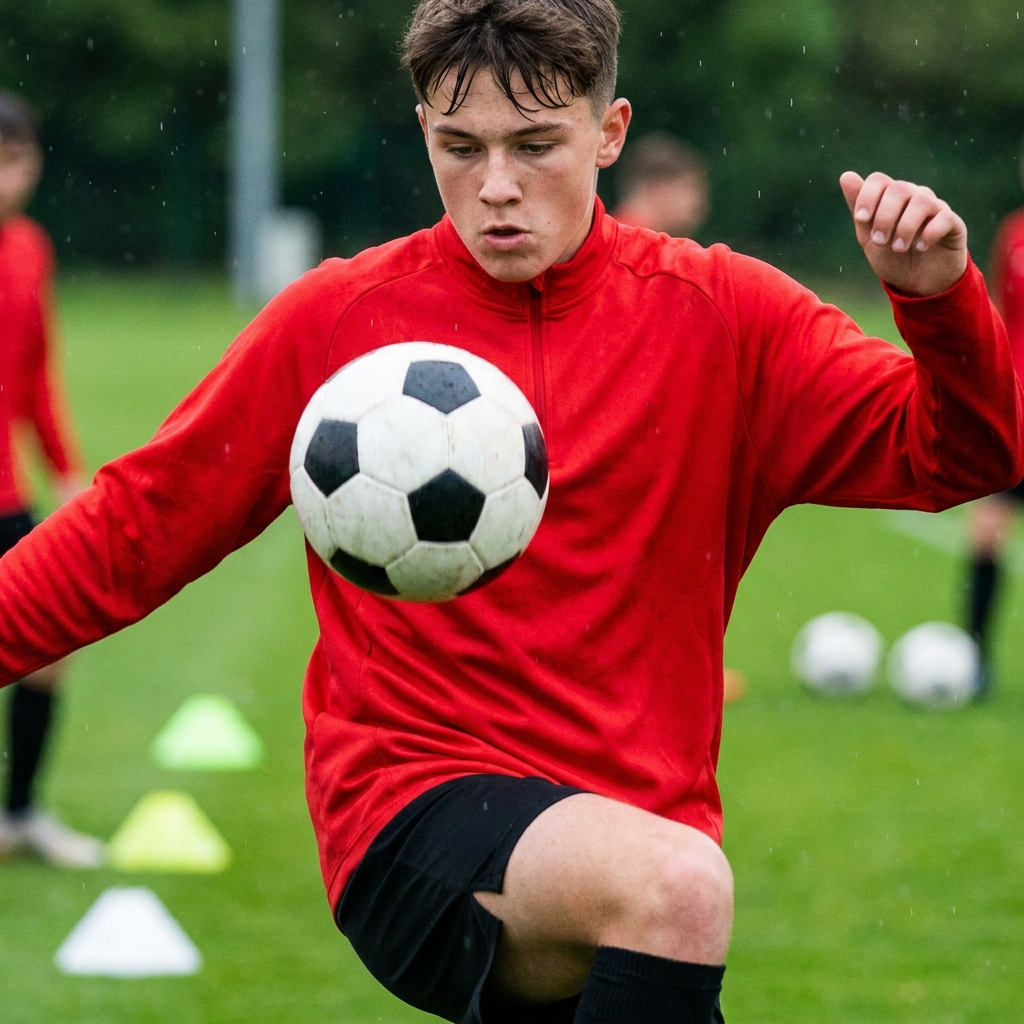
Used when the ball arrives with pace and the player wants to keep it close. The receiving foot withdraws on contact to absorb the energy. This is the most common first touch and is essential when receiving with your back to goal or in tight spaces where any bounce away from the body will be punished.
The Directional Touch
Rather than stopping the ball dead, the player uses their first touch to move the ball into the space they want to attack. This is the touch that creates separation from a marker. The key coaching point is that players must scan before receiving so they know which direction to push the ball.
The Across-Body Touch
When pressure comes from one side, the player receives with the foot furthest from the defender, using their body as a shield. The ball is taken across the body into the space on the opposite side. This requires confidence and awareness but is devastatingly effective when executed well.
The First-Time Layoff
Sometimes the best first touch is not a touch at all in the traditional sense, but a one-touch pass that releases a teammate. Recognising when to play first time rather than controlling is itself a first-touch skill that must be coached.

Why Pressure Changes Everything
The gap between a player's first touch in an unopposed drill and their first touch in a match is often enormous. This is because pressure fundamentally changes the task. Under pressure, the player must process additional information: where is the defender, how fast are they closing, which shoulder is the pressure coming over, where is the nearest teammate, is there space to turn?
All of this processing happens in the fraction of a second between seeing the ball arrive and making contact. If training does not replicate this cognitive load, players will look technically competent in practice but fall apart when it matters. The principle is straightforward: train first touch with a defender present as soon as the basic technique is established.
Progressions: From Simple to Game-Realistic
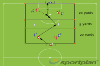
Effective first touch coaching follows a clear progression that gradually increases the complexity and pressure on the player. Rushing to the hardest stage is counterproductive, but staying too long at the easiest stage is equally wasteful.
Stage 1: Technique Rehearsal (5 minutes)
Pairs work with no opposition. One player serves, the other receives and controls. Focus on the technical details: body shape open to the field, receiving on the back foot, soft contact surface. Keep this stage short because it has limited transfer to the game.
Stage 2: Passive Pressure (10 minutes)
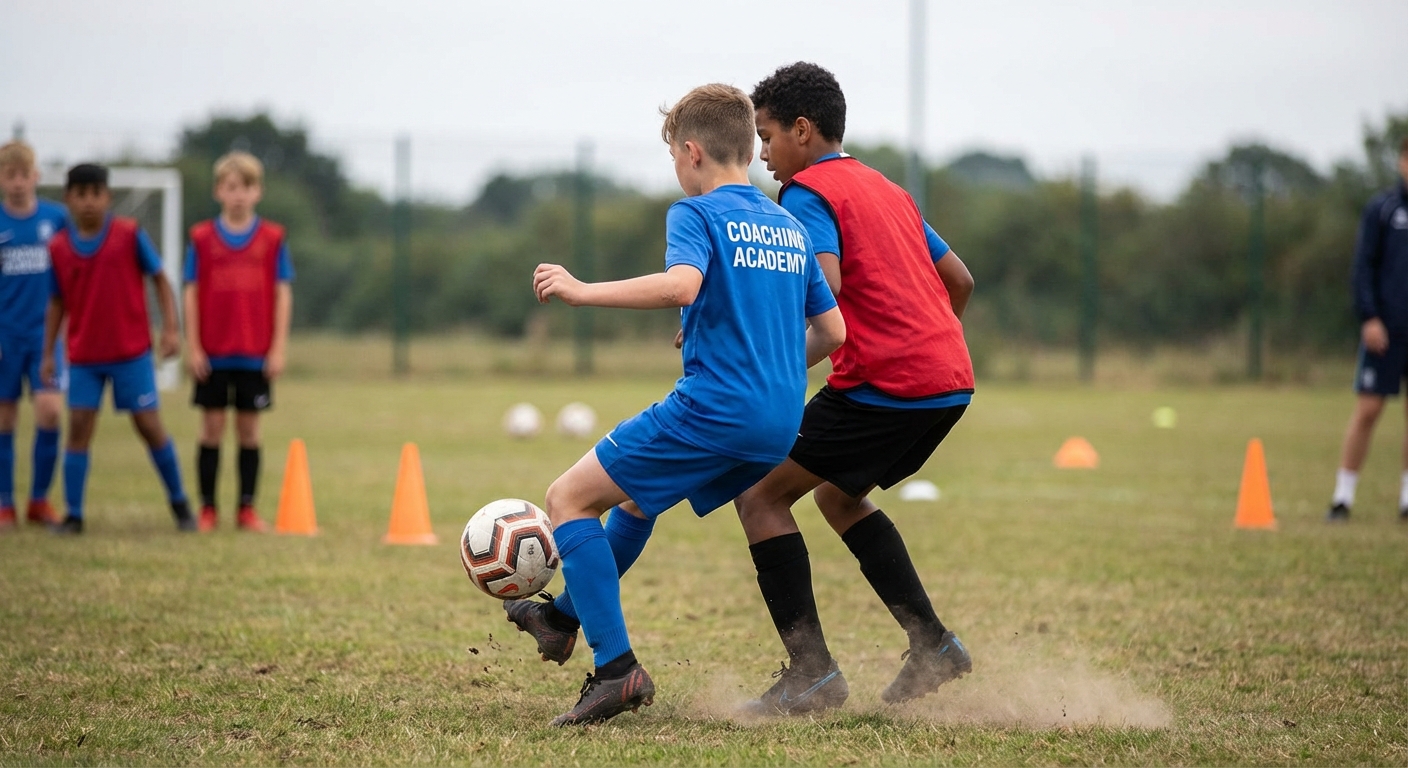
Add a defender who applies light pressure but does not try to win the ball. This forces the receiver to be aware of the defender's position and adjust their touch accordingly. The defender can increase intensity gradually as the session progresses.
Stage 3: Active Pressure in Small Spaces (15 minutes)
Small-sided games in tight grids where every touch is contested. Rondos, 3v1, 4v2, and 5v3 games are excellent here. The confined space means a poor first touch is immediately punished, creating a powerful feedback loop that accelerates learning.
Stage 4: Game-Realistic Scenarios (15 minutes)
Conditioned games that reward good first touches. For example, a player who turns their marker with their first touch earns a bonus point. Or a game where the team that completes five consecutive clean first touches scores a goal. These conditions make first touch quality the central focus of a competitive game.
Session Structure: First Touch Under Pressure
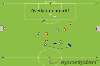
Here is a complete 70-minute session focused on developing first touch quality under match-realistic conditions:
Warm-Up (10 minutes)
Pairs passing and receiving on the move. Vary the service: ground passes, bouncing balls, lofted deliveries. Gradually reduce the space between players to increase the speed of the drill. Encourage receiving on different surfaces: inside of foot, outside, sole, thigh, chest.
Technical Practice (15 minutes)
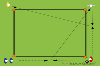
Triangle receiving drill: three players form a triangle with one defender in the middle. The receiver must use a directional first touch to evade the defender and pass to the next player. Rotate the defender regularly. Coaching focus: body shape before receiving, checking shoulder, and pushing the ball into space with the first touch.
Small-Sided Game (20 minutes)
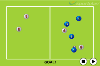
4v4 plus two neutral players in a 25x25 metre grid. Condition: players earn a bonus point for their team every time they turn a defender with their first touch. This creates a game where first touch is rewarded without removing the competitive element. Play multiple rounds with short rest periods.
Conditioned Match (20 minutes)
7v7 or 8v8 on a half pitch with full-size goals. No conditions on the game except that the coach periodically freezes play to highlight good and poor first touch decisions. Ask the player: what did you see before you received? Why did you touch the ball that way? Use questioning to develop awareness rather than just technique.
Review (5 minutes)
Gather the group and ask three players to demonstrate a first touch scenario. One shows a cushion control, one shows a directional touch, one shows an across-body touch. Reinforce that scanning before receiving is non-negotiable.
Key Coaching Points
Across all these drills and progressions, keep returning to three non-negotiable coaching points. First, scan before you receive. The first touch decision is made before the ball arrives, not after. Second, open your body to the field. A closed body shape limits options and makes the player predictable. Third, know your next action. The first touch should serve the second action, whether that is a pass, a dribble, or a turn.
Be patient with younger players. First touch under pressure is one of the hardest skills in football to develop because it combines technique, perception, and decision-making simultaneously. Celebrate improvement rather than demanding perfection, and always design your sessions so that the game is the teacher.
Frequently Asked Questions
At what age should you start coaching first touch under pressure?
From around age 8 or 9, players can begin receiving with passive pressure. The key is to make the pressure age-appropriate. At younger ages, the defender might simply be present without actively tackling. By under-12, players should regularly practise receiving with an active defender closing them down. The earlier you introduce realistic pressure, the faster the skill develops.
How do you improve first touch for players who receive with their back to goal?
Players who receive facing their own goal need to master two techniques: the layoff and the turn. Practise both in rondo-style games where one player is always in the middle receiving to feet. Emphasise using the body to shield the ball and taking a touch across the body to spin away from the defender. Shadow play before adding a defender helps players feel the movement pattern.
Is first touch something you are born with or can it be trained?
First touch is absolutely trainable. While some players have a natural feel for the ball, the vast majority of first touch quality comes from repetition in realistic environments. Research into deliberate practice shows that the volume and quality of touches in training, rather than innate ability, determines a player's technical ceiling. Consistent, pressured practice will improve any player's first touch over time.
What is the biggest first touch mistake you see at grassroots level?
The most common mistake is taking a heavy first touch that pushes the ball too far from the body. This usually happens because the player is not watching the ball onto their foot or is too tense on contact. Coach players to relax their receiving foot and withdraw it slightly on contact, like catching an egg. A close, controlled first touch in a tight space is worth more than a flashy flick that loses possession.
 sportplan_football