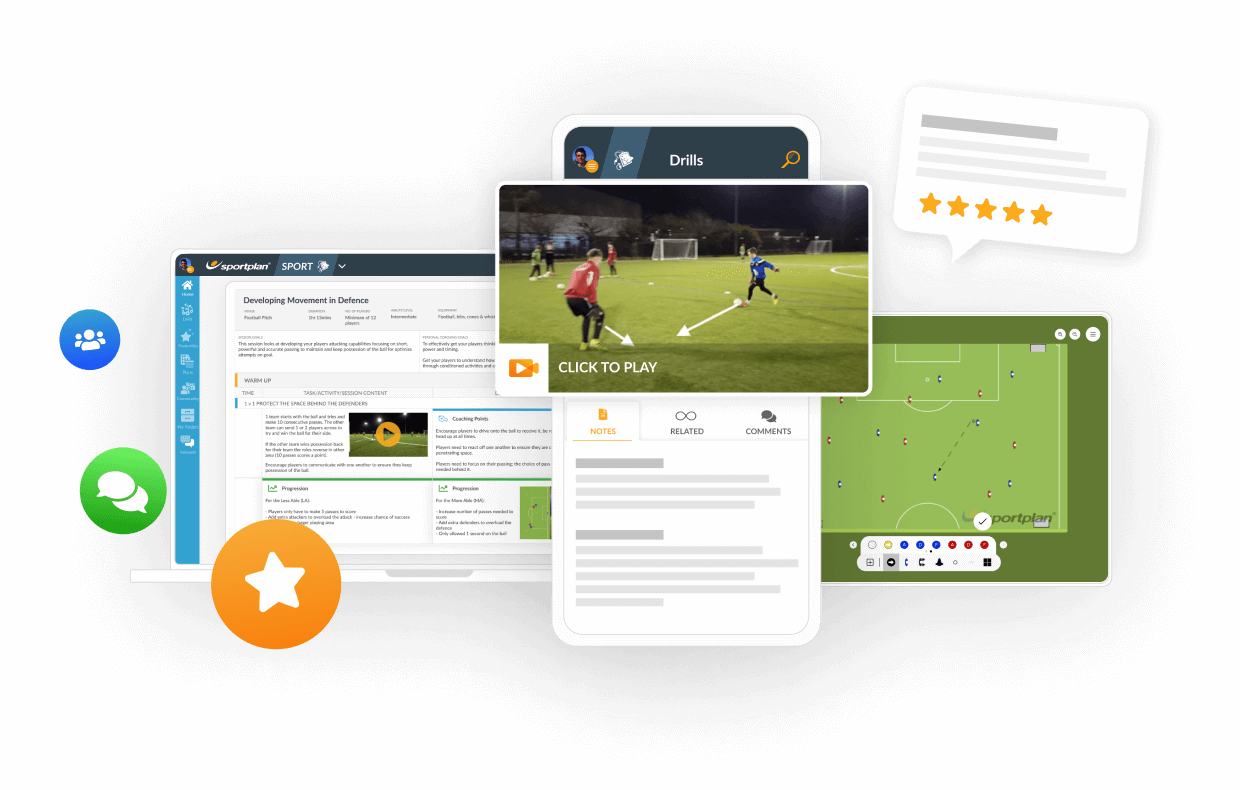
This first variation includes 2 defenders representing the opposition forwards in a typical G-4-4-2 formation.
Their role is a) win the ball by pressing together (closest to the ball presses first, next supports) b) stop at least 1 player touching the ball to win the drill.
The players in posession for this first variation has all in touches to begin with and can pass or receive more than once.
Progression 1 for this version is to restrict players in posession with 2 touches.
Progression 2 is 1 touch only. In each of the progressions the players in posession can pass and receive more than once but all players must touch the ball before reaching the objective and switching of play is not allowed.
Finally, the defending players must go for the ball. They are not allowed to stand on a non-receiving player, they must intercept, stop a pass being played or force an error.
The defensive pair will score points for the following:
1 point - winning the ball, forcing an error.
2 points - retaining posession for 4 passes.
3 points - scoring after winning possession.
The attacking team will only gain a point by scoring (1 point for each attacker). Defensive pairs are then switched with attackers to rotate the defenders, but each pair must keep score.
The pair with the lowest combined score (both individual and pair points) in the end must do a forfeit.
As with Part 1, success for the attackers relies on good touch and technique, body position and accurate passing.
However, this version and the progression are all about emphasising the importance of good movement and awareness of options.
Although the players start in a somewhat formal structure (to replicate a game), the game type and added defenders replicates the type of flow a player might experience in a game.
The best players will already have a a good mental picture of where his teammates are located based on the starting positions but will also be able to find space to enable him to both recieve the ball and maximise the passing options without having to delay once they recieve the ball.
Repetition of this drill aims to develop the attackers understanding of how to make space when touches on the ball are at a premium, to think 1 step ahead before receiving the ball and to play as a collective to achieve the objective.
in more ways than one
 sportplan_netball

in more ways than one
sportplan_football
The coaching methodology revolution sweeping grassroots football - and how to implement it at your club this season.
Why the best coaches in 2026 are measuring intensity, not just running drills - and how you can do it without expensive technology.
Why Barcelona's favourite training exercise should be in every coach's toolkit - and how to run rondos that actually transfer to matches.