

The Coaching Problem
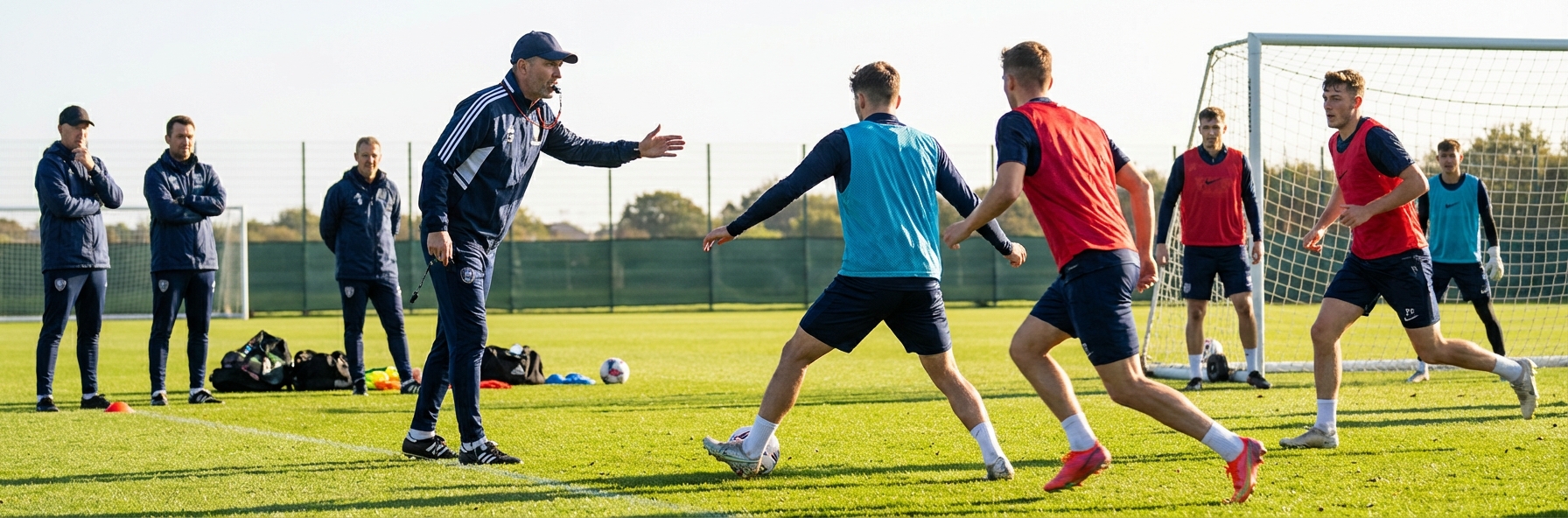
Your team loses the ball in midfield. Two attackers break against one defender. Your player dives in, gets beaten, and it's a goal. It happens week after week, and your team keeps conceding from counter-attacks.
The 2v1 situation is one of football's most common scenarios - and one of the most misunderstood. Defenders think their job is to win the ball. It isn't. Their job is to buy time.
Why Defenders Fail in 2v1 Situations
The natural instinct is to win the ball back. Defenders see the attacker, see the ball, and lunge in. But in a 2v1, the maths works against you. If you commit and get beaten, it's a 1v0 with a free run at goal.
Poor recovery runs make it worse. When teams lose possession, players often jog back rather than sprint. By the time they engage, teammates are still 20 yards away. The 2v1 becomes permanent instead of temporary.
The 4 Principles of 2v1 Defence
1. Delay, Don't Dive
Drop back at the same pace as the attacker. Stay on your feet. The longer you delay, the more time teammates have to recover. A failed tackle is worse than no tackle at all.
2. Force the Attacker Wide
Position your body to show the attacker toward the touchline. Central areas are dangerous - wide areas give you more recovery time and limit shooting angles.
3. Make Them Make the Decision
By holding your position between the ball carrier and the second attacker, you create doubt. Should they shoot? Pass? Dribble? Doubt leads to mistakes.
4. Communicate and Track
Talk constantly. Tell recovering teammates where to go. If the pass is made, track the second attacker and become the primary defender on the new ball carrier.

The Body Position Framework
The Side-On Stance
Face half toward the ball carrier, half toward the second attacker. This allows you to see both and react to either the dribble or the pass. Square-on stances leave you blind to runners.
The Imaginary Line
Picture a line between the two attackers. Your job is to stay on that line, adjusting position as they move. If the ball carrier goes wide, shuffle to maintain the angle. Never let them get between you.
The Retreat Distance
Stay 2-3 yards from the ball carrier. Close enough to pressure but far enough to react. Too tight and you'll be beaten with pace. Too far and you give them time to pick a pass.
Progressive Training Drills
Stage 1: Passive Opposition
Set up 2v1 situations where attackers can only walk. Defenders practice body shape and positioning without the pressure of pace. Build the habit before adding intensity.
Stage 2: Semi-Active
Attackers can jog but not sprint. The defender must now read movement while maintaining position. Add the rule that defenders score a point for every 5 seconds they delay.
Stage 3: Fully Active
Full speed 2v1 with recovery runners. A second defender starts 10 yards behind and must sprint to help. The first defender's job is to delay until the numbers are even.
Stage 4: Game-Realistic
Transition game where the defending team loses the ball and immediately faces a 2v1 counter. Rewards go to teams that prevent goals rather than win the ball back.
Recommended Drills
These Sportplan drills will help you train 2v1 defending:
Common Mistakes and How to Fix Them
- Diving in: Use the "hands behind back" drill to stop lunging. Defenders must delay for 5 seconds before they're allowed to tackle.
- Ball watching: Have defenders call out the second attacker's position every 2 seconds. This forces scanning.
- Square body shape: Use cones to mark angles. Defenders must keep one foot in the "ball zone" and one in the "cover zone".
- Poor communication: Award bonus points when recovering defenders respond correctly to the first defender's call.
- Giving up: If a defender stops, the drill restarts. Chasing to the end must become habit.
Frequently Asked Questions
Should the first defender ever tackle in a 2v1?
Only if the attacker takes a heavy touch or makes an obvious error. Otherwise, stay patient. A successful tackle is great; a failed tackle is often a goal.
When should the defender commit to the ball carrier?
When help has arrived and numbers are even, or when the attacker enters the penalty area and you must prevent the shot. In open play, delay is almost always better than committing.
How do you train recovery runs?
Every transition drill should include recovery running. Players who lose the ball must sprint back before pressing again. Make the sprint non-negotiable.
What if the attacker just runs past while I'm delaying?
Then retreat with them. Staying goal-side and slowing them down is still winning. An attacker who has to take an extra 3 seconds gives your teammates time to recover.