



So You're Running a Junior Football Team
Maybe your child's team had no coach and nobody else put their hand up. Maybe a friend roped you in over a coffee. However it happened, you are now responsible for a dozen or so excited children, a bag of footballs and a Saturday morning. It can feel daunting - but thousands of ordinary volunteers do exactly this every season, with no professional background, and have the time of their lives doing it. This guide walks you through your whole first season, in roughly the order you will need it.
The job splits neatly into two halves. There is the football - the sessions, the drills, the encouragement on the touchline - and there is the admin - affiliation, registration, fixtures and money. Most new coaches worry about the football and underestimate the admin. Get the admin set up properly at the start and it largely runs itself, freeing you to do the part you actually signed up for. Let's take it step by step.
Your First Season, Step by Step
- 1. Affiliate your team: Register the team with your County FA - this gives you official status and the insurance package most leagues require.
- 2. Get qualified and checked: Complete the entry-level FA Introduction to Coaching Football course, FA safeguarding training, and an FA Enhanced DBS check. Start this early.
- 3. Register your players: Add each child through the FA's Whole Game System with parental consent.
- 4. Find a league and a pitch: Join a local mini-soccer league for your age group and secure somewhere to train and play.
- 5. Sort your kit: A matched strip, a few balls, bibs, cones, goals and a first-aid kit will get you on the pitch.
- 6. Plan your first sessions: Keep it simple, fun and ball-heavy - little queueing, lots of touches.
- 7. Set up parents and comms: Agree a touchline code of conduct and one clear way to reach every family.
- 8. Handle the money: Set a fair sub and match fee, and pick a simple system to collect and track it.
1. Affiliate Your Team with the County FA
Affiliated football is football that is officially recognised and insured under The FA. To take part in a sanctioned league, your team must be affiliated to your local County FA - the regional body that administers grassroots football in your area (Surrey FA, Lancashire FA, and so on). Affiliation is an annual process, usually done online, and it typically bundles in the public-liability and personal-accident insurance that your league and your conscience both want you to have.
If you are joining an existing club, the club secretary handles much of this and you simply slot your team in. If you are setting up from scratch, there are a few more boxes to tick - committee roles, a constitution, a bank account - which we cover in detail in our starting a grassroots football team checklist. Either way, your County FA's grassroots team is the single best phone call you can make; they do this all day and will walk you through every step.
2. Get Qualified, Trained and DBS-Checked
You do not need a UEFA badge to coach an under-8s side, but to work with children in affiliated football there are three things you genuinely do need, and you should start them now because they take a little time to come through.
First, the entry-level coaching course: the FA Introduction to Coaching Football. It is a friendly, practical course that gives a brand-new volunteer the basics of running a safe, fun session - no prior experience assumed. Most leagues expect at least one qualified coach per team. Second, FA safeguarding training - a short course on keeping children safe that everyone in a coaching role completes. Third, an in-date FA Enhanced DBS check, the criminal-records check required for anyone in a regulated role with under-18s, renewed every three years. Your County FA processes the DBS for you.
Book the course and start the DBS as early as you can in the summer. Checks can take a few weeks to clear, and you want everything in place before the first whistle of the season.
3. Register Your Players
Once the team is affiliated, every child who plays in competitive fixtures must be registered. This is done through the FA's Whole Game System, the official online platform for affiliated football. You add each player's details and a photo, and a parent or guardian confirms consent. Your league will tell you its registration deadline and any squad-size rules - mini-soccer formats (5v5 at under-7/8, 7v7 at under-9/10, 9v9 at under-11/12) have sensible limits on matchday numbers.
One important point to be clear on from day one: the FA Matchday app and your league's Full-Time system are the official place for fixtures, results and registration. Whatever else you use to organise your team day to day, these FA systems remain the record that counts - keep them up to date.
4. Find a League and a Pitch
Your County FA can point you to the local youth and mini-soccer leagues for your age group. Most leagues run an autumn-to-spring season with registration over the summer, so make contact early. When you join, you will be told your match format, the matchday rules for your age group, and the registration deadline.
You will also need somewhere to play and train. Many teams use a local recreation ground, a school pitch hired for the season, or a club's home venue. For training, a flat, safe patch of grass and a set of portable goals is plenty at mini-soccer age. Sort the pitch before you confirm fixtures - a fixture with nowhere to play it is no fixture at all.
5. The Kit You Actually Need
It is easy to overspend here, so focus on the essentials. A new mini-soccer team really only needs:
Your Starter Kit List
- A matched playing strip: Numbered shirts, shorts and socks in one colour so the team looks like a team. Many clubs find a local sponsor to cover this.
- Footballs: A handful of size 3 balls (size 4 from under-10) - ideally one between two so nobody stands waiting for a turn.
- Bibs: Two sets in contrasting colours for splitting the group into teams in seconds.
- Cones: A bag of flat markers and a few taller cones to mark out grids and goals.
- A first-aid kit: Stocked, in-date, and in your bag at every single session and match. Know who your first-aider is.
- Goals and a pitch: Portable mini-soccer goals or whatever your venue provides. Always check they are anchored safely.
That is genuinely enough to start. Resist the temptation to buy gadgets and elaborate training aids in week one - cones, balls and bibs will see you through your entire first season.
6. Plan Your First Sessions
The golden rule of coaching young children: maximum touches, minimum queueing. Avoid long lines where one child kicks a ball and eleven others watch. Instead, run small games and activities where everyone has a ball, or nearly everyone is involved at once. Keep it fun, keep it moving, and always finish with a game - it is the bit they came for.
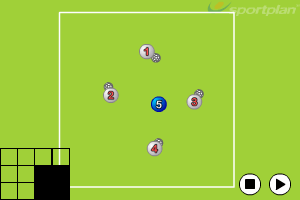
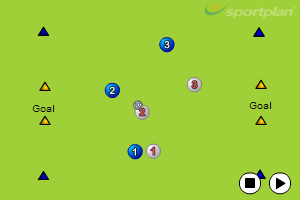
A simple session shape works every time: a lively ball-based warm-up, a skill activity, a small-sided conditioned game, then a match. You do not have to invent this from scratch. Drop ready-made practices into our free football session plan template, and pull age-appropriate ideas from our drills for juniors guide. Here are two reliable starters from the Sportplan library:
7. Managing Parents and the Touchline
Here is a truth no FA course quite prepares you for: the children are rarely the hard part - the touchline is. The vast majority of football parents are wonderful, but a noisy minority can sour a Saturday for everyone. Get ahead of it. At your first parents' meeting, share the FA Respect touchline code of conduct: support, do not coach from the sideline; clap good play from both teams; no shouting at the referee, who is often a teenager; and let the children make their own decisions on the pitch. Many leagues ask parents to sign up to this, and a designated spectators' area keeps everyone the right side of the line.
Beyond conduct, you need one clear way to reach every family. New coaches default to a WhatsApp group and a spreadsheet, and for a first few weeks that is fine. But it quickly becomes a second job: messages lost in the scroll, availability re-asked every week, payments chased by hand. Our guide to football club communication looks at this in more depth.
8. Sorting Fixtures, and the Money Side
Once the season starts, your week settles into a rhythm: confirm who is available, name your squad, play the game, log the result. Remember that FA Matchday and Full-Time are the official place for your league's fixtures, results and registration - that is non-negotiable and you should keep them current.
The money side need not be complicated. Most teams charge a subscription - a termly or monthly amount from each family that covers affiliation, insurance, kit, pitch hire and league fees - topped up by a small match fee on the day. Set a sub that genuinely covers your costs without pricing any child out of playing, and keep a small buffer for replacing balls and bibs. Our guide to setting subs and match fees shows how to work out a fair figure.
This is where the day-to-day admin can quietly eat your evenings - chasing the same three unpaid match fees, counting thumbs-up emojis to work out who is coming, copying numbers into a spreadsheet. A purpose-built club app pulls availability, subs and match fees, registration and parent comms into one mobile-first place instead of a spreadsheet plus a WhatsApp group. Teamo does exactly that - players' families RSVP in a tap, recurring subs collect by Direct Debit (2% + 20p at the time of writing, cheaper than card for regular subs), and live payment status sits alongside your squad selection so unpaid balances surface without an awkward chase. It is free for up to 25 members with no ads. In the interest of being straight with you, it is made by the Sportplan team behind this site, so weigh that and try it alongside the alternatives. And to be clear, it does not replace FA Matchday or Full-Time - those remain the official system for fixtures, results and registration; a club app simply takes the day-to-day organising off your plate.
You've Got This
Read end to end, that is a lot of steps - but spread across a summer of preparation it is very manageable, and your County FA, your league and the wider football community are all on hand to help. Set the admin up well once, lean on ready-made sessions so planning is quick, and protect the joy of the thing: a dozen children, a ball each, and a coach who clearly wants to be there. When you are ready to plan week one, browse the full Football drills library for hundreds of age-appropriate practices. Have a brilliant season.
Frequently Asked Questions
What do I need to start a junior football team?
At a minimum you need: a team affiliated to your County FA, your players registered through the FA's Whole Game System, at least one volunteer who has completed the entry-level FA coaching course and holds an in-date FA DBS (safeguarding) check, a place in a local mini-soccer league, and the basic kit - a matched playing strip, a few balls, bibs, cones, a first-aid kit and access to goals and a pitch. After that it is fixtures, a way to communicate with parents, and a simple plan for collecting subs and match fees. None of it is expensive, and most County FAs will hold your hand through the affiliation steps.
Do football coaches need a DBS and FA qualification?
To coach children in affiliated grassroots football, yes. Anyone in a regulated role with under-18s needs an in-date FA Enhanced DBS check (renewed every three years) and is expected to have completed FA safeguarding training. For coaching itself, the entry-level FA Introduction to Coaching Football course gets a new volunteer started, and most leagues expect at least one qualified, DBS-checked adult per team. Your County FA processes the DBS and can point you to the next available courses - start this early, as checks can take a few weeks to clear.
How do I register players with the FA?
Player registration is done through the FA's Whole Game System, the official online platform for affiliated football. Once your team is affiliated to the County FA, you add each child's details and a photo, and a parent or guardian confirms consent. Your league will tell you its registration deadline and any rules on squad size. The FA Matchday app and the league's Full-Time system are then the official place for fixtures, results and registration - keep these up to date, as they are the record that counts.
How much does it cost to run a junior football team?
It varies, but a new mini-soccer team can usually get going for a few hundred pounds: County FA affiliation, a public-liability and personal-accident insurance package (often bundled with affiliation), a matched strip, a few balls, bibs, cones and a first-aid kit, plus league entry and any pitch hire. Most clubs cover this with subscriptions - a termly or monthly sub from each family - topped up by match fees on the day. Set a sub that covers your real costs without pricing children out, and keep a small buffer for replacing kit.