Every season throws up the same afternoon. You have seventy per cent of the ball, the opposition have not left their own half, and the game finishes goalless because nobody could find a pass between the lines. A well-organised mid-block is one of the most frustrating problems in football, and it is far more common at grassroots level than a high press.
The good news is that a block that sits deep is making a trade. It is buying compactness with territory, which means the space is always there somewhere. Your job is to teach your players where it is and how to get the ball into it before the block can shift.
Why Your Team Gets Stuck
Most teams stall against a block for one of three reasons. They circulate the ball too slowly, so the defence has time to slide across and reset. They play everything in front of the block, passing sideways between centre-backs while the opposition happily watch. Or they force the pass too early, giving the ball away cheaply and inviting a counter.
Underneath all three is the same issue: the ball moves faster than players think. If your midfielders are only scanning when the ball arrives, the picture has already changed by the time they look up.
Where the Space Actually Is
Against two compact banks, three spaces are almost always available. Behind the block, if you can get a runner beyond the last line. Wide of the block, in the channels the wide midfielders have vacated by tucking in. And between the lines, in the pocket a striker or attacking midfielder can occupy if they position themselves in the shadow of an opponent.
The trick is that these spaces are only available in sequence. You cannot access the pocket between the lines until the block has been stretched wide. You cannot get in behind until somebody has occupied the pocket and turned the defence around. Teaching that sequence is the whole job.
A Five-Step Framework
Step One: Move the ball, not your feet. Two-touch circulation across the back and through midfield forces the block to shift. Every shift creates a moment where one player is late, and that is your entry point.
Step Two: Stretch it wide, then attack the middle. Switch the ball from one side to the other with purpose. A block that has slid twice in ten seconds is a block with gaps in it.
Step Three: Occupy the pocket permanently. Give one player the standing instruction to find space between the opposition midfield and defence and to stay there. Even when they do not receive, they pin defenders and stop the block from squeezing.
Step Four: Time the run to the pass. The forward run and the forward pass have to happen together. If the runner goes early they are offside or covered; if they go late the window has shut. This is a rehearsal problem, not a fitness problem.
Step Five: Set your rest defence before you commit. Teams that sit deep are usually good at countering. Know which players stay behind the ball, every single time, before you send the full-backs forward.
How to Train It
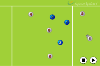
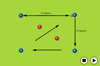
Use overload games where the attacking side has an extra player and a compact defensive zone to break into. A five against three end-zone game teaches exactly the right habits: patient circulation, then a sharp entry pass when the defence commits.
Add a condition that rewards what you want. A goal counts double if the assist comes from a pass into the pocket, or if the ball is switched from one side to the other in the build-up. Players solve the problem you set them, so set the right one.
Key Coaching Points
- A deep block trades territory for compactness, so the space is always somewhere; find it in sequence.
- Fast, two-touch circulation forces the shifts that create gaps; slow passing lets the block reset.
- Give one player the permanent job of occupying the pocket between the lines.
- Time the forward run and the forward pass together, and rehearse it until it is automatic.
- Switch the point of attack with purpose, not for the sake of possession statistics.
- Fix your rest defence before committing full-backs, because deep teams counter well.
Recommended Drills
Frequently Asked Questions
My players just hit long balls when they get frustrated. How do I stop that?
Give the long ball a purpose rather than banning it. A diagonal into the channel behind a full-back is a good option against a deep block; a hopeful ball into a crowded box is not. Coach the difference, and your players will stop treating the long pass as a way out of thinking.
Should I push both full-backs forward against a team that sits in?
Usually one, not both. You need width to stretch the block, but a team defending deep is looking to counter into the space you leave. Send one full-back high, keep the other tucked in alongside the centre-backs, and rotate which side goes.
How long should we be patient before forcing the issue?
Patience is not the same as passivity. If you have circulated twice and nothing has opened, that is the moment to change something, whether that is a switch, a run in behind, or a player dropping into the pocket. Waiting without changing anything is just slow possession.
 sportplan_football