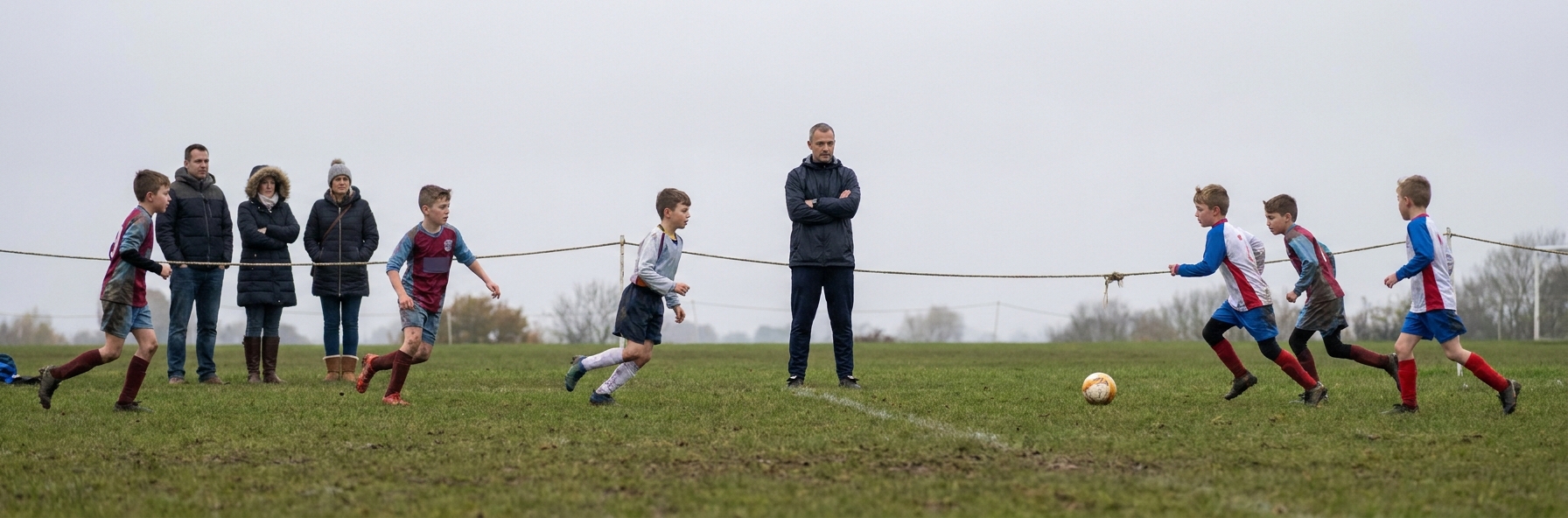
Listen to most grassroots games and you will hear the same soundtrack: a parent calling "man on", a coach shouting "pass it", another voice telling a defender to push up. All well meant, all too late by the time the words land, and all of it training players to wait for an instruction instead of making their own decision.
The FA's national Silent Support Weekend returns on 14 and 15 November 2026, and it is a good prompt for every coach, not just the clubs taking part, to ask a harder question: how many of your players could actually play well if nobody told them what to do?
Why Shouting From the Sideline Backfires
A shouted instruction arrives after the player has already had to look towards the noise to understand it, which is a split second they are not scanning the pitch. Over a season, players who are constantly told what to do stop reading the game for themselves. They wait to be instructed, and when the pitch goes quiet, as it does in a real match once the whistle blows, they freeze.
Players who are taught to scan, call to each other and read cues from team-mates make faster decisions because they are gathering the information themselves, continuously, rather than waiting for someone else to shout it from thirty yards away.
What Silent Support Weekend Actually Asks For
Silent Support Weekend is a national England Football and FA initiative. Applause for good play is welcome, and so is quiet encouragement from coaches, but the running commentary and shouted instructions that fill a typical touchline are paused for the weekend. The point, in the FA's own words, is to give young players space to talk to each other and make their own decisions on the pitch, without hearing from the sidelines. The previous national weekend in March 2026 had over a million players take part, and 97% of those surveyed said behaviour either improved or stayed the same.
Whether or not your league is formally taking part on 14 and 15 November, the idea behind it is worth building into training all year round.
Build Players Who Do Not Need Telling
Step One: Teach scanning as a habit. Before every pass, players should take a shoulder check to see space and team-mates. Make it part of your technical coaching, not a one-off reminder, so it becomes automatic rather than something only done when told.
Step Two: Give the team a shared language. Agree two or three simple calls, such as "time" or "man on", that players use with each other on the pitch. The aim is for players to organise themselves, not to replace parent noise with coach noise.
Step Three: Train with the talking removed. Use silent rondos and silent small-sided games so players rely on eye contact, body shape and anticipated movement instead of calling. It sharpens the non-verbal communication that a noisy touchline usually drowns out anyway.
Step Four: Coach between the play, not during it. Save your detailed input for the team talk before kick-off and for half-time and full-time. In open play, limit yourself to calm, brief encouragement and let mistakes happen.
Step Five: Debrief with questions, not answers. After training or a match, ask "what did you see?" and "what else could you have done?" rather than telling players what they should have done. It builds the habit of thinking it through themselves.
How to Train It: A Quiet-Touchline Session Plan
Warm-up: start with a short silent small-sided game. No calling for the ball, no talking at all, just eye contact and movement to show for a pass.
Technical: move into a scanning-focused passing drill where players must keep their head up to spot a visual cue before they can play.
Decision-making: add a small possession game where one player has to read passing lanes and decide when to step in and intercept, rather than being told.
Game: finish with a conditioned small-sided game that rewards players for recognising space and communicating a run, bringing the whole session together under match pressure.
Key Coaching Points
- Give your detailed instructions before kick-off and at half-time, not as a running commentary during play.
- Make scanning (the shoulder check) a coaching point in every passing drill, not a separate topic.
- Agree two or three simple calls as a team so players organise each other on the pitch.
- Practise with talking removed occasionally, so players build genuine non-verbal communication.
- Ask questions in the debrief instead of giving answers, to build independent decision-making.
- Praise a good decision even when the outcome goes wrong, so players keep trying to think for themselves.
Recommended Drills

VIEW ALL PASSING AND RECEIVING DRILLS
Frequently Asked Questions
What exactly is Silent Support Weekend?
It is a national England Football and FA initiative, returning on 14 and 15 November 2026. Applause and quiet encouragement from coaches are welcome, but the shouted instructions and running commentary that usually fill the touchline are paused, so players get space to talk to each other and make their own decisions.
Can coaches still say anything during the match?
Quiet encouragement is fine. What the weekend asks everyone to pause is the constant stream of shouted instructions, from both coaches and parents, that can stop players reading the game for themselves.
My players look lost without instructions shouted at them. What do I do?
That reaction is normal the first time the sideline goes quiet; it usually means they have not had much practice making decisions on their own. Build scanning, simple team calls and silent training games into your normal sessions, and the quiet will feel far less sudden on the day.
 sportplan_football