From Idea to Kick-Off: What It Actually Takes
Plenty of grassroots clubs in England start the same way: a parent or two decide the local kids need somewhere to play, or a group of friends want a Sunday-league side, and suddenly someone has to make it real. The good news is the path is well worn and the steps are clear. The catch is that there are more of them than people expect, and the order matters - in particular, you cannot play sanctioned fixtures until you are affiliated, and you should not run a single junior session until your safeguarding is in place.
This guide is a working checklist for starting a grassroots football team or club in England. It assumes you are setting up to play in the affiliated game - mini-soccer or youth football for juniors, or open-age adult football - rather than a casual kickabout. Work through it roughly in order and you will have everything you need to register players, enter a league and run safe sessions by the start of a season.
Step 1: Affiliate With Your County FA
The first formal step is affiliation. Every grassroots club in England plays under the umbrella of its County FA, the local arm of The Football Association. You affiliate through the FA's Whole Game System - the online portal that registers your club, your teams, your officials and, in time, your players. Affiliation gives you access to the laws of the game, the disciplinary structure and, crucially, the route to insurance and league entry. Without it you cannot play sanctioned fixtures.
When you affiliate you will be asked for club details, the teams you intend to run, and the key officials - typically a chairperson, secretary, treasurer and, for any club with juniors, a Club Welfare Officer. Set the club up properly on the Whole Game System now, because almost everything else - player registration, official records, your safeguarding checks - flows through it.
Longer term, aim to become an FA-accredited club (the scheme formerly known as Charter Standard). Accreditation is a quality mark showing you meet The FA's standards on coaching, safeguarding and how the club is run. It is not required to start playing, but it reassures parents and leagues, and can help with access to pitches and funding. Most clubs affiliate first, get a season under their belt, then work towards accreditation.
Step 2: Set Up the Club Itself
A football club is, in legal and practical terms, a small organisation - and it needs a little structure so that it does not all rest on one exhausted volunteer. Three things make a club a club rather than one person's side project: a committee, a constitution and a bank account.
Pull together a small committee - at minimum a chairperson, a secretary and a treasurer, with as many willing hands as you can find. Write a short constitution: a one or two-page document setting out the club's name, aims, how decisions are made and how money is handled. Leagues and your County FA will often want to see one, and it protects everyone if there is ever a dispute. Then open a dedicated club bank account in the club's name, ideally requiring two signatories, so that subs and match fees never run through a personal account. This matters for transparency and it matters for safeguarding the club's money.
Step 3: Insurance, a Pitch and a Winter Venue
Two practical essentials sit alongside affiliation. The first is public liability insurance - cover in case someone is injured or property is damaged in connection with your activities. Many County FAs offer or include a scheme as part of affiliation; check what your affiliation covers and top it up if needed. Do not run sessions uninsured.
The second is somewhere to play. You will need a match and training pitch - often hired from a local council, school or sports facility - and, for the autumn and winter, an indoor or all-weather training venue for when grass pitches are frozen or waterlogged. Sort the winter venue early; demand for sports halls and 3G surfaces is high and slots get booked up months ahead. Confirm pitch dimensions and goal sizes match the format you are playing, especially for mini-soccer.
Step 4: Join a League and Register Players
To play regular fixtures you need to enter a local youth or adult league sanctioned by your County FA. Leagues usually take applications in the spring for the following season, so plan ahead. Once you are in, you register each player - again through the Whole Game System / FA Matchday, the official record for grassroots registration, fixtures and results. League and registration fees vary by area, so budget for them.
Keep the official FA registration and your day-to-day club admin clearly separate in your mind. FA registration through the Whole Game System is the system of record and is required - nothing replaces it. The week-to-week chasing of availability, subs and messages is a different job, and we will come to the tools for that shortly.
Step 5: Kit, Equipment and Volunteers
Now the visible bits. You will need a set of matching kit (shirts, shorts, socks - check your league's colour-clash and sponsorship rules), and basic training equipment: a bag of balls in the right size for your age group, bibs, cones, a decent first-aid kit, and portable goals if your pitch does not have its own. None of this needs to be expensive to start with.
Just as important are people. Beyond the coach you will want a team manager, someone to run the line and help on matchdays, and ideally a fixtures secretary. Recruit a couple of reliable volunteers early - a club that leans on one person does not last. When you are ready to think about how to organise all of this week to week, our guide on how to run a junior football team walks through the full season.
Step 6: Safeguarding - Get This Right Before Anything Else
If your club involves under-18s, safeguarding is not optional and it is not a formality to rush through. It is a legal and moral duty, and The FA takes it seriously - so should you. Put it in place before your first junior session, not after. Here is the core of what The FA requires.
The Junior Safeguarding Mini-Checklist
- Club Welfare Officer: Appoint a designated Club Welfare Officer who has completed the FA Safeguarding Children course and the FA Welfare Officer workshop. Every junior club must have one, and they are your first point of contact for any concern.
- FA DBS checks for everyone in regulated activity: Coaches, assistant coaches, team managers and the Welfare Officer must hold a current FA Enhanced DBS check (FA CRC), processed through The FA - not just any DBS certificate. Track expiry dates and renew on time.
- FA Safeguarding Children certificate: Anyone coaching children should hold the FA Safeguarding Children certificate alongside their DBS, and refresh it when The FA requires.
- A written safeguarding policy: Adopt The FA's safeguarding policy and procedures, make sure everyone knows where to find them, and know how to report a concern to your County FA Designated Safeguarding Officer.
- Codes of conduct: Put The FA's codes of conduct in place for coaches, players, parents and spectators - and be willing to enforce them on the touchline.
- Safe communication: Decide how adults will and will not contact young players. Avoid private one-to-one messaging between coaches and children; keep communication open, group-based and visible to parents.
Treat this checklist as the floor, not the ceiling. The detail of qualifications and timescales is set by The FA and your County FA, so confirm the current requirements with them - but the principle never changes: no DBS-checked, qualified, supervised setup means no junior football. Get it in place first.
Registration, Consent and Day-to-Day Admin
Two things happen the moment players join: you need their details captured properly, and you need to be able to reach them safely all season. Doing that on paper and a group chat works for a fortnight, then quietly becomes the job that eats your evenings - chasing emergency contacts, re-asking who is available, mixing parents and children in one open chat.
This is where a club app helps, and it is worth being clear about what it does and does not do. FA registration through the Whole Game System / FA Matchday remains separate and required - it is the official record for fixtures, results and registration, and no club tool replaces it. What a club app does is the day-to-day layer alongside it: capturing member details with emergency contacts and consent recorded properly under GDPR, handling availability and reminders, and keeping communication child-safe with guardian visibility.
One option here is Teamo. In the interest of being straight with you, Teamo comes from the Sportplan team behind this site, so weigh that as you would any recommendation from a maker. It is built whole-club and mobile-first - which matters when around nine in ten members will only ever open it on a phone - with online member registration that captures emergency contacts and consent under GDPR, and child-safe communication with guardian visibility designed for junior squads. On the safeguarding point specifically, it was nominated best safeguarding app by England Athletics' Head of Safeguarding - that recognition was for England Athletics, in another sport, so we mention it as a credential rather than a football endorsement. If a safer way to register members and message a junior club is useful, you can see how Teamo handles club registration and safe comms. Whatever you choose, your FA registration still goes through the Whole Game System.
A Few Drills to Get Your First Sessions Going
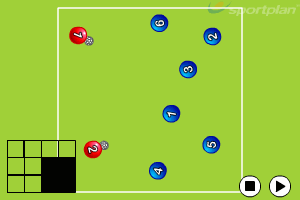
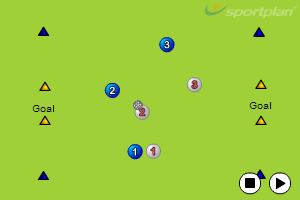
Once the admin is done, the fun begins - actually coaching. For brand-new teams of mini-soccer age, keep early sessions simple, high-energy and full of touches on the ball. A couple of starting points from the Football drills library:
For more on the season-long jobs, our guides on communicating with your football club and parents and setting subs and match fees pick up where this checklist leaves off. Get the foundations in place, keep the players smiling, and the rest follows.
Frequently Asked Questions
How do I start a grassroots football team?
Start by affiliating with your County FA through the FA's Whole Game System - this registers your club, gives you access to the rules and is required before you can play sanctioned fixtures. Then form a small committee, write a short constitution, open a club bank account, take out public liability insurance, secure a pitch and a winter training venue, and apply to a local youth or adult league. Recruit players and a few volunteers, sort kit and basic equipment, and - before anyone runs a session - put your safeguarding in place: an FA-qualified Club Welfare Officer and FA DBS checks for everyone in regulated activity. Working as a recognised FA-accredited club (formerly Charter Standard) is a sensible longer-term goal.
Do you need a DBS to coach junior football?
Yes. Anyone in regulated activity with children - coaches, assistant coaches, team managers and your Club Welfare Officer - must hold a current FA Enhanced DBS check (also called an FA CRC) processed through The FA, not just any DBS certificate. The FA renews these on a rolling basis, so check expiry dates each season. A DBS check is one part of safeguarding, not the whole of it: qualified coaches should also hold the FA Safeguarding Children certificate and the club should have a safeguarding policy and codes of conduct in place.
What is FA Accreditation (formerly Charter Standard)?
FA Accreditation is The FA's quality mark for grassroots clubs that meet agreed standards on coaching qualifications, safeguarding, codes of conduct and how the club is run. It replaced the older Charter Standard scheme. Accreditation is not required to play, but it signals to parents and leagues that the club is properly organised and safe, and it can help with access to facilities and funding. Most new clubs affiliate first, get the basics right over a season, then work towards accreditation.
How much does it cost to set up a football team?
It varies a lot by county and league, but expect to budget for County FA affiliation, league entry and player registration fees, public liability insurance, FA DBS checks and any coaching courses, a set of kit and basic equipment (balls, bibs, cones, a first-aid kit, portable goals if your pitch has none), and pitch or hall hire. As a rough order of magnitude many new junior teams spend a few hundred pounds to get going, then cover ongoing pitch hire and league fees through subs and match fees across the season. Check exact figures with your County FA and league, as they change each year.

 sportplan_football