


The Touchline Flashpoint Nobody Warns You About
Ask a grassroots football coach what causes them the most stress and few will say tactics or training. It is game-time. A parent has counted the minutes their child sat out. Another thinks their son should start. Someone mutters about the same seven players always finishing the match. None of it is about the football itself - it is about fairness, and fairness is the thing parents watch most closely of all.
This matters because at junior level - mini-soccer and the 9v9 and 11v11 years that follow - the point of the game is not the scoreline. It is to develop young players and keep them in love with football. The FA is unambiguous about this: in youth football, development comes before winning, and every child should get meaningful, broadly equal playing time. A child who spends most of Saturday on the bench is not developing, and is far more likely to drift out of the game altogether. Get game-time right and most touchline friction disappears with it.
What the FA Actually Asks of You
The FA's youth philosophy puts long-term player development ahead of short-term results, and fair playing time is central to it. The principle is straightforward: in the formative years every child deserves a genuine chance to play, improve and feel part of the team. "Fair" does not have to mean identical to the second - but it does mean no child is repeatedly left watching while their teammates play.
How strict you make it shifts with age. At the youngest mini-soccer ages (5v5 and 7v7), aim for genuinely equal minutes - the gap between your most-used and least-used player over a match should be small. As players move into 9v9 and then 11v11, and the game gradually becomes more competitive, many coaches move from strictly equal towards demonstrably fair: everyone still plays a real part of every match, but minutes may flex a little. The line you must not cross at any junior age is benching a child for most of the game to chase a win. That is the behaviour the FA's guidance exists to prevent.
Plan Your Substitutions Before Kick-Off
Here is the uncomfortable truth about game-time: if you do not plan it, your strongest players will quietly end up with the most minutes. In the heat of a tight match, the instinct is to keep your best XI on and leave the substitutes shivering. You do not do it out of malice - you do it because you are reacting, not planning.
The fix is to decide your rotation before kick-off, written down, so you are not making emotional calls at 1-1 with ten minutes to go. Modern grassroots football makes this practical because most youth leagues allow rolling substitutions - a player who comes off can go back on later. That means you can move your whole squad through the match in planned blocks rather than benching anyone for the full ninety. Split the match into thirds or quarters, work out roughly how many minutes that gives each player, and stick to it unless there is a genuine reason not to.
A Sample Matchday Game-Time Plan
To show how this works in practice, here is a worked example for a 9v9 squad of twelve playing two 30-minute halves (60 minutes total). With three substitutes on the bench, you need everyone rotating through to keep minutes fair. The same logic scales to a 7v7 squad of ten with shorter halves.
9v9 Matchday: Fair Game-Time Plan (Squad of 12, 60 mins)
- Before kick-off: Write the four 15-minute blocks down the side of a card and pencil each player into the blocks you plan to rest them. Aim for each player to sit out one block, no more.
- Block 1 (0-15 mins): Starting nine on; three players rest. Note who is resting so it is not the same three all season.
- Block 2 (15-30 mins): Roll the three rested players on; bring three different players off. Everyone has now had a turn on the pitch.
- Half-time: Quick check of your card. Anyone already short on minutes goes on first in the second half.
- Block 3 (30-45 mins): Rotate again, rest a fresh three. Use this block to give players a position they do not usually play.
- Block 4 (45-60 mins): Final rotation so that, by full-time, every player has roughly 45 minutes and nobody has fewer than 40.
- After the whistle: Jot each player's total minutes into your season tracker before you forget. This is the step that makes fairness provable.
You will not hit it to the minute, and you do not need to. The goal is that across the match - and far more importantly across the season - the totals are close. A card in your pocket and two minutes of planning beats a season of touchline arguments.
Rotate Positions, Not Just Minutes
Fair game-time is about more than the clock. Where a child plays matters just as much as how long. Pigeon-holing a seven-year-old as "the defender who never gets forward" or parking the less confident child in goal every week is its own kind of unfairness - it limits their development and, often, their enjoyment.
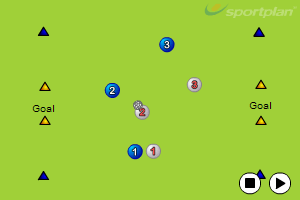
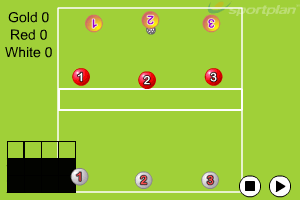
At junior ages, rotate players through different positions so everyone learns the whole game. Let your quick winger try centre-back; give the shy full-back a spell up front; rotate the goalkeeping role so nobody is stuck between the posts by default. It produces more rounded footballers and it quietly defuses the "my child always plays in goal" complaint before it starts. Small-sided practices are perfect for building this comfort in different roles - a session of 3 vs 3 Football or a rotating possession game asks every player to attack and defend, whatever their usual position.
Track Minutes So Fairness Is Provable
A feeling that things are "about fair" will not survive a determined parent counting minutes from the touchline. The only honest answer to "why does my child play less?" is data. If you track minutes across the season, you turn a vague impression into something you can put in front of anyone - and almost always, the totals show a fairness you would otherwise struggle to prove.
It need not be complicated. A notebook with a row per player works. A shared spreadsheet works. Whatever you use, the discipline is the same: record minutes after every match and check the running totals before you pick the next squad. The player who has fallen behind starts the next game; the one who has crept ahead sits the first block. Over a season this self-corrects, and you end up with a record that quietly answers every game-time question before it is even asked.
This is also where the weekly admin starts to bite. To split minutes fairly you first need to know your numbers - who is actually available this Saturday - and then keep a running tally of who has played how much, match after match, all season. Done on paper across a twelve-strong squad and twenty-odd fixtures, that is a real chore. This is the kind of thing a club app handles well: collecting availability so you know your numbers before you plan the rotation, and keeping a record of minutes and appearances so game-time is fair and, crucially, provable if a parent ever asks. Teamo - which, in the interests of being straight with you, is made by the Sportplan team behind this site - does exactly this from your phone, where most grassroots admin actually happens; you can see how Teamo handles availability and the season record. Whether you use an app or a well-kept notebook, the principle stands: if you cannot show the minutes, you cannot prove the fairness.
Handling the "Win at All Costs" Parent
Every grassroots coach meets them eventually: the parent who treats an under-10s fixture like a cup final, questions every substitution, and wants their child on the pitch at the expense of someone else's. Handled badly, one such parent can sour a whole touchline. Handled well, it rarely escalates at all.
The single most useful thing you can do is set expectations before the season starts. Tell parents plainly, in writing or at a pre-season meeting, that this is a development team: everyone gets meaningful game-time, players rotate positions, and results are not the priority at this age. When you have published that philosophy, you have a calm, consistent answer ready for every game-time question - you are simply pointing back to the deal everyone signed up to.
When a conversation does happen, a few principles keep it civil:
Defusing a Game-Time Complaint
- Never on the touchline, never mid-match: Agree to talk afterwards, away from the pitch and out of earshot of the children. Heated touchline debates help no one.
- Listen first: Let the parent say their piece and acknowledge they care about their child. Most just want to feel heard before they will hear you.
- Point to the philosophy: Restate the development-first, everyone-plays approach you set out pre-season. Consistency is your strongest card.
- Show the facts: If they still doubt it, show the minutes you have tracked. Data ends most disputes that opinion cannot.
- Protect the child: Keep it parent-to-coach. A child should never overhear an argument about their own playing time.
Almost every pushy parent softens once they see a clear, fair system rather than favouritism. The minutes record does a lot of quiet work here - it is hard to argue with totals that show their child has had as fair a deal as everyone else.
Communicate Selection Openly
Most game-time conflict is really a communication failure. Parents fill an information vacuum with the worst assumption - favouritism - so the cure is to leave no vacuum. Be transparent about how you select and rotate, and far fewer grievances ever take root.
In practice that means explaining your rotation approach at the start of the season, letting parents know roughly how the matchday will run, and being open about why you do things the way you do. You do not owe anyone a tactical justification for every decision, but a team that understands the system trusts it. Our guide to football club communication covers how to keep parents informed without drowning in a noisy group chat, and the how to run a junior football team guide walks through the whole season alongside it.
Bringing It Together
Fair game-time is not a constraint on good coaching - it is good coaching. Plan your rotation before kick-off, use rolling substitutions to keep everyone meaningfully involved, rotate positions as well as minutes, and write down what you do so fairness is provable rather than merely felt. Do that, and the touchline grumbling fades, the children keep playing, and your weekends stop being spent refereeing parents.
Selection is, of course, only half the picture - the players still need to be developing when they are on the pitch. When you are ready to work on the football itself, our guide to formations and positions helps you balance the team you put out, and you can browse the full Football drills library for hundreds of practices sorted by skill and age.
Frequently Asked Questions
Should every child get equal game-time in junior football?
At mini-soccer and junior age groups the FA's guidance is clear: development matters more than the result, and every child should get meaningful, roughly equal playing time. Equal does not have to mean identical to the minute, but it does mean no child sits on the touchline for most of the match week after week. Younger age groups should be closer to genuinely equal; from around U13 upwards, as football becomes more competitive, some coaches move towards fair rather than strictly equal minutes. The key is that every player gets a real chance to play, improve and feel part of the team.
How do I track playing time fairly?
Keep it simple and write it down. Note each player's minutes for every match in a notebook, a shared spreadsheet, or your club app, and glance at the running total before you pick the next squad. Plan substitutions in advance rather than reacting in the moment, because that is when the strongest players quietly end up with the most minutes. A written record turns a vague feeling into something you can show a parent: across a season, the totals should be close. Tracking minutes is also the only honest way to prove game-time has been fair if anyone ever questions it.
How do I handle a pushy football parent?
Stay calm, never debate it on the touchline mid-match, and bring the conversation back to your published philosophy and the facts. If you set out at the start of the season that this is a development team where everyone plays, you have a fair, consistent answer ready. Listen properly, acknowledge they care about their child, then explain your selection and rotation plan and, if needed, show the minutes you have tracked. Most pushy parents calm down when they see there is a clear, fair system rather than favouritism. Agree to talk away from the pitch, parent to coach, never in front of the children.
How do rolling substitutions work in youth football?
In most grassroots youth football, rolling (or 'repeat') substitutions are allowed: a substituted player can come back on later in the same match, usually at a stoppage and with the referee's nod. This is what makes fair game-time practical, because you can rotate the whole squad through the game in planned blocks rather than benching anyone for the full match. Always check your own league and competition rules, as some cup or older-age-group fixtures revert to a fixed number of one-way substitutions.