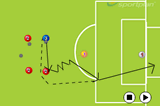
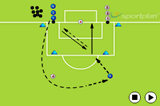
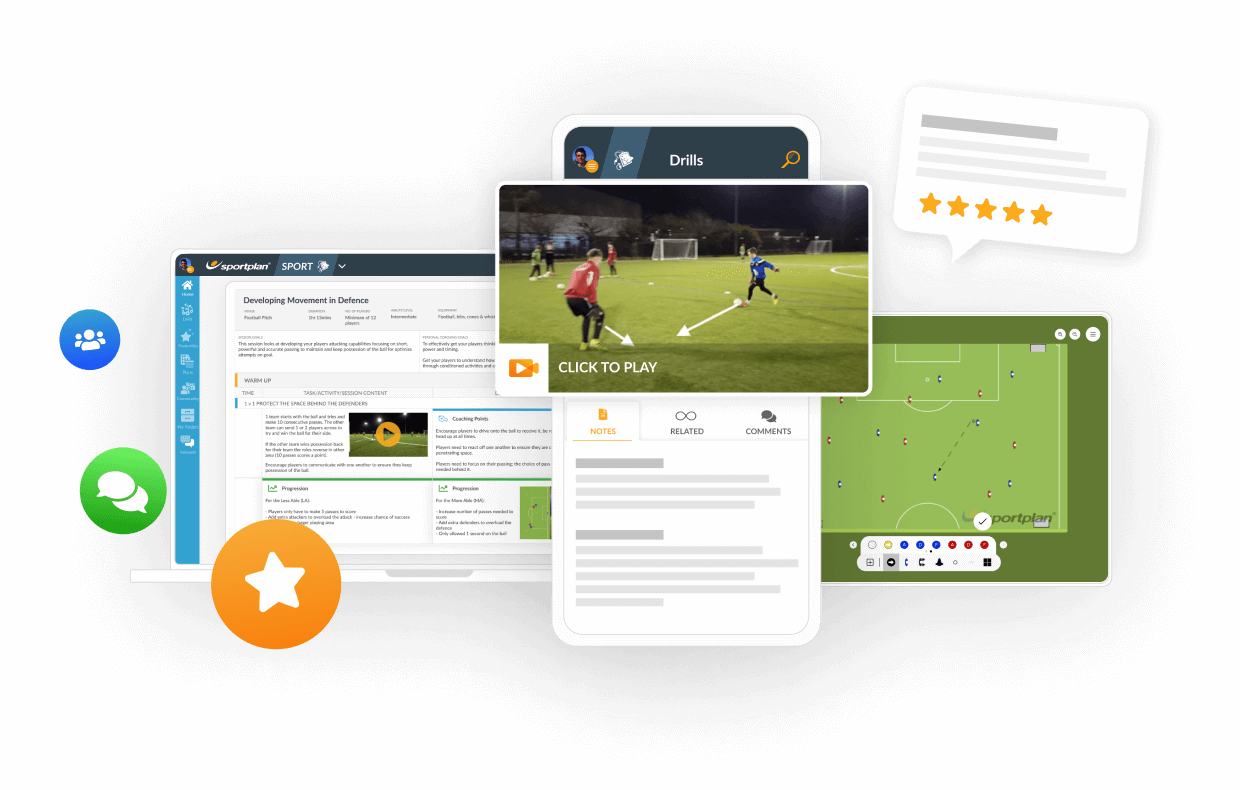
Have a mannequin on the edge of the penalty circle, and another in line with it out, out at the left hand corner of the penalty box.
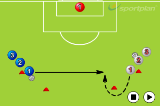
Players positioned on cones 1, 2 and 3 as shown in the diagram, each with a ball.
Player 1 dribbles a ball to the mannequin in front of them, feints one way then moves the ball the other way to shoot. The Player then runs back towards the next mannequin and receives the ball from Player 2. Player 2 runs up to the right of the mannequin and Player 1 lays the ball off to them to take a shot.
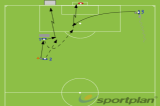
Both players then run in to receive a cross from Player 3, on the outside right. (Player 1 takes front post, Player 2 back)
Shots from position 1:
Shots from 2:
When finishing a cross: sometimes the players don't need to try to produce power, they can just use pace from cross and guide the ball.
Where the ball is crossed to is usually dictated by the strikers. In this scenario the crosser should have 2 options. Cross should take visual cues from the strikers run and verbal communication to make their decision.
in more ways than one
 sportplan_netball

in more ways than one
sportplan_football
Four Halloween-themed games sneak a full warm-up, finishing, rondo and small-sided game into one junior football session this week.
Deliberate heading is now out of U11 grassroots matches. Here is how to coach chest, thigh and foot control so your players still win the ball in the air.
Long-range goals doubled at the 2026 World Cup as teams sat deep. Here is how to coach when to shoot from distance, the technique, and the follow-up.