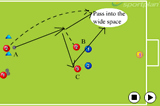
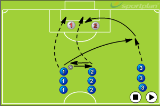
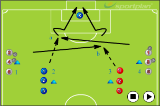
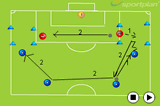
Player 1 starts the drill of by passing the ball to the wide player. The wide player then crosses the ball into the box on their first touch for both the attacking players to run onto and attack (near and far post runs).
Immediately after the two strikers have headed for goal the opposite wide player then delivers in another cross into the box.
After the second cross players swap roles (crossers join the queue and the attackers become the two next crossers).
Focus on the timing of runs into box, player and ball should arrive at the same time (no waiting for the cross!)
The attackers should use their runs to get across defenders (don't just run in a straight line - it's easy to mark!)
Strikers should remain switched on and alert to the second ball in the box.
Progression:
Bring in a defender inside the box in a 2 vs 1.
in more ways than one
 sportplan_netball


in more ways than one
sportplan_football

Deliberate heading is now out of U11 grassroots matches. Here is how to coach chest, thigh and foot control so your players still win the ball in the air.

Long-range goals doubled at the 2026 World Cup as teams sat deep. Here is how to coach when to shoot from distance, the technique, and the follow-up.

Under FutureFit, your Under-9s stay at 5v5, your Under-11s stay at 7v7 and your Under-13s stay at 9v9. Same pitch, same numbers, one more year. Here is how to make sure that year feels like a step forward rather than a repeat.