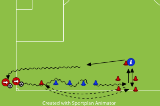
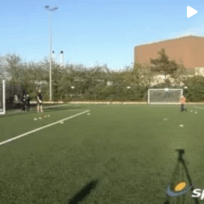
Players start on the baseline and run one at a time. The next player starts once the player in front of them has run around the first cone.
Players sprint around the outside of the 18 yard box and then run around the cone near the D.
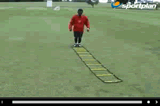
Players then slow down to a 50% jog and use quick feet to place both feet in each rung of the ladder.
After running through the ladder players run around the next cone and slalom in and out of the cones/poles, facing forward at all times and using quick shuffle feet.
Finally players jog back around the cones back to the start point.
Players should push themselves here and work hard throughout.
Encourage them to focus on the use of their arms when sprinting and also using quick feet in the ladder section of the course.
Recovery time is when players are jogging back to the start cone (no standing still - players will be given chance to get their breath back between activities).

in more ways than one
 sportplan_netball


in more ways than one
sportplan_football

Deliberate heading is now out of U11 grassroots matches. Here is how to coach chest, thigh and foot control so your players still win the ball in the air.

Long-range goals doubled at the 2026 World Cup as teams sat deep. Here is how to coach when to shoot from distance, the technique, and the follow-up.

Under FutureFit, your Under-9s stay at 5v5, your Under-11s stay at 7v7 and your Under-13s stay at 9v9. Same pitch, same numbers, one more year. Here is how to make sure that year feels like a step forward rather than a repeat.