Player at cone 1 passes to player on cone 2 and then follows the ball to cone 2 position.
The player at cone 2 receives the ball using his back foot (right), then passes to the player on cone 3 using his left foot and then follows the ball to position 3.
This drill carries on until the player at cone 5 receives the ball. He then passes a diagonal ball inside the circle to the player on cone 6 and runs to the cone 7 position.
The player at cone 6 plays a first time touch (bounce pass) to the player on cone 7.
The player on cone 7 passes a diagonal ball across to the player on cone 8 and the drill starts again but in the opposite direction.
The player on cone 6 remains on his cone for now and the player on cone 7 follows his pass to the cone 8 position.
For the two players in the middle of the circle, who ever passes the ball back to the outer player must follow his pass and the other player must remain at his cone.
EG: When the ball is traveling in an anti-clockwise direction in the drill the player at cone 7 follows his pass and when the ball is traveling in a clockwise direction in the drill the player at cone 6 follows his pass.
Accurate passing.
Passing with pace.
Using both feet
Body shape when receiving and passing the ball.
Good communication between players.
Timing of runs with the players in the middle.
Variations:
1 touch passing.
Player 1 uses player 2 as a bounce player and then passes to player 3.
Then add another bounce pass, eg: Player 3 bounces with player 4 then passes to player 5. this can also be done on the other side of the drill.
in more ways than one
 sportplan_netball


in more ways than one
sportplan_football
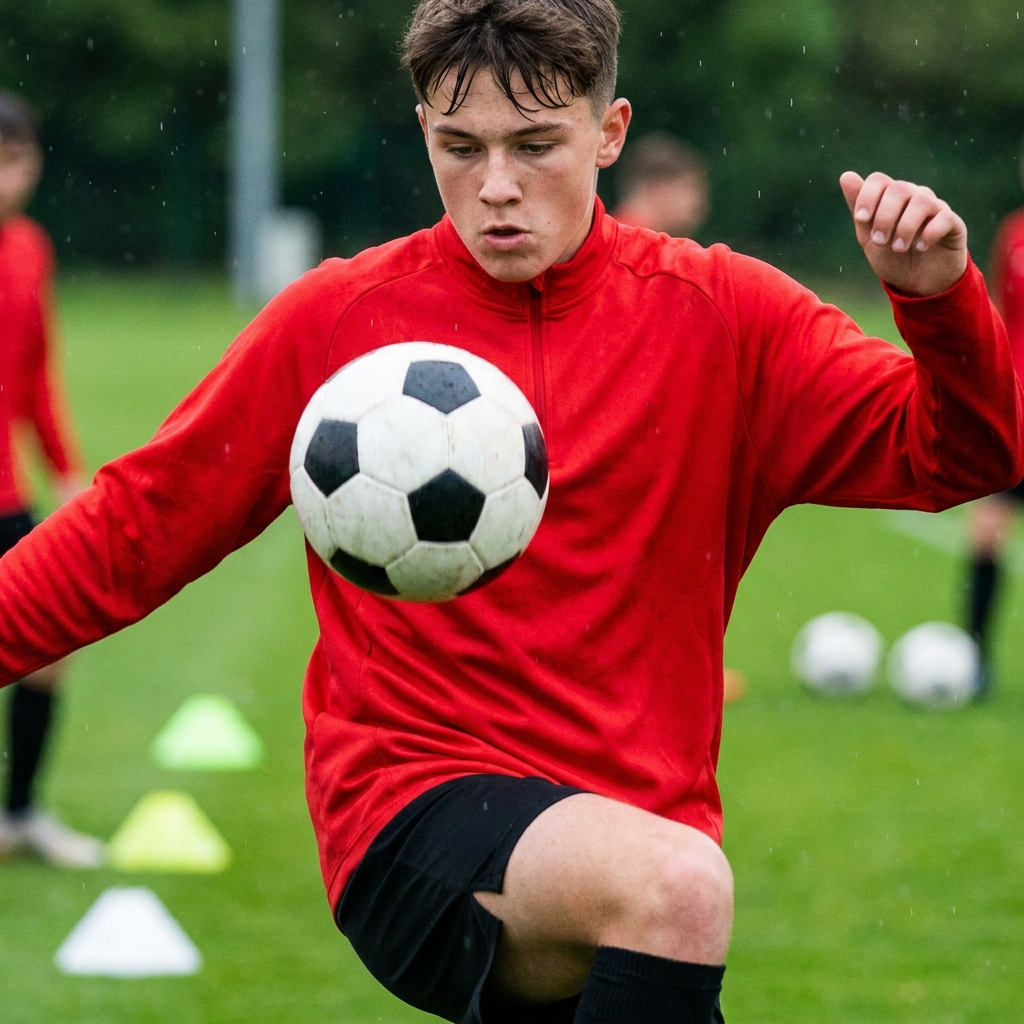
Deliberate heading is now out of U11 grassroots matches. Here is how to coach chest, thigh and foot control so your players still win the ball in the air.
Long-range goals doubled at the 2026 World Cup as teams sat deep. Here is how to coach when to shoot from distance, the technique, and the follow-up.
Under FutureFit, your Under-9s stay at 5v5, your Under-11s stay at 7v7 and your Under-13s stay at 9v9. Same pitch, same numbers, one more year. Here is how to make sure that year feels like a step forward rather than a repeat.