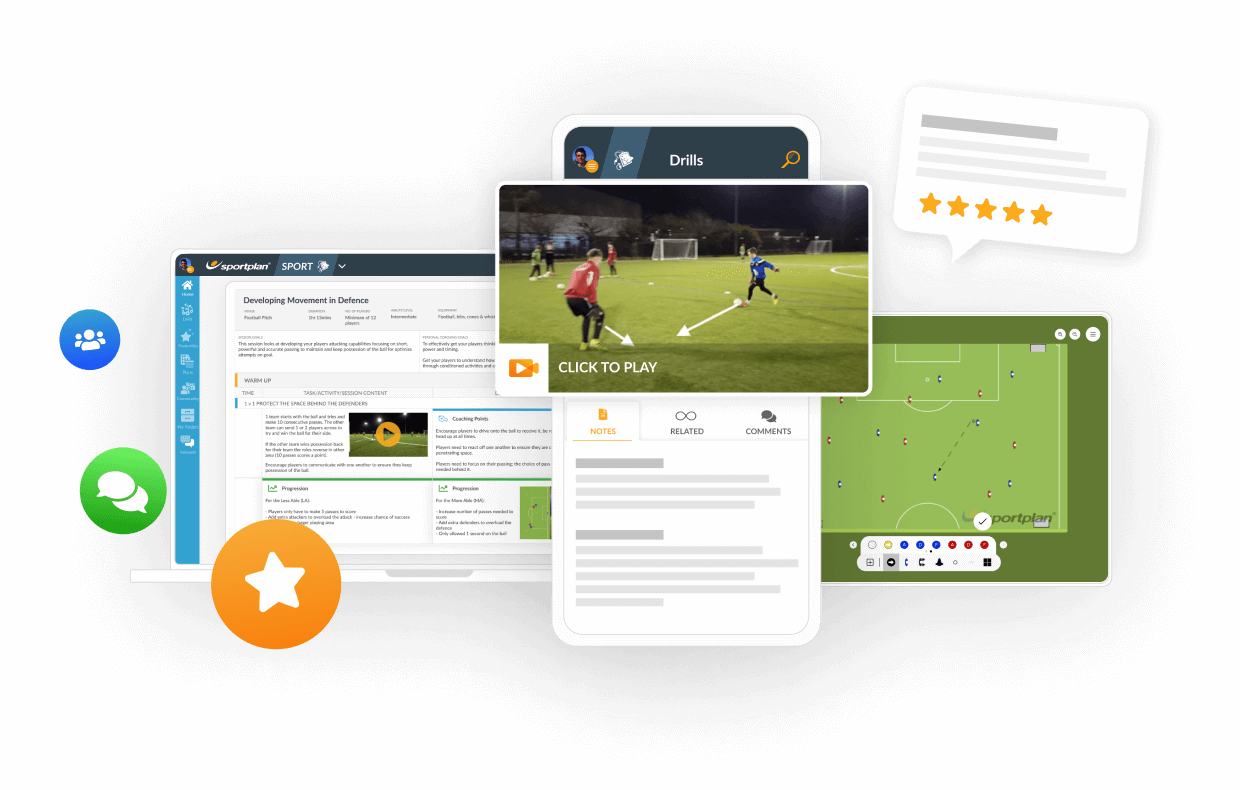
Set up a palaying area suitable for age group with a small square marked out at each end.
Play 3V3 or 4V4 with a floater player in each square. The floater player plays with the team in possession.
Play starts with floater player looking to play to a red player.
Red players must be on the move and constantly trying to make space for themselves and team mates.
Once red player receives the ball, he should play a first time pass back to floater.
Player receiving the ball with body in open position.
Player receiving the ball ensuring they receive it on their "safe side" (side furthest from marker).
Let players play themselves first and watch how they make one continuous run around in different directions. Stop game and explain how it may take 2 or most probably 3 runs to shake their marker. This can be done by slowing down their movement and then suddenly bursting into space.
in more ways than one
 sportplan_netball


in more ways than one
sportplan_football

Deliberate heading is now out of U11 grassroots matches. Here is how to coach chest, thigh and foot control so your players still win the ball in the air.

Long-range goals doubled at the 2026 World Cup as teams sat deep. Here is how to coach when to shoot from distance, the technique, and the follow-up.

Under FutureFit, your Under-9s stay at 5v5, your Under-11s stay at 7v7 and your Under-13s stay at 9v9. Same pitch, same numbers, one more year. Here is how to make sure that year feels like a step forward rather than a repeat.