Ask ten coaches what their team is about and you will get ten vague answers. "We try to pass it." "We work hard." "We want to play out from the back, sometimes." Meanwhile the best sides at every level, from the Premier League down to your local under-14s, share one thing: you can watch them for five minutes and know exactly what they are trying to do.
That is a team identity, or a game model. It is the set of principles that governs how your team plays in each moment of the game, and pre-season is the perfect time to build it. Get the miles in the legs by all means, but if you do not also decide who you want to be, you will spend the season reacting rather than imposing.
What a Game Model Actually Is
A game model is not a formation and it is not a magic tactic. It is a shared understanding of what "good" looks like in each phase: in possession, out of possession, and in the two transition moments between them. It answers questions before they happen so players do not have to guess.
When you have one, decisions get faster because everyone is reading the game through the same lens. When you do not, you get eleven individuals all solving the same problem in different ways, which is exactly how disorganised teams look.
Train the Whole, Not the Parts
The trend that has filtered down from the professional game is integration. Rather than doing a "fitness bit," then a "passing bit," then a "shooting bit" in isolation, modern sessions train the game as a whole. Every drill carries a piece of the identity inside it.
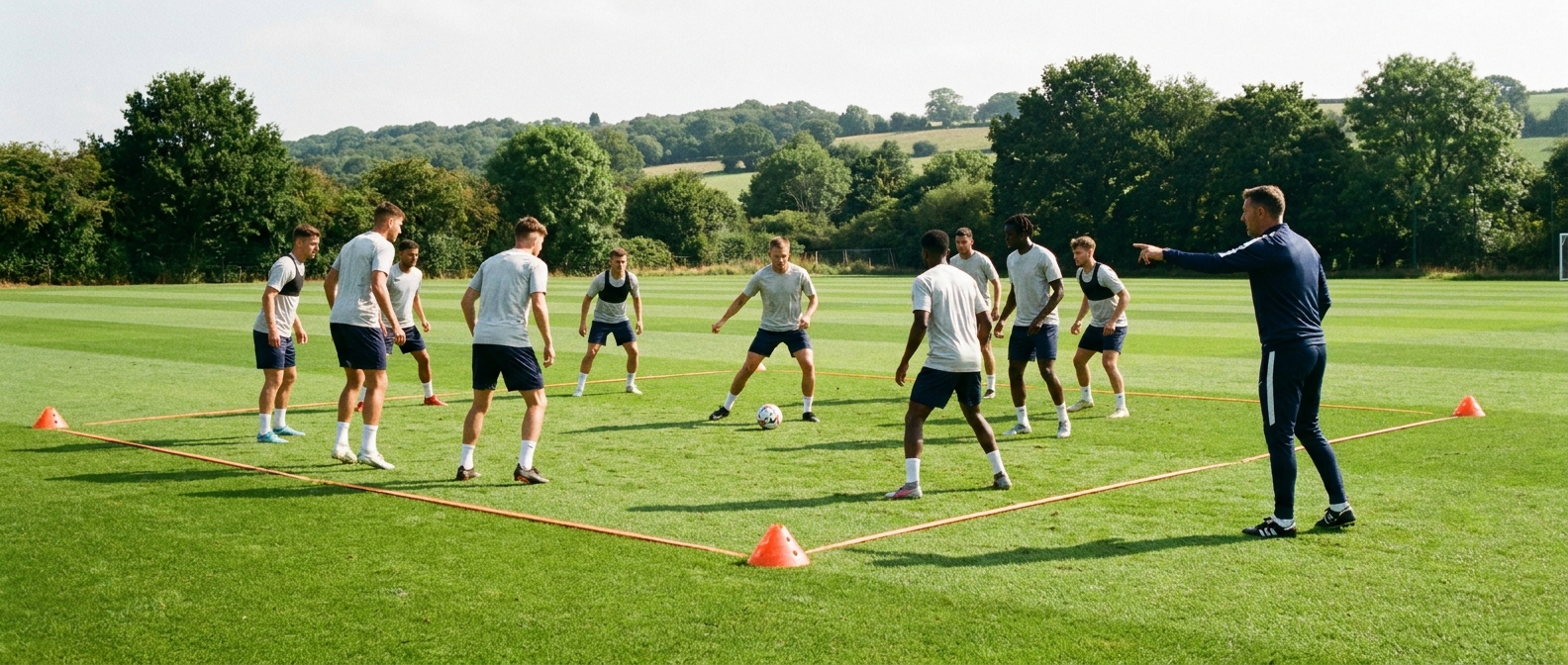
This is why possession games are so powerful in pre-season. A well-designed rondo or positional game builds fitness, sharpens technique under pressure and rehearses your in-possession principles all at once. The ball keeps players engaged while you quietly embed the way you want to play.
How to Build Your Identity
You do not need a fifty-page document. You need clarity, and a way to drip-feed it into every session across pre-season.
Step One: Decide your non-negotiables. Pick three or four principles that define you, such as "we play forward when we can, sideways when we must" or "we press together or not at all." Keep the list short enough that players can recite it.
Step Two: Choose the moments. Define what each principle looks like in possession, out of possession and in transition. Vague ideas do not stick; specific pictures do.
Step Three: Design sessions around the principles. Build your pre-season drills so the desired behaviour is the way to succeed in the game. If you want quick ball circulation, use a rondo with a touch limit; if you want fast counters, reward speed in transition.
Step Four: Coach the picture, not the mistake. When you intervene, reference the principle. "Where's our support angle?" beats "no, wrong." Players learn to see the game the way you do.
Step Five: Progress toward the full pitch. Start in small-sided games where the principle appears constantly, then scale up to larger numbers and finally to 11 v 11 so the identity survives contact with a real match.
Key Coaching Points
- Keep your principles few and memorable; three or four beats a dozen every time.
- Define what each principle looks like in each phase so it is concrete, not a slogan.
- Use possession games to build fitness, technique and identity in the same drill.
- Constrain your drills so the identity is the natural way to win the game.
- Coach by referencing the principle, not just correcting the error.
- Scale from small-sided games up to 11 v 11 so the identity holds under full match demands.
Recommended Drills
Frequently Asked Questions
Is a game model only for elite teams?
Not at all. A clear identity helps at every level, and arguably matters more at grassroots where training time is limited. Simple, well-drilled principles give amateur players the shared understanding that turns a squad into a team.
How many principles should we have?
Keep it to three or four to start with. Players need to be able to recall and apply them under pressure, and a long list just creates confusion. You can add detail as the season goes on, once the core ideas are second nature.
What if my players are not technically good enough for my ideal style?
Build the identity around what your players can do today, then stretch it. If playing out from the back is too risky right now, define a clear, brave-but-sensible way to progress the ball and develop the technique alongside it. Identity and skill grow together.
 sportplan_football