The Science Is Clear
A player in an 11v11 game gets the ball approximately every 3 minutes. In a 4v4? Every 30 seconds. That's 6 times more touches, 6 times more decisions, 6 times more learning opportunities in the same time frame.
Small-sided games (SSGs) aren't just for juniors. The world's best academies and professional clubs use them as the foundation of technical and tactical development. Barcelona, Ajax, Manchester City - they all prioritise small formats in training.
Why SSGs Work Better Than Drills
Traditional drills are predictable. The same pass, the same movement, the same outcome. But football is chaos. SSGs create unpredictable scenarios that force players to scan, decide, and execute under real pressure.
The transfer problem with drills is well-documented: players perform beautifully in isolated practice but freeze in matches. SSGs eliminate this gap because the practice is the game.
The 4 Principles of Effective SSG Design
1. Manipulate the Space
Smaller spaces demand quicker decisions and tighter technique. Larger spaces reward vision and switching play. Match the space to your training objective. Tight passing work? 15x15m. Building attacks? 30x40m.
2. Adjust the Numbers
Equal numbers (3v3, 4v4) create balanced challenges. Overloads (4v2, 5v3) train specific situations like building out or pressing. Underloads (2v3, 3v4) develop resilience and defensive organisation.
3. Add Constraints
Touch limits, time limits, scoring rules, playing directions - these shape behaviour without instruction. Two-touch football forces faster thinking. Goals only from crosses develops wide play. The constraint is your coaching.
4. Create Targets
Goals, end zones, target players, gates to dribble through - targets give purpose to possession. Without targets, SSGs become keep-ball. With targets, they develop match-winning behaviours.
SSG Progressions That Work
Structure your session with progressive SSGs:
Phase 1: Technical Focus (3v3 or 4v4)
Maximum touches, tight spaces, focus on first touch and combination play. Players get comfortable with the ball under constant pressure. Duration: 10-15 minutes.
Phase 2: Game-Specific Challenge (5v5 or 6v6)
Introduce a condition related to your session theme. Working on wide play? Goals only count from crosses. Developing defensive compactness? Points for winning the ball in your half. Duration: 15-20 minutes.
Phase 3: Free Play (7v7 to 9v9)
Remove constraints. Let players apply what they've learned in a more match-realistic format. Coach observes more than intervenes. Duration: 15-20 minutes.
Recommended Games
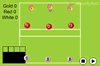
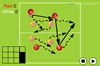
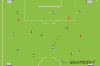
These SSGs cover every training objective:
Sample Session: SSG-Based Training
A 75-minute session built entirely on small-sided games:
- Warm-up (10 mins): 3v3 free play on small pitches - immediate ball work, natural activation
- Technical SSG (15 mins): 4v4 with 2-touch limit - focus on first touch quality
- Themed SSG (20 mins): 5v5 to end zones - can only score by dribbling into the zone
- Match-Related (20 mins): 7v7 with goalkeepers - normal rules, coach observes
- Cool-Down (10 mins): 2v2 games at walking pace - low intensity, high touches
Common SSG Mistakes
- Pitches too big: If players aren't under pressure, the space is too large
- Over-coaching: Let the game teach - intervene only when learning stops
- Ignoring imbalances: Mismatched teams create poor learning for everyone
- No targets: Pointless possession without purpose to attack
- Changing rules constantly: Players need time to adapt - settle on constraints
Frequently Asked Questions
How do I stop SSGs becoming unstructured chaos?
Structure through design, not intervention. Clear pitch boundaries, visible targets, and simple rules create order. If it's truly chaotic, reduce numbers or tighten the space until quality improves.
When should we use 11v11 training?
11v11 has its place for positional work, set pieces, and pre-match preparation. But for skill development, it's inefficient. Use SSGs for development, 11v11 for match preparation.
What if I have odd numbers at training?
Use neutral players who play for the team in possession. This creates natural overloads and keeps everyone involved. Two neutrals can make a 5v5 into a 7v5 for the attacking team.
How long should each SSG last?
4-6 minute rounds work well. Long enough to get into a rhythm, short enough to maintain intensity. Rotate teams, change conditions, keep it fresh. Total SSG time: 40-50 minutes per session.
 sportplan_football