

The Most Important Decision a Captain Makes
In limited-overs cricket, no in-game choice carries more tactical weight than a bowling change. A well-timed switch can break a partnership before it becomes a match-winning stand. A late or careless change can give the batters momentum the bowlers will not pull back. Across the 2026 IPL season, analysts repeatedly identified the bowling-change call as the single largest predictor of which captain controlled the middle phase of an innings.
The modern process is collaborative. Pre-match meetings between captain, coach, and analyst map out likely matchups and over-by-over plans. Contingency options are prepared for early wickets, a flying start, or a powerplay collapse. Yet the in-game call still falls to the captain on the field, who must balance the plan against the rhythm of the actual match. A clear framework helps captains make these calls with confidence, especially at club and age-group level where the captain is also expected to bowl, set the field, and manage tired teammates.
This article distils current professional thinking into a coaching framework you can use with developing captains. It covers when to change, who to bring on, how to set the field around the new bowler, and the signals that tell you the change has worked or failed.
Four Triggers for a Bowling Change
Professional captains rarely change bowlers on instinct alone. Each switch is triggered by a recognisable cue. Teaching young captains to identify these cues turns gut feel into a repeatable skill.
1. The Partnership Trigger
When a partnership reaches 30 runs without a chance, the bowling unit is being neutralised. The change should disrupt rhythm with a different pace, angle, or style. Pace bowler on for a spinner. Right-arm over for a left-arm angle. The aim is not always to take a wicket immediately. It is to break the visual and timing patterns the batters have settled into.
2. The Boundary Trigger
Two boundaries in an over, or three in two overs, indicates the bowler has lost their length or the batter has worked out the plan. Either way, the bowler needs to be taken off before a third over compounds the damage. The first job of the next bowler is to bowl a dot. Set the field accordingly and prioritise control over wicket-taking.
3. The Matchup Trigger
Modern data identifies which bowlers each batter scores most freely against. If a left-handed batter is at the crease and your data shows they struggle against off-spin, bring on the off-spinner regardless of the over plan. Matchup-led changes are the most analytically supported decision in modern white-ball cricket, and they apply at any level where coaches keep simple matchup notes during the season.
4. The Phase Trigger
Each phase of a limited-overs innings has its own bowler profile. Powerplay favours new-ball seamers who can swing or seam the ball. The middle overs reward control bowlers and spinners who can dry up runs. The death overs need yorker specialists and pace variation. Changes between phases should be planned in advance, with the field adjusted accordingly. Forcing a powerplay swing bowler to operate at the death is a common club-level mistake.
Reading the Rhythm of the Over
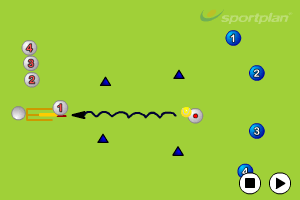
Bowling changes are decided over by over, but the cues appear ball by ball. Teach captains to watch for four micro-signals during the current over before they make the call for the next.
Body language of the bowler: Slumped shoulders, slow walks back to the mark, or a long look at the ball after a boundary all suggest the bowler has lost belief. A fresh bowler with confidence usually outperforms a tired bowler with doubt, even if the tired bowler is more skilled.
Batter intent: If both batters are stepping out of the crease, looking for boundaries, and exchanging quick chats between overs, they are about to attack. Pre-empt the assault with a change that resets the matchup, rather than letting the surge land.
Conditions: Dew, fading light, and pitch wear all shift the bowler match-up over the course of an innings. A wet ball makes spin difficult and rewards quicker bowlers who can rely on skid. A worn pitch in the back half of an innings rewards spinners over seamers.
The scoreboard equation: If the required run rate is climbing, the chasing side is under pressure. Maintain the squeeze with control bowlers and protective fields. If the run rate is falling, the chasers are in control and a wicket-taking option is needed.
The Coaching Framework: Three Drills for Young Captains
Captaincy is rarely coached deliberately at junior level. Most young captains are simply expected to learn by doing. These three drills create structured situations where developing captains can practise reading the game and calling changes with low risk.
Drill 1: The Live Commentary Drill
During a practice match or a televised game, ask the young captain to talk through the match as if commentating. After each over, they must call out what they would do next: keep the same bowler, change the bowling, change the field, or both. They must give a reason. The coach challenges weak reasons and reinforces strong ones. This builds the verbal articulation that supports clear in-game thinking.
Drill 2: Scenario Cards
Prepare a deck of cards each describing a match situation: "Over 12 of 20, 95 for 2, partnership of 40, your opening seamer has two overs left, the spinner has bowled three of four." The captain must call their next bowler, set their field, and explain their thinking. Rotate the cards through the squad. This works for whole-team education, not just for the captain on duty.
Drill 3: The Conditioned Net
Run a net session where the captain manages the bowling order against a pair of batters. Each bowler has a limited number of balls. Boundaries cost the bowling side ten balls of bowling capacity. The captain must use their resource carefully and call changes that suit each batter. The pressure of finite bowling forces deliberate decisions rather than autopilot rotation.
Setting the Field for the New Bowler
A bowling change without a field change is a wasted opportunity. The new bowler brings a different threat and needs a field that supports it. Coach captains to ask themselves three questions before the first ball of any change.
Where will this bowler bowl? Set the field to the bowler's strength, not the batter's weakness. A seamer who swings the ball needs three slips and a gully. A spinner who turns it sharply needs a short leg or a leg slip. Forcing a bowler into a field that fits another bowler is the most common captaincy error at club level.
What is the batter expecting? If the previous bowler had a heavy off-side field, the batter has been working the ball on the leg side. Surprise them by switching one of the off-side fielders behind square on the leg side. Small field changes between bowlers reset the batter's mental picture.
What is the worst outcome? Plan the field to limit damage on the bowler's bad ball as well as reward the good ball. A new seamer's likely error is a short ball outside off. Cover it with a deeper third or a backward point. A new spinner's likely error is a full toss or a long hop. Leave a fielder out for the slog sweep.
Common Captaincy Mistakes
Watch for these recurring patterns when you observe young or developing captains in matches:
- Bowling friends too long: The captain sticks with a teammate they like long after the data says it is time to change. Coach the discipline of looking at the over rate and economy, not the friendship.
- Burning the best bowler too early: Using your strike bowler in the first six overs and then having nothing left for the death is a classic club-level mistake. Plan the bowling allocation across the full innings.
- Refusing to bowl part-timers: A part-timer at the right moment, with the right field, can break a partnership that the front-line bowlers cannot. Captains who only trust their top three bowlers leave a tool unused.
- Changing for the sake of it: Some captains rotate bowlers every over to look busy. If a bowler has built pressure with three dots, give them one more over. Rhythm is precious. Do not break it for the sake of activity.
- No follow-up plan: Captains call a change but do not have a plan if the new bowler also goes for runs. Always know who the next two bowlers will be before the current change is made.
Building the Captain's Decision Diary
One of the most effective coaching tools for captaincy is the post-match decision diary. After each game, the captain writes down the three biggest bowling-change decisions they made, the trigger they used, and what happened. Over a season, patterns emerge. The captain learns where their instincts are reliable and where they need more rehearsal. The coach learns where to focus their teaching.
This habit also brings the captain and the coach closer. Captaincy is a lonely role at age-group level, and a structured debrief turns isolated decisions into a learning conversation. Many county and franchise coaches use the same approach with their senior captains, often supported by video clips of the key moments. There is no reason a club coach cannot do the same with a phone camera and a notepad.
Frequently Asked Questions
How many overs should a captain plan in advance?
At professional level, captains plan the full bowling allocation before the innings starts, with contingencies for each phase. At club level, planning the first six overs and the last four overs is realistic. The middle is more fluid, but the captain should always know who their next two bowlers will be. Without that, every change becomes a reaction rather than a decision.
Should the captain bring themselves on as a bowler?
Only when the data and the situation support it. Many captains bring themselves on too early because they want to be involved. The same captains then have no overs left when the team needs a final spell. Treat yourself like any other bowler. If your matchup is right and your form is good, bowl. If not, manage the bowlers you have.
How do you handle a bowler who does not want to come off?
Calmly and quickly. A captain who hesitates loses authority. State the reason for the change ("they are starting to read your length, we need a different angle"), thank the bowler, and move on. If the bowler resists, hand the ball directly to the next bowler. Discussions can happen after the over, not during it. Authority on the field is what gives a captain the room to make tough calls without resentment.
What is the most useful piece of pre-match information for captains?
Matchup notes on the opposition batters. Knowing which batter struggles against which type of bowling is the single most valuable input for in-game decisions. At club level, this can be gathered from previous fixtures by a scorer or analyst with a simple spreadsheet. The captain who arrives at the toss with one page of matchup notes makes better bowling-change calls than the captain who arrives with no information at all.