Finishing Tech/Tact

July 2026

It is July, the fixtures have dropped, and somewhere a coach is drawing cones in a straight line for the traditional pre-season run. We have all done it. Six weeks of "getting the miles in the legs" that leaves players fit for a marathon and rusty with a ball. Then Matchday 1 arrives and everyone looks a yard short and two touches heavy.

The modern approach flips this on its head. Football fitness is not the same as general fitness. Players do not jog at a steady pace for ninety minutes; they sprint, decelerate, turn, jump and recover, over and over. Pre-season is your one clean window to build that specific engine, and the smart money says you build it with the ball involved as often as possible.

Why Running Laps Lets You Down

Steady-state running develops a base, but it trains the wrong system for football. The game is a series of high-intensity bursts separated by incomplete recovery. That is the quality you want to develop, and long slow running barely touches it.

There is a retention problem too. Fitness built without the ball tends to disappear the moment the ball comes back, because the movement patterns are different. Turning to protect possession, accelerating onto a pass, tracking a runner while glancing over your shoulder, none of that is trained by a lap of the pitch.

The Case for Conditioning With the Ball

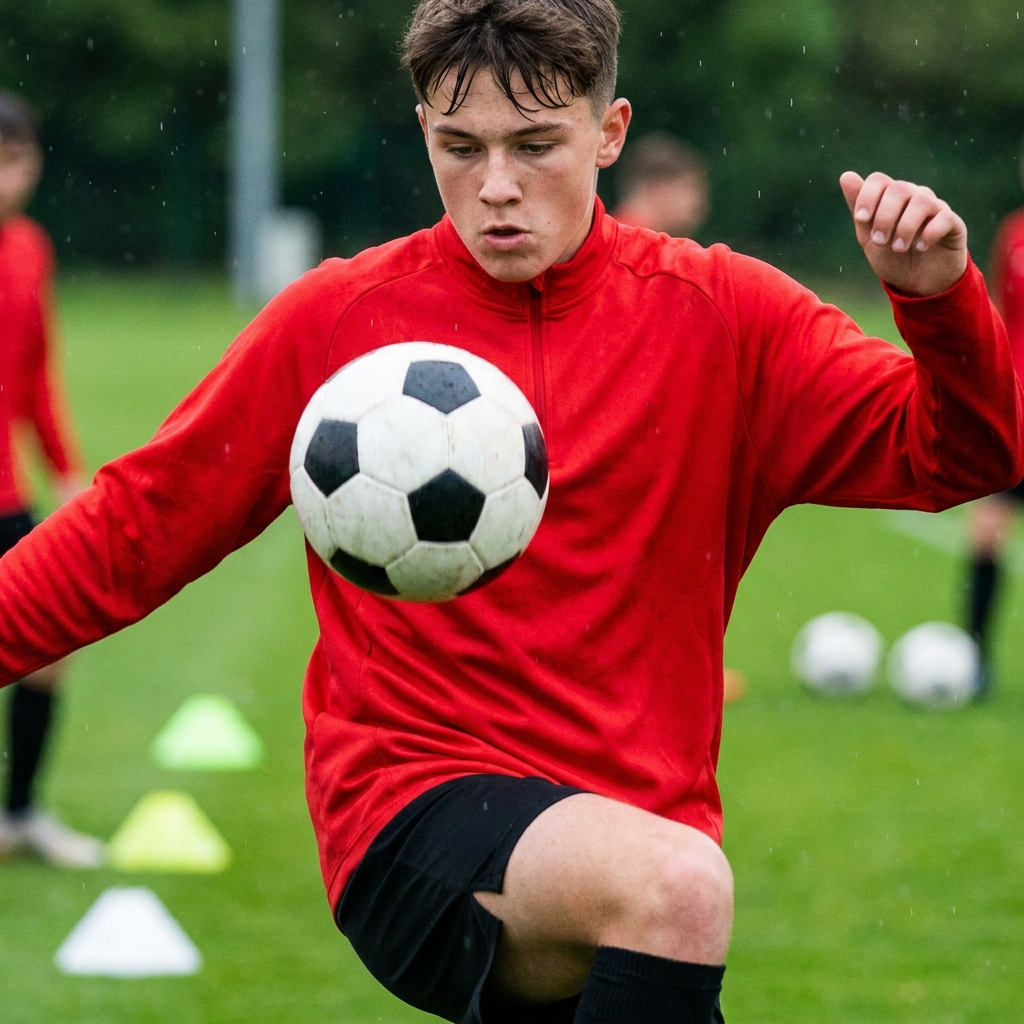
When you put a ball in the drill, three things happen at once. Players work at match-relevant intensities, they sharpen touch and decision-making while fatigued, and crucially, they stay engaged. A tired player will chase a game long after they would have pulled up on a run.

This does not mean fitness becomes an afterthought. It means you disguise the hard yards inside relays, transition games and repeated-sprint circuits that keep the ball at the centre of the work. The heart rate still hits the numbers you need, but every rep also builds a footballer.

How to Build Your Pre-Season Block

Structure matters. Throwing players straight into maximal work invites soft-tissue injuries and sets you back weeks. Build in phases across your available time.

Step One: Start with an aerobic base. In the first week or two, use possession games and extended small-sided games with generous space. High volume, moderate intensity, lots of touches. You are re-introducing the body to load, not testing it.

Step Two: Layer in speed-endurance. Introduce structured repeated-sprint work, shuttle runs and agility circuits, ideally with a ball to finish each rep. Think 30 seconds of hard work, 90 seconds of recovery, repeated in sets.

Step Three: Add football-specific power. Bring in change-of-direction work, decelerations and short explosive efforts. Relays that force a dribble, a turn and a sprint back are gold here.

Step Four: Sharpen with transition games. In the final phase, use games that swing quickly from attack to defence. This tops up the tank while rehearsing the exact intensity of a real match.

Step Five: Taper before your first fixture. Reduce volume in the last few days, keep the intensity sharp, and let the legs freshen so your players peak when it counts, not in a friendly three weeks early.

Key Coaching Points

  • Match the work-to-rest ratio to the game: short, sharp efforts with incomplete recovery beat long steady running.
  • Get the ball involved wherever you can so fitness transfers straight to match performance.
  • Build load progressively across the weeks; the biggest injury risk is doing too much too soon.
  • Watch technique under fatigue and stop a drill when quality falls off a cliff.
  • Use small-sided and transition games to hit high intensities while keeping players engaged.
  • Taper in the final week so the team peaks for Matchday 1, not for a mid-July friendly.

Recommended Drills

VIEW ALL PRE-SEASON DRILLS

Frequently Asked Questions

Do players still need any running without the ball?

A little, especially early on to build a base and to run a simple fitness benchmark. But keep it short. Once the base is in, almost all of your conditioning can and should be done with a ball involved so it transfers to the game.

How long should a grassroots pre-season last?

Four to six weeks is ideal for most amateur teams. That gives you time to build a base, add speed-endurance, sharpen with games and still taper. If you only have three weeks, prioritise progressive loading and finish with transition games rather than trying to cram everything in.

How do I avoid injuries in pre-season?

Progress the load gradually, warm up thoroughly every session, and respect the 30-90 style work-to-rest ratios rather than flogging players into the ground. Most pre-season injuries come from a sudden spike in workload, so build up week by week.

DESCRIPTION

A plays a pass into B, who, with one touch, plays back to A. On this cue, C or D begin to make a diagonal run fdrom out wide. A will then look to play a pass into the path of C/D, who have to then finish past the onrushing GK. // A joue une passe dans B , qui, avec une seule touche , reproduit à A. Sur cette cue , C ou D commencent à faire une course fdrom diagonale sur l'échelle . A sera ensuite chercher à jouer une passe dans la voie de la C / D , qui ont pour finir ensuite passé GK onrushing . Progression: Add in D, who can play by adding passive pressure to the attacking unit

COACHING POINTS

B - Target Man. Ensure they are checking (moving) away from A, before then quickly moving to show for the pass. A - before playing through ball to C/D, ensure that body shape is "open" to the side they are going to play the pass. Helps with Vision and Accuracy of pass. Pass must be in fron of C/D to ensure they can receive in path of existing run. C/D - Winger/Striker. Diagonal run in between defenders (similar to the run Ahunsic made for their 3rd goal). First touch needs to be out of your feet but still under control. From here, look up to see positioning of GK and make necessary decisions. Power/Accuracy, Low/High, Left/Right. All need to be judged before making decision and getting your shot away. Rotate between C and D with each pass. Ensure players are rotating between all positions. // B - Man Target . Assurez-vous qu'ils vérifient (en mouvement) loin de A, avant de passer ensuite rapidement à montrer pour la passe. A - avant de jouer passer la balle à C / D , veiller à ce que la forme du corps est "ouvert" sur le côté , ils vont jouer la passe. Aide à la vision et la précision de la passe . Passe doit être en fron de C / D pour assurer qu'ils peuvent recevoir en voie de conduite existante . C / D - Winger / Striker . run Diagonal entre les défenseurs (semblable à la course Ahunsic fait pour leur 3e but) . Premier contact doit être de vos pieds, mais toujours sous contrôle . De là , regardez pour voir le positionnement de GK et prendre les décisions nécessaires . Puissance / Précision , Bas / Haut , Gauche / Droite . Tous ont besoin d'être jugé avant la prise de décision et d'obtenir votre projectile loin . Pivoter entre C et D à chaque passage . Assurer que les joueurs sont en rotation entre toutes les positions.

This practice has no coaching points

PROGRESSION

This practice has no progressions

READ MORE
READ LESS

JOIN SPORTPLAN FOR FREE

  • search our library of 550+ Football drills
  • create your own professional coaching plans
  • or access our tried and tested plans

JOIN SPORTPLAN FOR FREE

  • search our library of 500+ football drills
  • create your own professional coaching plans
  • or access our tried and tested plans
;

Sportplan App

Give it a try - it's better in the app

X
YOUR SESSION IS STARTING SOON... Join the growing community of football coaches plus 500+ drills and pro tools to make coaching easy.
LET'S DO IT