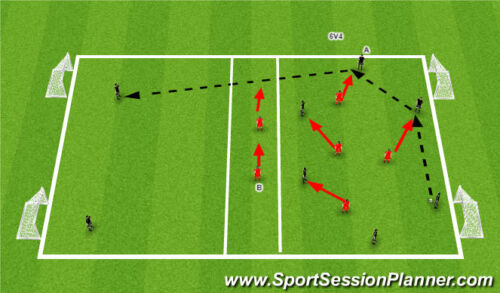

Organization: This practice is a small-scale possession game that is geared towards laying down the pressing concepts. The practice sees a group of 14 players split into a group of 8 players and a group of 6 players. Instructions: This 6+2 vs 4+2 positional possession game sees one team â Team A â set up in a 4-2-2 shape against Team B, which positions in a 2-3-1 shape. Team A aims to connect 5 passes in the initial 6v4 scenario before passing the ball towards their two teammates in the opposite half of the playing area. Team B presses in a 3-1 shape in the 6v4 scenario. Two players are restricted to the middle zone and shuffle across, trying to intercept passes from Team A. Team A scores a goal by connecting 5 passes and then transferring the ball â with a pass on the ground â to the opposite side. Team B scores by intercepting the ball and scoring in one of the two small goals they are facing within 5 seconds. If Team A successfully transfers the ball to the other side, two players stay in the initial zone, while the other four players sprint to the opposite side, quickly regaining the offensive shape. Team B sprints across, quickly organising the two players in the central restricted zone and 3-1 defensive shape in the possession zone. Once on the opposite side, the sequence repeats itself. If a goal is scored by Team B or the ball goes out of bounds, a new ball will be played in on the side it went out on for Team A to restart.
OUT OF POSSESSION COMPACTNESS ⢠Press together in a compact unit, moving together in a 3-1 shape with the central thought of âforce play wideâ. Once the first pass is played towards the sideline, shift together as a unit, stepping to defend the closest mark while being aware of defending passing lines. SHIFTING ⢠The forward is responsible for forcing the first pass wide and not allowing the ball to be rotated through the centre-backs. Once the ball is in the side lane, the far-side winger must stay connected to his number 10, denying the possibility of a split pass between players and marking one of the holding midfielders. The two midfielders must shift with the play, stepping to defend the opposing midfielder if they receive behind the winger while the other marks the opposing 10. BALL ROTATION ⢠If the opponent is able to rotate the ball through the second centre-back, the far-side winger will jump to press as the ball is travelling and deny the option to play to the full-back â especially if it is a poor pass or touch. The central midfielders must be ready to shift and deny passing options. If pressing the second centre-back is not possible, the group must drop diagonally to defend the space before initiating a new pressing sequence. REORGANISE DEFENSIVE SHAPE ⢠If the opponent is able to successfully transfer the ball to the opposite side, the out-of-possession team must initiate an immediate reaction to press the ball-carrier.The two new players must survey and communicate to the group of four and give clear information (force right, force left, man right, man left etc) in order to quickly establish the collective pressing. OFFENSIVE TRANSITION ⢠When possession is recovered, quickly secure it with the first pass and look to switch play towards the opposite side to score a goal. MANAGING THE OPPOSITION ⢠Circulate the ball quickly, using as few touches as possible, even though there are no touch restrictions. Maintain positioning of the two centre-backs, the two full-backs and the two midfielders. The midfielders look to prioritise central movements and spaces. When possession is lost, apply a fast counter-press to regain the ball as quickly as possible. Once possession is regained, immediately reorganise team positioning.
This practice has no coaching points
This practice has no progressions

in more ways than one
 sportplan_football


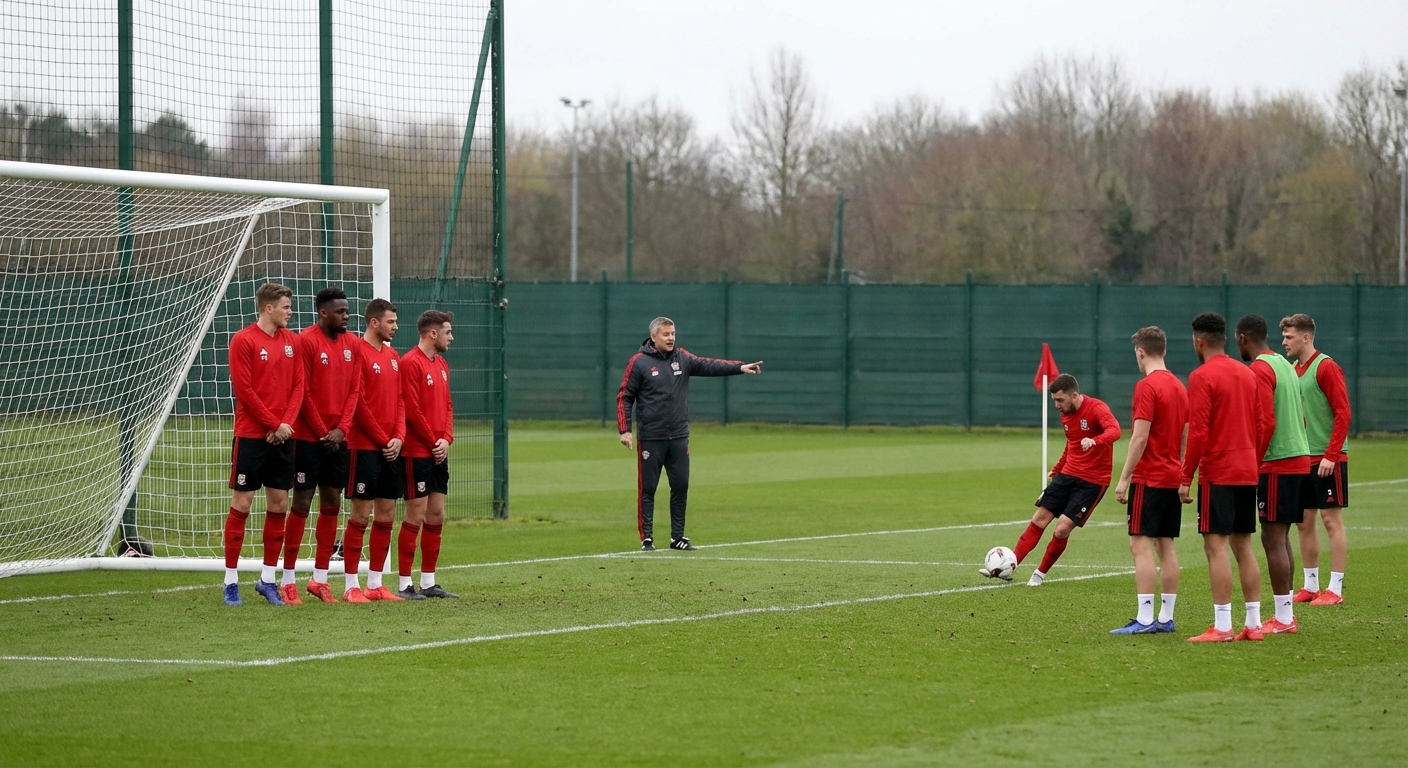
Set pieces account for roughly a third of all goals in football, yet many coaches spend surprisingly little time coaching defensive organisation at corners and free kicks. This article compares zonal and man marking systems, explores hybrid approaches, and provides a practical session structure for building set piece resilience into your team.
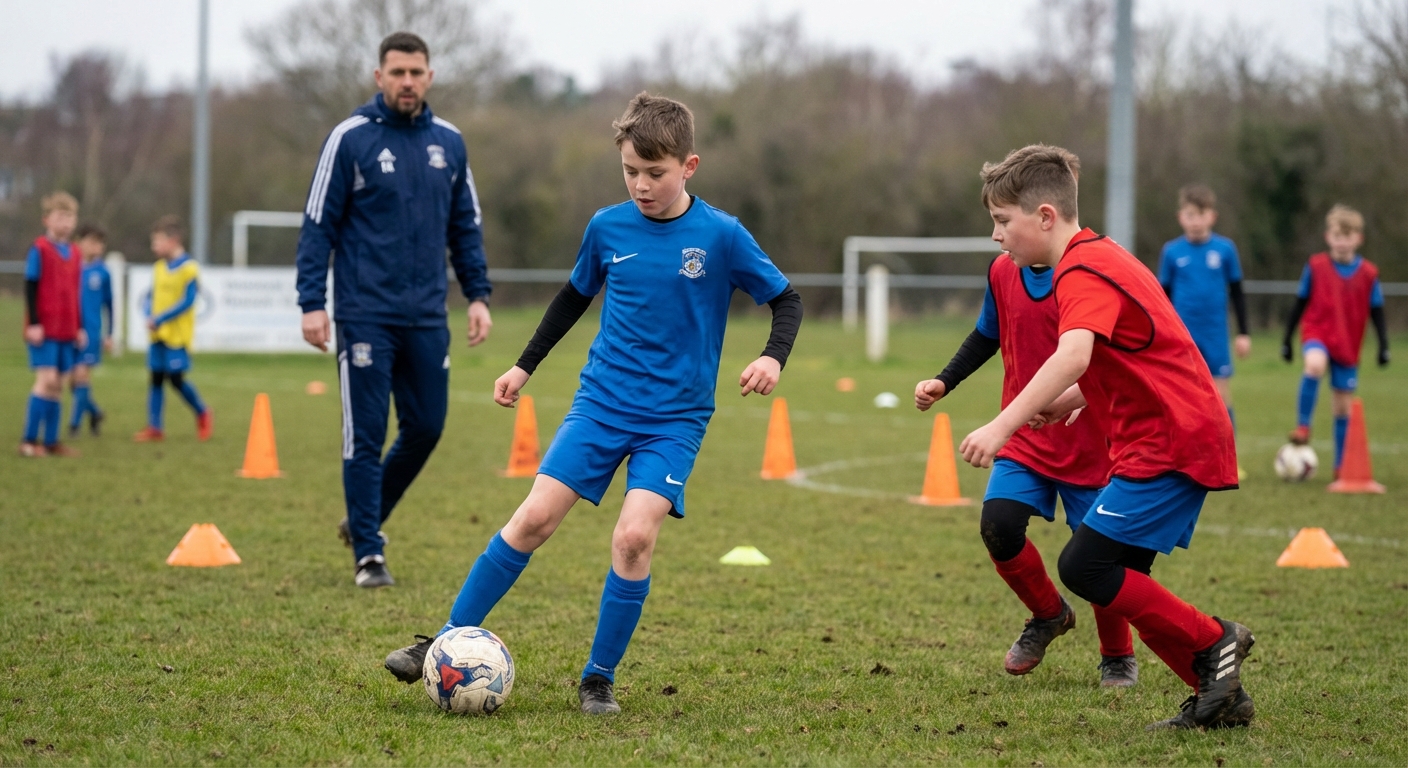
A player's first touch determines everything that follows: whether they can play forward, turn, or simply retain the ball. This article explores why training first touch in isolation is not enough, and how to design sessions that develop this critical skill under realistic game pressure.
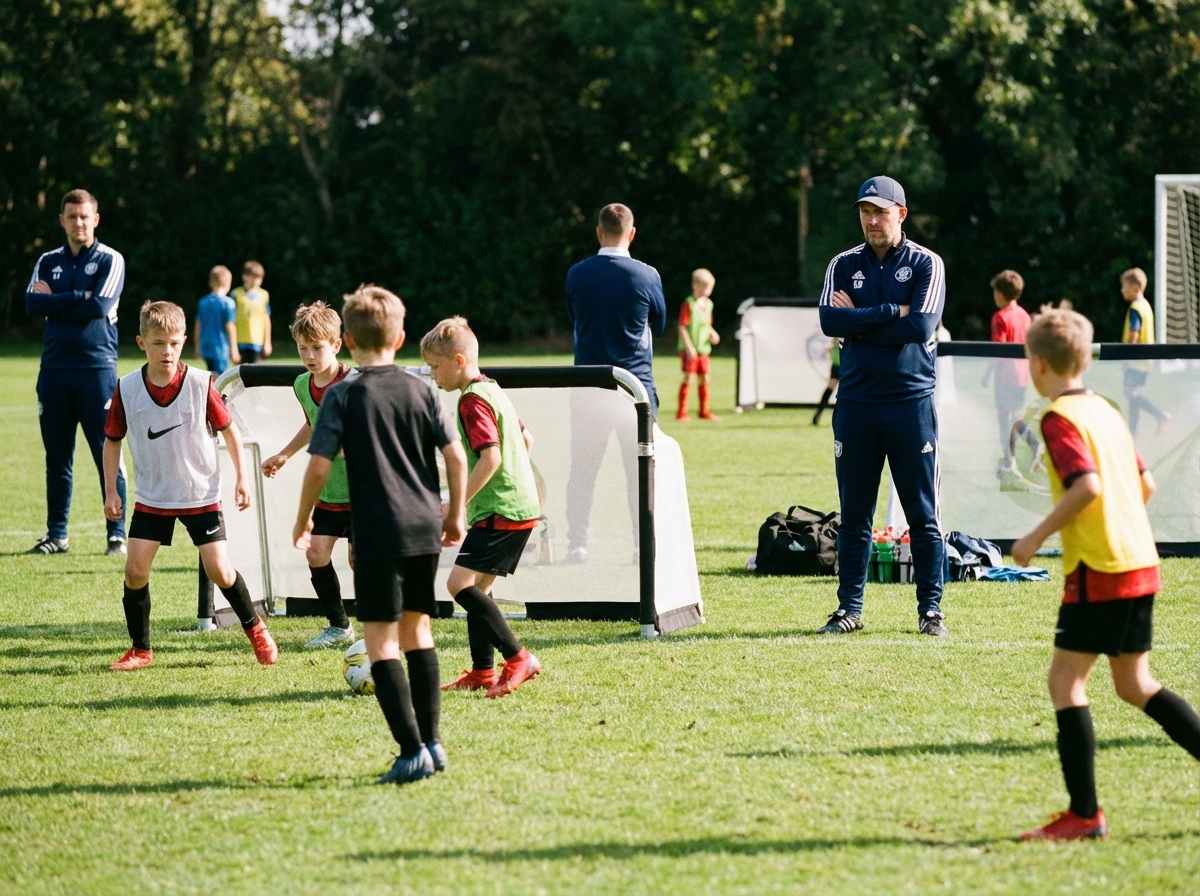
The coaching methodology revolution sweeping grassroots football - and how to implement it at your club this season.