

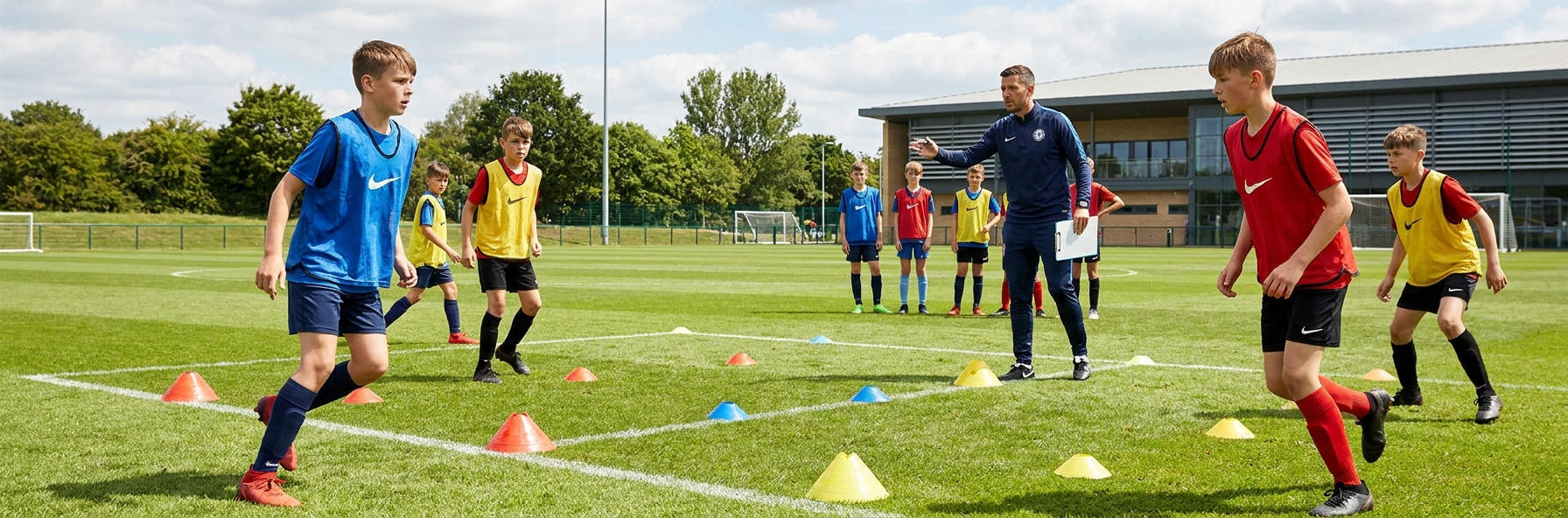
Walk into any elite academy in 2026 and you will see something different from the academies of ten years ago. Players still pass, dribble, and shoot. But every drill is layered with cognitive demands. They scan before they receive. They make multiple decisions per touch. They are coached to think faster as much as to move faster.
This shift is driven by a wave of research showing that football performance is fundamentally a cognitive activity. The fastest player on the pitch is no good if they make the wrong decision. The most technical player is wasted if they cannot read the picture in front of them. The new frontier of player development is what happens between the ears in the half-second before the ball arrives.
What Cognitive Load Training Actually Is
Cognitive load training is the deliberate addition of perceptual and decision-making demands to football drills. Researchers at the University of Bologna and elsewhere have developed a five-level Cognitive Load Scale that classifies drills by how much thinking they demand of the player. Level one drills are pure technique with no decisions. Level five drills involve multiple simultaneous decisions under fatigue and time pressure.
The idea is not to make every drill maximally complex. It is to design progressions that gradually overload the player's brain, just as you would gradually overload their muscles with physical training. A young player who can only handle level two drills today should be able to handle level four drills by the end of the season.
The key insight: Technique without decision-making is a passport, not a destination. The best coaches treat passing, dribbling and shooting as the basic alphabet, and then build cognitive demands on top to produce real football intelligence.
The Three Pillars of Cognitive Load
Pillar One: Scanning. Elite players scan their surroundings six to ten times in the ten seconds before they receive the ball. Most amateur players scan once or twice. Scanning is a trainable habit. Add it to every drill by introducing a coloured cone or numbered bib that the player must identify before their next touch.
Pillar Two: Choice. Every football action involves a choice. A drill with one possible outcome trains technique. A drill with three or four possible outcomes trains decision-making. Build choice into every drill by adding optional targets, conditional rules, or floating support players.
Pillar Three: Dual-task demands. The brain processes football and verbal instructions in different ways. By layering a secondary task on top of a football action - calling out a colour, counting backwards, identifying a number - you force the player to perform under conditions that mirror real match chaos.
Three Practical Drills You Can Use This Week
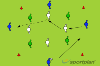
Drill One: Coloured cone passing. Set up a passing circle of six players. In the middle, place four coloured cones. Before each pass, the receiver must call out the colour the coach holds up. If they fail to call the colour, the ball is turned over. This adds a perceptual layer to a simple drill and trains scanning.
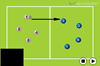
Drill Two: Conditional rondo. A standard 4v2 rondo, but with a rule change every thirty seconds. Sometimes one-touch only. Sometimes a maximum of three passes before the ball must be returned. Sometimes players can only use their weaker foot. Players must constantly adapt to changing rules while playing.
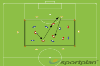
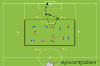
Drill Three: Numbered finishing. A standard finishing drill, but as the striker prepares to shoot, the coach calls out a number from one to four. Each number represents a different finishing target: top left, top right, bottom left, bottom right. The striker must finish to the called corner under match-realistic pressure. This trains the ability to choose under cognitive load.
How to Apply Cognitive Load by Age Group
The art is matching the cognitive demand to the player's stage of development. Too much load on a young player and the technique falls apart entirely. Too little load on an older player and they coast through training without improving.
Under 8s and Under 9s: Keep cognitive load very low. Focus on technique with one simple decision per drill. Add a coloured cone or a "look before you pass" cue.
Under 10s to Under 13s: Introduce two or three choices per action. Use small-sided games with conditional rules. Begin formal scanning training in every session.
Under 14s and Under 15s: Add dual-task demands. Use video review to show players when they did and did not scan. Begin training in pre-action decision-making, where the choice is made before the ball arrives.
Under 16s and above: Maximum cognitive load with multiple simultaneous demands, fatigue layered on top, and complex tactical decisions integrated into every drill.
Common Mistakes to Avoid
The first mistake is adding cognitive demands too fast. If players are still struggling with technique, layering on choice and scanning just produces frustration. Build the technical base first, then add cognitive complexity gradually.
The second mistake is using cognitive drills that have no connection to the game. A drill that requires players to memorise a sequence of cone colours might be cognitively demanding, but it does not transfer to football. The best cognitive drills look like football, feel like football, and demand the same kinds of decisions a player would make in a real match.
The third mistake is forgetting to reduce the load when teaching new patterns. When you introduce a brand new tactical idea, drop the cognitive load back down so players can focus on the new concept. Once they have it, layer the load back on.
Key Coaching Points
- Add a scanning cue to every drill: a coloured cone, a numbered bib, a coach signal
- Design drills with multiple possible correct answers, not just one
- Use small-sided games with frequently changing conditional rules
- Match the cognitive demand to the developmental stage of your players
- Reduce cognitive load when teaching brand new tactical concepts
- Review decisions on video, not just technical execution