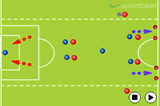
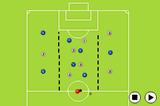
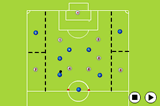
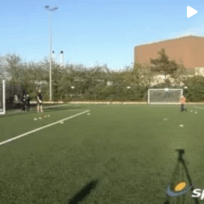
Place 5 cones across the middle of the area, 10 yards in from each sideline. Play 4 vs 4.
The ball is not allowed to travel through or over the discs. The object of the game is to get the ball wide in the near side of the field and attack the flanks of the attacking area.
Although the ball is not allowed to travel over the discs, players may make runs over the discs.
Create space on the flanks by drawing defenders from the attacking space.
Diagonal runs, blind-side runs and overlapping runs should be encouraged to exploit space.
Supporting players must get forward to meet the crosses in to the prime scoring area.
Decrease the number and width of the discs in the area.
Players can pass the ball through the discs if they play a 1-2 combination to do so.

in more ways than one
 sportplan_netball


in more ways than one
sportplan_football

Deliberate heading is now out of U11 grassroots matches. Here is how to coach chest, thigh and foot control so your players still win the ball in the air.

Long-range goals doubled at the 2026 World Cup as teams sat deep. Here is how to coach when to shoot from distance, the technique, and the follow-up.

Under FutureFit, your Under-9s stay at 5v5, your Under-11s stay at 7v7 and your Under-13s stay at 9v9. Same pitch, same numbers, one more year. Here is how to make sure that year feels like a step forward rather than a repeat.