

Fielding Placement Is Tactical, Not Random
At grassroots level, fielding positions in limited overs cricket are often set once at the start of an innings and barely changed until a wicket falls or the runs start flowing. The captain waves players into roughly the right positions, and everyone stays there ball after ball. This approach wastes one of the biggest tactical weapons available to the fielding side.
In professional cricket, field placements change almost every over. The captain and bowler work together to create a plan: what delivery are we bowling, where do we want the batter to hit it, and where should the fielders be positioned to either prevent runs or create a catching opportunity? This constant adjustment is not just a professional luxury. It is a skill that can and should be coached at every level.
Understanding how field placement changes across the three phases of a limited overs innings, the powerplay, the middle overs, and the death overs, gives captains and coaches a framework for making better tactical decisions under pressure.
Phase 1: The Powerplay
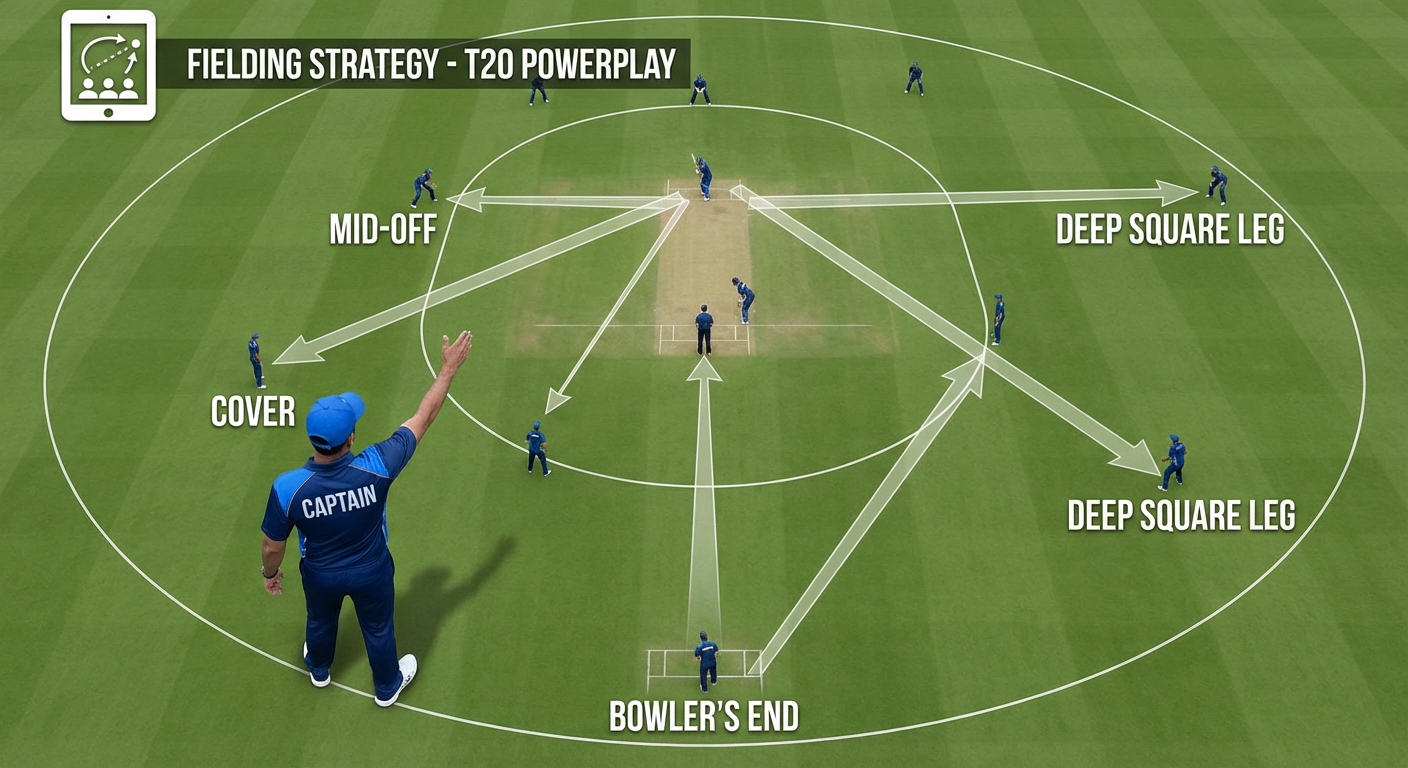
During the powerplay, fielding restrictions limit the number of players allowed outside the inner ring. In most formats, only two fielders can be positioned on the boundary. This creates a challenging scenario for the fielding side because the batting team is encouraged to attack and score quickly.
The key to effective powerplay fielding is accepting that some runs will be scored and focusing on creating wicket-taking opportunities. Aggressive fields with catchers close to the bat can produce early breakthroughs that change the entire complexion of the innings. A slip, a gully, and a short leg position send a clear message to the batters: we are here to take wickets, not contain.
Powerplay Fielding Principles
- Prioritise wicket-taking positions over run-saving positions
- Use your two boundary fielders to protect the areas where the batter is most likely to find the fence
- Position catchers based on the type of bowling: slip and gully for seamers, short leg and silly point for spinners
- Accept that singles will be scored but focus on preventing boundaries and creating catching chances
- Adjust quickly if the pitch is not offering assistance; remove catchers and protect the boundaries if the ball is not doing anything

Phase 2: The Middle Overs
The middle overs are where tactical field placement has the greatest impact. Fielding restrictions ease, allowing the captain to spread the field more creatively. The batting team is typically looking to rotate strike and score at a steady rate without taking excessive risks. The fielding team's goal is to build pressure through dot balls and create wicket-taking opportunities through frustration.
Effective middle-over fields are about closing gaps and forcing the batters into hitting areas where fielders are positioned. This requires the captain to read the batters' strengths and preferences. If a batter favours the leg side, stack fielders there and challenge them to hit through the off side. If a batter likes to sweep, place a fielder at deep backward square leg to neutralise the shot.
The Ring and the Boundary
The balance between ring fielders (positioned 20 to 30 metres from the bat) and boundary riders (on the fence) is the central tactical decision in the middle overs. Ring fielders prevent easy singles and create run-out opportunities but leave gaps on the boundary. Boundary riders prevent fours and sixes but concede easy singles that keep the scoreboard ticking.
The best captains adjust this balance based on the match situation. If the required run rate is climbing, they can afford to concede singles and protect the boundary. If the batting team is ahead of the rate, they bring the ring in to create pressure and force the batters into risky shots.

Phase 3: The Death Overs
The final overs of a limited overs innings are the most challenging for the fielding side. Batters are looking to score boundaries on almost every ball, and the risk-reward calculation shifts heavily towards aggression. Field placements in this phase are almost entirely defensive, designed to prevent boundaries and force batters into hitting over fielders rather than through gaps.
A typical death-over field has five or six fielders on the boundary, with only two or three inside the ring. The boundary riders are positioned based on the bowler's plan: if the bowler is going wide outside off stump, the deep point and deep cover positions are essential. If the bowler is targeting the yorker and slower ball, long on and deep midwicket cover the most likely hitting zones.
Death Over Fielding Principles
- Protect the boundary above all else; conceding two singles is far better than conceding one four
- Position boundary fielders based on the specific delivery being bowled, not in generic positions
- Keep one or two ring fielders to prevent easy singles that rotate the strike and bring the more dangerous batter back on strike
- Anticipate the batter's preferred scoring areas and stack the field accordingly
- Communicate between bowler and captain before every ball about the plan and the field
Session Structure: Tactical Fielding Awareness
An 80-minute session focused on developing fielding placement understanding and game awareness:
Warm-Up: Fielding Reactions (10 minutes)
High-intensity catching and ground fielding in pairs. Include reflex catches, flat throws at the stumps, and diving stops to the left and right. This warms up the body while reinforcing the athletic skills that make fielding placements effective.
Tactical Discussion: The Three Phases (10 minutes)
Use a tactics board or cones on the ground to walk through typical field placements for the powerplay, middle overs, and death overs. Ask players to explain why each position exists and what delivery it is designed to complement. This builds understanding before the practical work begins.
Scenario Practice: Powerplay Fields (15 minutes)
Set up a powerplay field with two boundary riders and close catchers. A batter faces live bowling while the fielding team practises holding their positions and reacting to scoring shots. After each over, the captain adjusts the field based on how the batter is playing. Coach the captain through their decision-making process.
Scenario Practice: Death Over Fields (15 minutes)
Set up a death-over field with boundary protection. The bowler practises yorkers and slower balls while the fielders hold their boundary positions. The batter tries to clear the field. After each over, review whether the field placements matched the bowling plan. Adjust and repeat.
Match Simulation (25 minutes)
Play a 10-over match simulation where the captain must set and adjust fields for each phase. After the innings, review the field placements as a group. Ask the captain to explain their reasoning at key moments. Discuss alternative placements that could have been more effective.
Cool-Down (5 minutes)
Each fielder shares one thing they learned about positioning in the session. Reinforce the message that fielding placement is a team responsibility, not just the captain's job. Every fielder should understand why they are standing where they are.

Coaching Fielders to Anticipate
The most valuable fielders are not the ones with the strongest arms or the safest hands, though those help. They are the ones who anticipate where the ball is going before it is hit. This anticipation comes from understanding the game situation, reading the batter's body language, and knowing the bowler's plan.
Coach your fielders to walk in with the bowler, not stand flat-footed. A fielder who is moving forward as the ball is bowled reacts faster and covers more ground than one who is static. Teach fielders to watch the batter's feet and hands in the moment before the shot is played. A batter who plants their front foot early is likely driving; a batter who rocks back is likely pulling. These cues give fielders a fraction of a second's head start that can be the difference between a stop and a boundary.
Finally, create a culture where fielders communicate constantly. The wicketkeeper and captain should be talking to fielders between every ball, adjusting positions by a few metres based on the previous delivery. These micro-adjustments are invisible to spectators but make a significant difference over the course of an innings.
Frequently Asked Questions
How many fielders should be on the boundary during the death overs?
In the death overs, most teams position five or six fielders on the boundary, leaving only two or three inside the ring. The exact number depends on the bowler's plan and the match situation. If you need a wicket, you might bring one fielder up into a catching position as a gamble. If you are defending a total, keep the boundary stacked and force the batters to find the gaps rather than clearing the field.
Should grassroots captains change the field as often as professionals do?
Not as frequently, but more often than most currently do. At a minimum, the field should change when a new batter arrives, when the phase of the innings shifts, and when a batter is clearly targeting a specific area repeatedly. Even small adjustments, moving a fielder five metres squarer or deeper, can make a noticeable difference. Encourage young captains to be proactive rather than reactive with their field placements.
How do you teach captaincy and field placement to young players?
Start by involving them in the process during training. Before each over in a practice match, ask the young captain to explain where they want the field and why. Guide them with questions rather than giving answers. Use video analysis of professional matches to show how captains adjust their fields. Over time, players develop an intuitive understanding of fielding placement through experience and guided reflection.
What is the most common fielding placement mistake at club level?
The most common mistake is setting a field that does not match the bowling plan. A bowler targeting the off stump corridor with three fielders on the leg side is a tactical contradiction. Before every over, the captain and bowler should agree on a plan: what line and length are we bowling, and where should the fielders be to support that plan? When the field matches the bowling, the pressure on the batter doubles.