

Why Pre-Season Is the Time to Rebuild
Once the competitive season starts, batters focus on scoring runs and winning matches. There is little appetite for deconstructing technique when there is a game on Saturday. This makes pre-season the most valuable window for technical development. It is the one period in the year when a batter can afford to feel uncomfortable, to strip back their technique to its fundamentals, and to rebuild from a solid base.
The best batting coaches use pre-season progressively. They do not throw players straight into high-speed net sessions and hope for the best. Instead, they work through a deliberate sequence: stance and setup, shadow work, underarm feeds, throwdowns, bowling machine work, and finally live bowling. Each stage builds on the previous one, and players only progress when the foundation is secure.
Too many club coaches skip straight to live bowling in the first indoor net session of the year. Players who have not held a bat for three months are immediately facing quick bowling with no technical preparation. The result is a reinforcement of bad habits: playing across the line, poor head position, and tense grip. Pre-season should be about quality of practice, not intensity of bowling.
The Four Foundations of Batting Technique
Every consistent batter, regardless of style or level, has four technical foundations that are worth revisiting every pre-season. Even players with established techniques benefit from a conscious check of these positions.
1. The Stance
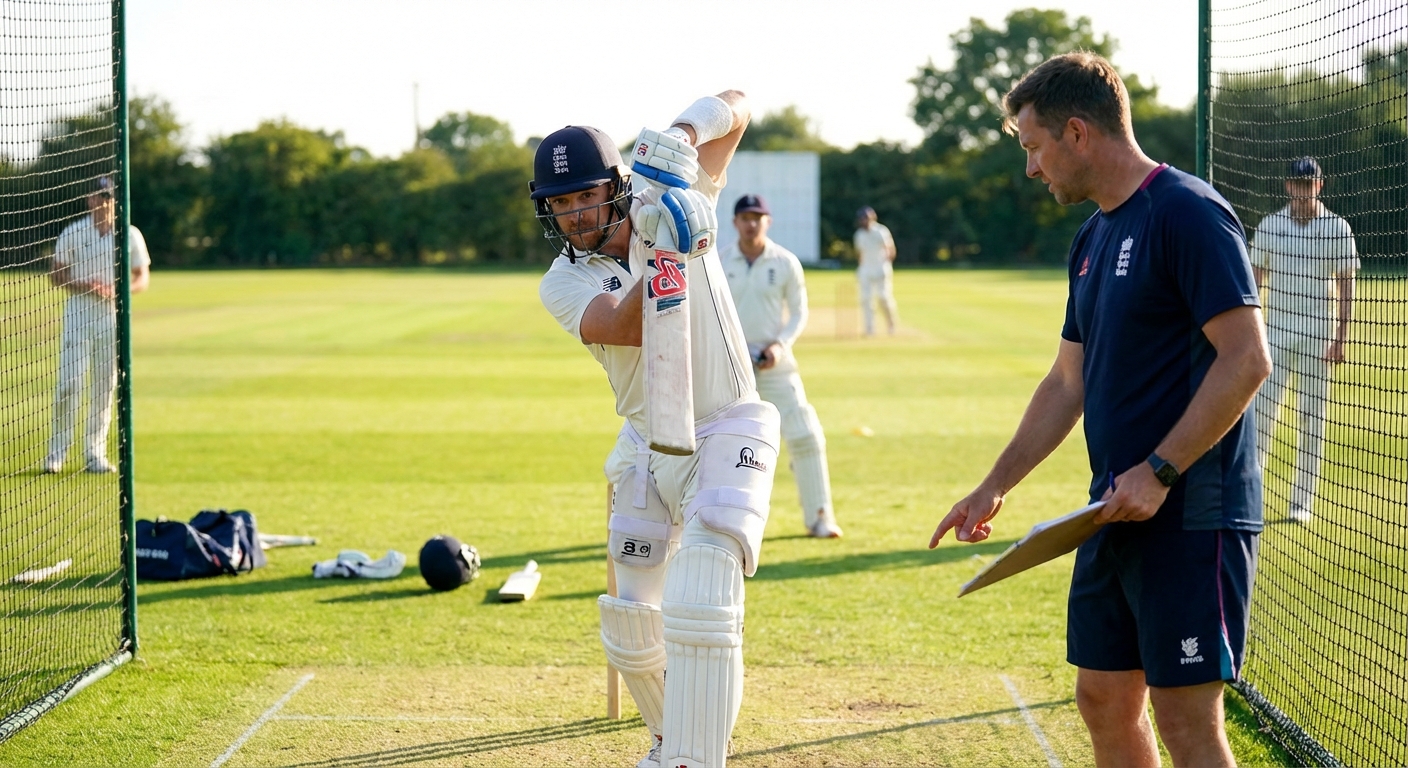
A good batting stance is balanced, relaxed, and ready. Feet should be roughly shoulder-width apart with weight evenly distributed. The head should be level, with eyes horizontal to the ground. The bat should rest naturally behind the back foot. Common faults include feet too close together, weight leaning too far forward or back, and a head that tilts to one side. Use a mirror or video in pre-season to give batters visual feedback on their stance.
2. The Backlift
The backlift is the preparatory movement of the bat before the downswing. A straight backlift that takes the bat back over middle stump gives the batter the best chance of playing straight. However, many successful batters have slightly open or closed backlift positions. The key is consistency: whatever the backlift looks like, it must be the same every ball to produce repeatable timing.
3. Head Position
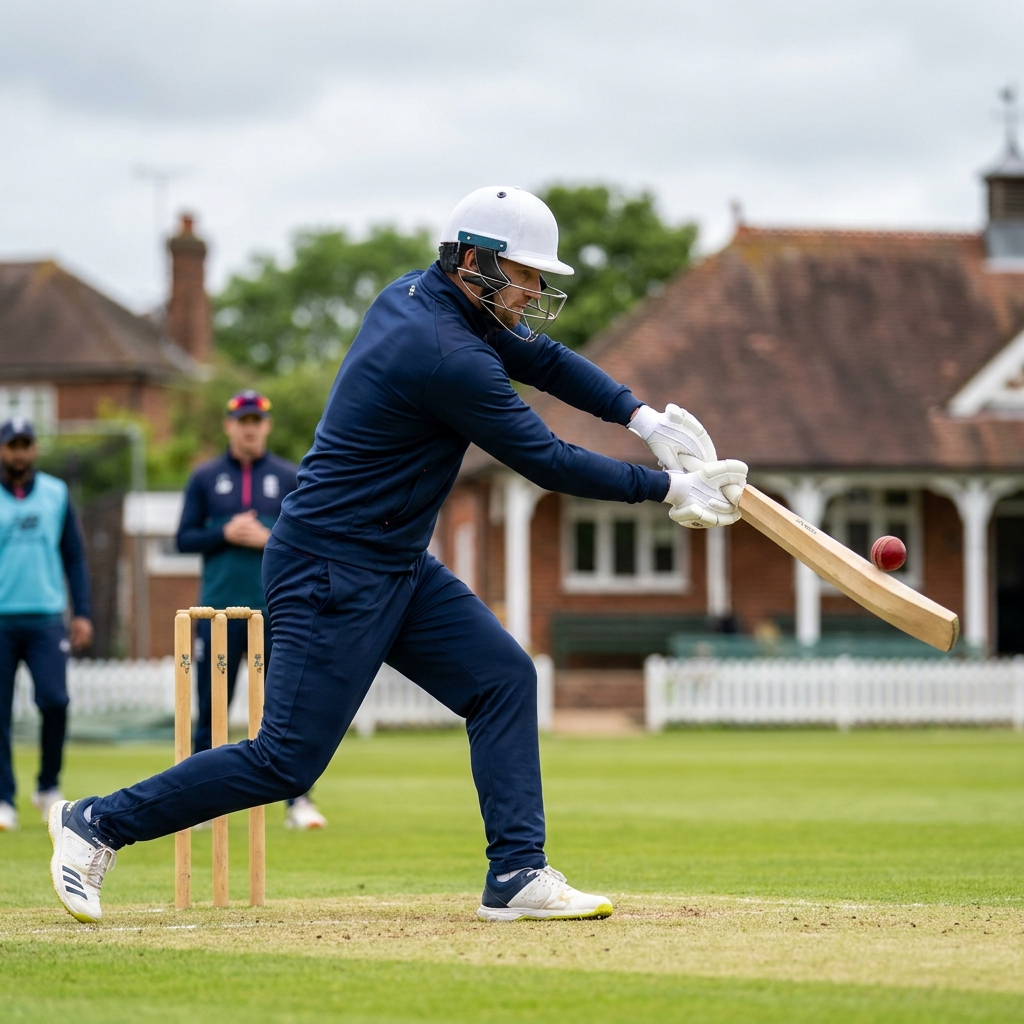
The single most important factor in consistent batting is the position of the head. Where the head goes, the body follows. A batter whose head falls to the off side will play across the line. A batter whose head stays still and moves towards the ball will play straight and find the middle of the bat more often. In pre-season, focus relentlessly on head position. Film batters from the side and front to check that the head is leading the movement towards the ball.
4. The Follow-Through
A complete follow-through is a sign that the batter has committed to the shot and played through the ball rather than checking the stroke. In pre-season, encourage batters to exaggerate their follow-through to build the habit of full commitment. A checked or abbreviated follow-through often indicates fear of the ball or tension in the hands and forearms.

The Pre-Season Progression
Rather than jumping straight into full-speed net sessions, follow this six-stage progression over the first four to six weeks of pre-season. Each stage should occupy at least one full session before moving on.
Stage 1: Shadow Batting
No ball. The batter goes through their stance, backlift, trigger movement, and shot execution in front of a mirror or camera. The coach provides verbal cues: "Front foot drive... backlift... head forward... full extension." This stage is about reconnecting the mind with the body after the off-season. It feels simple but is extremely valuable for resetting technique.
Stage 2: Underarm Feeds
The coach feeds the ball underarm from close range. The batter focuses on footwork, head position, and playing the ball back past the feeder. The slow pace of the delivery allows the batter to concentrate on technique without worrying about reaction time. Use this stage for at least two sessions.
Stage 3: Throwdowns
The coach throws the ball overarm from a shorter distance than normal bowling. Throwdowns offer more control over length and line than bowling, making them ideal for targeted technical work. Want to practise the cover drive? Throw the ball on a consistent off-stump length. Want to work on the pull? Throw short on leg stump. This targeted approach is far more productive than random net bowling.
Stage 4: Bowling Machine
If available, a bowling machine provides consistent pace, bounce, and line that allows batters to groove their technique against repeatable deliveries. Set the machine to a moderate pace and work through specific scenarios: facing the new ball, playing spin, dealing with short-pitched bowling. Gradually increase the speed as the batter's timing improves.
Stage 5: Live Bowling in Nets
Now introduce live bowling, but with conditions. Ask bowlers to bowl at three-quarter pace for the first few sessions. The batter's goal is not to smash every ball but to play with good technique and positive intent. Encourage batters to call out their shot selection before each ball to reinforce conscious decision-making.
Stage 6: Match Simulation
In the final pre-season sessions, create match-like scenarios. The batter faces a set number of balls and must build an innings. Simulate a new ball spell, a spin partnership, and a death bowling phase. Fielders can be positioned to create realistic pressure. This bridges the gap between net practice and match performance.

Session Structure: Pre-Season Batting Foundations
Here is a structured 90-minute pre-season batting session that can be adapted for any level:
Physical Warm-Up (10 minutes)
Light jogging, dynamic stretches, and cricket-specific movements: lateral shuffles, forward lunges mimicking front foot shots, and backward movements for back foot play. Include wrist and forearm mobilisation to prepare for gripping the bat.
Shadow Batting (10 minutes)
In pairs, batters shadow their stance, trigger movement, and four key shots: forward defence, cover drive, pull, and leave. Partners provide feedback. Use a phone camera to record and review. Focus on head position and balance throughout.
Throwdown Station (20 minutes)
Split into groups of three: one batter, one thrower, one feeder. The thrower delivers from 16 metres at moderate pace. The batter plays 12 balls at each of three targets: off stump (cover drive), middle stump (straight drive), and short of a length (back foot punch). Rotate roles every 36 balls.
Net Sessions (30 minutes)
Live bowling at three-quarter pace. Each batter faces 24 balls. Conditions: the first 8 balls simulate a new ball spell (play straight, leave well), the next 8 simulate the middle overs (rotate strike, work the ball into gaps), and the final 8 simulate a finish (positive intent, boundary options). Coaches provide technical feedback between spells.
Scenario Practice (15 minutes)
A batter faces a mini-innings of 30 balls. Award runs for good shots and simulate dismissals for poor technique. The batter must build an innings rather than simply hitting. This develops the match temperament alongside the technique.
Cool-Down and Individual Feedback (5 minutes)
Each batter receives one specific technical focus point to work on before the next session. Keep it simple: "Your head is falling to off side on the drive. Work on keeping it still and leading towards the ball." One point, consistently reinforced, is more effective than a list of corrections.

Common Pre-Season Batting Mistakes
Avoid these common pitfalls that undermine the value of pre-season batting work:
- Going too fast too soon: Facing full-pace bowling before technique is established reinforces survival habits rather than good technique. Be patient with the progression.
- Ignoring the basics: Even experienced batters need to revisit stance, grip, and head position. Assuming these are fine without checking leads to ingrained flaws.
- Net sessions without purpose: Turning up and having a hit without any focus or feedback is wasted practice. Every net session should have a clear technical objective.
- Neglecting the mental side: Pre-season is also the time to build mental routines: a consistent pre-ball routine, a strategy for dealing with good balls, and a process for resetting after a poor shot.
- Overloading with information: Give batters one or two focus points per session, not ten. Technical change takes time and repetition, not a flood of coaching instructions.

Frequently Asked Questions
How early should pre-season batting work begin?
Ideally, structured batting practice should begin six to eight weeks before the first competitive match. The first two weeks can focus on fitness and shadow work, with throwdowns and net sessions introduced from week three. This gives batters enough time to work through the full progression without rushing. Starting too late means players enter the season with their technique still under construction.
Should pre-season nets be indoors or outdoors?
Both have value. Indoor nets offer consistent conditions and are available regardless of weather, making them ideal for the early stages of pre-season when technical work is the priority. Outdoor nets introduce natural variation in bounce and movement that better simulates match conditions. Transition to outdoor practice as soon as the weather permits, ideally in the final two to three weeks before the season starts.
How do you keep pre-season nets interesting for experienced players?
Introduce challenges and scenarios. Set target scores, simulate match situations, or create competitions between batters. Use throwdowns to target specific weaknesses rather than random bowling. Film sessions and review footage as a group. Experienced players respond to purposeful practice far better than repetitive net sessions without structure or feedback.
What is the most important technical element to focus on in pre-season?
Head position. If you could only fix one thing in pre-season, make it the position and movement of the head. A still, balanced head that moves towards the line of the ball solves or masks a multitude of other technical issues. Conversely, a head that falls away or moves laterally creates problems that no amount of hand-eye coordination can consistently overcome. Film every batter from the side to check head position early in pre-season.