Expired Page

This is a great site. The days of scratching practice drills and back...
Andrew
READ MORE
READ LESS

Whoops - you've found an old page

You have some how come to an old link - please try one of these:

javax.servlet.jsp.JspException: java.io.FileNotFoundException: The requested resource [/relatedContent/drills/sessions_drills_21.html] is not available
1009

SIGN UP NOW FOR FREE

  • search our library of 1100+ rugby drills
  • create professional rugby coaching plans
  • or access our tried and tested rugby plans
STAY CONNECTED

in more ways than one

sportplan_netball
MORE DRILLS

Group coaching for the back foot drives

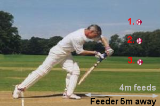
Rules of the practice 1. All shots to be executed with two hands (top hand dominant). 2. Each player has 8-10 balls, then all rotate clockwise. 3. Give groups 2-3 coaching points to work on. 4. Have about 3-4 rounds each (depending on time limit). 5. Make the last round competitive; see who can hit all balls through target area along the ground. Fielders must stop the ball. 6. If players leave the ball they get another ball. If they play and miss they do not. 7. If players delibrately play cross-batted shots on leg side they lose that round. (Be strict on this point - safety). 8. If a player hits the ball into the air, over the fielders, it does not count and they lose that ball. 9. On the competitive round, if a player gets out, all change. Do not set up groups too close to one another - think safety! Coach positions himself where he can monitor all groups safely.

Front foot batting

Group coaching for the front foot drives

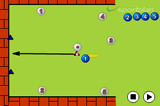
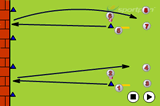
Set up for the practice 1. Set up the practice as shown in the diagram. 2. Target area: 10 metres away from the batsman - safety. 3. Target area 10-15 metres wide. Fielders stand between markers.NOTE: For better players target area should be further away and more narrow. 4. Mark out parallel lines on the floor to show line and length of the ball. 5. Ideal numbers for groups is 4-6 players - Maximum activity. 6. Thrower stands 10-12 paces from the batsman. 7. Thrower says Bat up!, then throws a bobble ball, which bounces more than twice below the batsmans knee height. (Underarm feed standing up.) 8. Each group has 3 balls. 9. Ideal duration of the practice: 25-35 mins.

Front foot batting

Ian Bell - Coming Down The Wicket

Coming down the wicket is an attacking option which puts pressure on the (usually spin) bowler and can force them to change their length. It takes confidence to come down the wicket but from this drill you'll be able to teach your players how to do it effectively.

Front foot batting

Ian Bell - Cover Drive

Ian Bell was famous for having the best cover drive in world cricket. Batters should always be looking to score runs. When a bowler delivers a half-volley, it should be scored off and the best way of doing this is by playing the cover-drive. Watch this drill to see how you can coach your players to drive like Bell!

Front foot batting

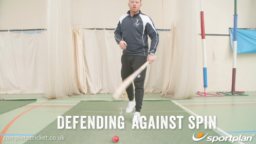
Ian Bell - Defending Against Spin

Defending against spin has changed a lot over the past few years. This is particularly notable at the top end of the game where DRS has been introduced. Umpires generally give out more LBWs when bat and pad are next to each other. 

Front foot batting

Ian Bell - Forward Defense

A forward defense is played to a good length delivery. It's a defensive type of shot and therefore the amount of runs scored from it is irrelevant

Front foot batting

Moving Out Competition Game

Two teams have 3 shots each (moving out to drive) which they must play as a drive shot. If they don't they will out. Fielders (3), (4) and (5) must collect the rebounds (or direct hits if there are no walls for you to use) and try to run out the batman. Players 1 and 2 are to back up incoming throws. If the ball hits the side wall 4 runs are awarded. If the ball is hit along the ground past the fielders 4 runs are awarded. If the ball is hit over head, six runs are awarded. Batsmen must complete 2 runs if they hit the ball and do not hit a boundary. Teams get a certain number of lives which are lost when out, they keep batting until all their lives are used.

Front foot batting

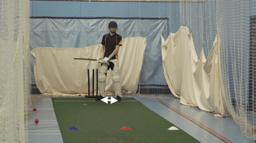
Moving Out to Drive

Exercise for groups of 3-6 players. 1 person throws 6 balls to the batsman who has to try and hit all the balls between the target area (doesn't necessarily need to be played against a wall). After the 6 balls the batsmen becomes the thrower and the thrower goes to back of queue to field, whilst the next batsman steps in.

Front foot batting

Moving out to lofted drive (4-6 groups)

1) drops feeds to 2) who moves out to drive, aiming for the basketball board. 3 goes each and then the batsmen becomes the thrower and the thrower joins the back of the queue. In teams, the first group to have 10 hits wins.

Front foot batting

Off Drive

Front foot batting

On Drive from Set Position

*AUDIO DESCRIPTION ON* Set up two cones half way down the wicket, one central and one leg side. Feed from around the wicket with a bobble feed. Batter to hit from the on drive set position, knees and feet facing down the wicket, and aiming for the two cones.  Back lift over first/second slip, hit a straight line through the ball to the target area. Batter to hold the shape, and take small steps towards the direction of the shot to the cone. 

Front foot batting

Open Stance to Drive Position

*AUDIO DESCRIPTION ON* Batsman stands with an exaggerated open stance. On contact with the ball the batsman is to get into position for the drive and step into where the shot should go.  Alternate between the exaggerated, open stance and the batsmans normal stance. 

Front foot batting

Pick Up That Ball

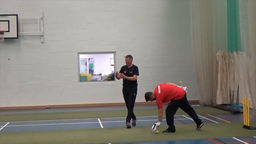
*AUDIO DESCRIPTION ON* Get batter to stand in their normal stance.  Place a ball in front of them and ask them to pick it up.  Player should automatically lead with their front foot and head to pick up the ball. This is the movement pattern to encourage.  Can move the ball around and drill can be completed by the cricket at home. 

Front foot batting

Prevent Batsman from Backing Away

*AUDIO DESCRIPTION ON* Batsman to step in to the shot, once the front foot is planted, have the batsman strike the ball with the back foot in the air to prevent them from being able to back away from the ball. 

Front foot batting

Serve and Drive

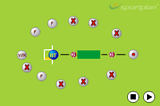
Organisation: Divide the group into groups of 5. Organise the group as shown in the diagram. The server serves the ball overarm from a kneeling position onto target, after batter shouts 'ready'. The target to be bowled at is positioned in line with middle stump 2-3 metres in front of batter. A wicket keeper is placed behind the batter not too close to the batter. Equipment: 1 tennis ball and 1 bat per group. 2 marker cones. Chalk marking.

Front foot batting

Short Ball Practice

Can be done in pairs/ groups of three. One batter and one feeder minimum required, with 6 tennis balls per pair/group. Each batter should be wearing a minimum of helmet and gloves on. This drill is designed to improve player's confidence against the short ball. Feeds should range from heights 1,2 and 3, and each batter should have 10 feeds before swapping over. Feeds are from a close range, under arm feed, without bouncing, from a kneeling position. The batter should be encouraged to learn to defend and/or evade at first, gaining confidence and getting them in a better position than before to attack after.

Front foot batting

Sweep

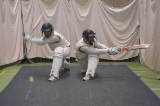
Played to a length ball pitching on or around line of the stumps Can be done in pairs/ groups of three. One batter and one feeder minimum required. 6 tennis balls per pair/group. Feeder looks to feed the ball around middle stump, using an underarm 'bobble' feed. Already down on one knee in sweep position, batter looks to play orthodox sweep shot (shot number 1), aiming for the line indicated on diagram.

Front foot batting

Sweep Technique

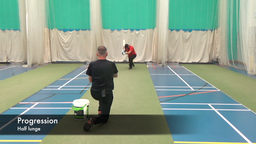
**AUDIO DESCRIPTION ON** Step 1: Batsman starts down on 1 knee in the sweep position with a full backlift. Coach feeds an under arm single bounce throw. Batsman excutes the sweep shot. Step 2: Batsman starts in a half lunge position with the front foot stepping down the pitch. Coach feeds the same delivery. Batsman completes the lunge and executes the sweep shot. Step 3: Batsman starts in their normal stance. Coach feeds the same delivery. Batsman completes the full sweep shot.

Front foot batting

The front foot defence survival game

Using the crease : Alternate front foot and back foot defence. 2. Judging length for front foot or back foot. 3. For competent players, throw the ball faster.

Front foot batting

The front foot drive

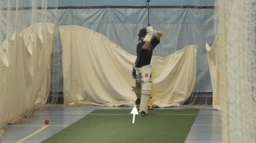
Dip your head and shoulder more than for the off or straight drive and let the ball come through. Open your leading shoulder to point straight/ mid on, so that your hip opens slightly, allowing the bat to swing through. Take a short stride towards the ball, stand tall on the balls of your feet and point the toe of front foot directly up the wicket. Plant foot down the line of leg stump - no wider. Stand tall, get up onto your toes with the weight on your front foot and head forwards, directly above body - eyes level. As the bat swings through the line of the ball, work hard to maintain the following: A dominant top hand, relaxed fingers and thumb bottom hand grip, diamond shape with arms, high hands, hands forward of bat face on impact.

Front foot batting

Sportplan App

Give it a try - it's better in the app

POPULAR SEARCH TERMS
YOUR SESSION IS STARTING SOON... Join the growing community of rugby coaches plus 1100+ drills and pro tools to make coaching easy.
LET'S DO IT